
If you've ever priced out a trash chute rental for a renovation or roofing project, you already know the number on the invoice can feel disconnected from the number you expected. A single-day rental that looks reasonable on Monday starts to look expensive by Thursday — especially when you factor in delivery fees, pickup windows, and the minimum billing periods most rental yards bury in the fine print.
This guide breaks down exactly what trash chute rental costs per day across common project types in 2026, what drives those costs up, and when buying your own lightweight fabric chute actually pencils out better than renting. Whether you're a roofing crew doing a single tear-off or a renovation contractor juggling multiple floors of gut work, the math here applies to you.
What "Trash Chute Rental" Actually Means in 2026
When contractors search for trash chute rental, they're usually talking about one of two very different products. The first is a rigid, interlocking plastic or galvanized-steel debris chute — the kind you see bolted to the side of scaffolding on large commercial builds. The second is a flexible, fabric-based chute that hangs from window openings, roof edges, or scaffold rails using loops and carabiners.
These two categories carry very different price points, logistics requirements, and job-site footprints. Understanding which category applies to your project is the first step toward an accurate cost estimate.
Rigid vs. Fabric Chute Rentals
- Rigid plastic or metal chutes: Typically rented from scaffold and equipment yards. Requires a truck delivery, professional installation in many cases, and a formal pickup appointment. Daily rates are higher, and minimum rental periods commonly run 3-5 days.
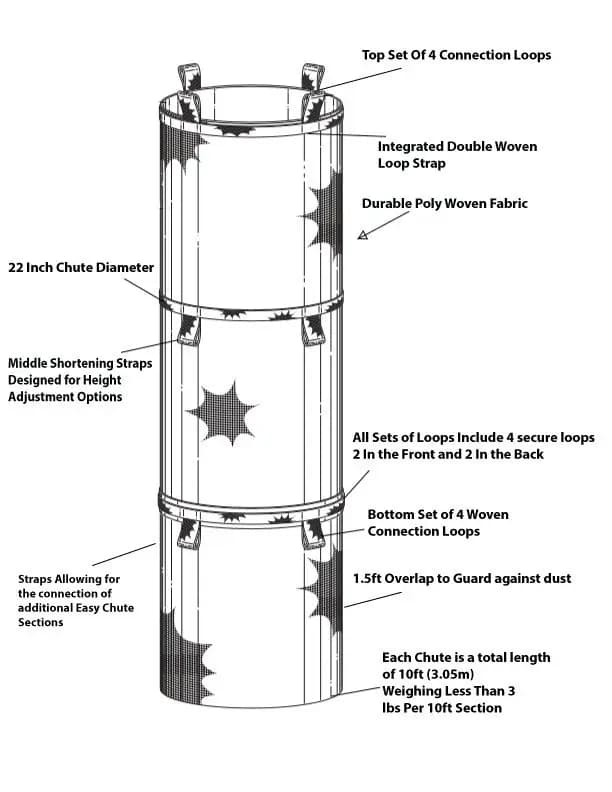
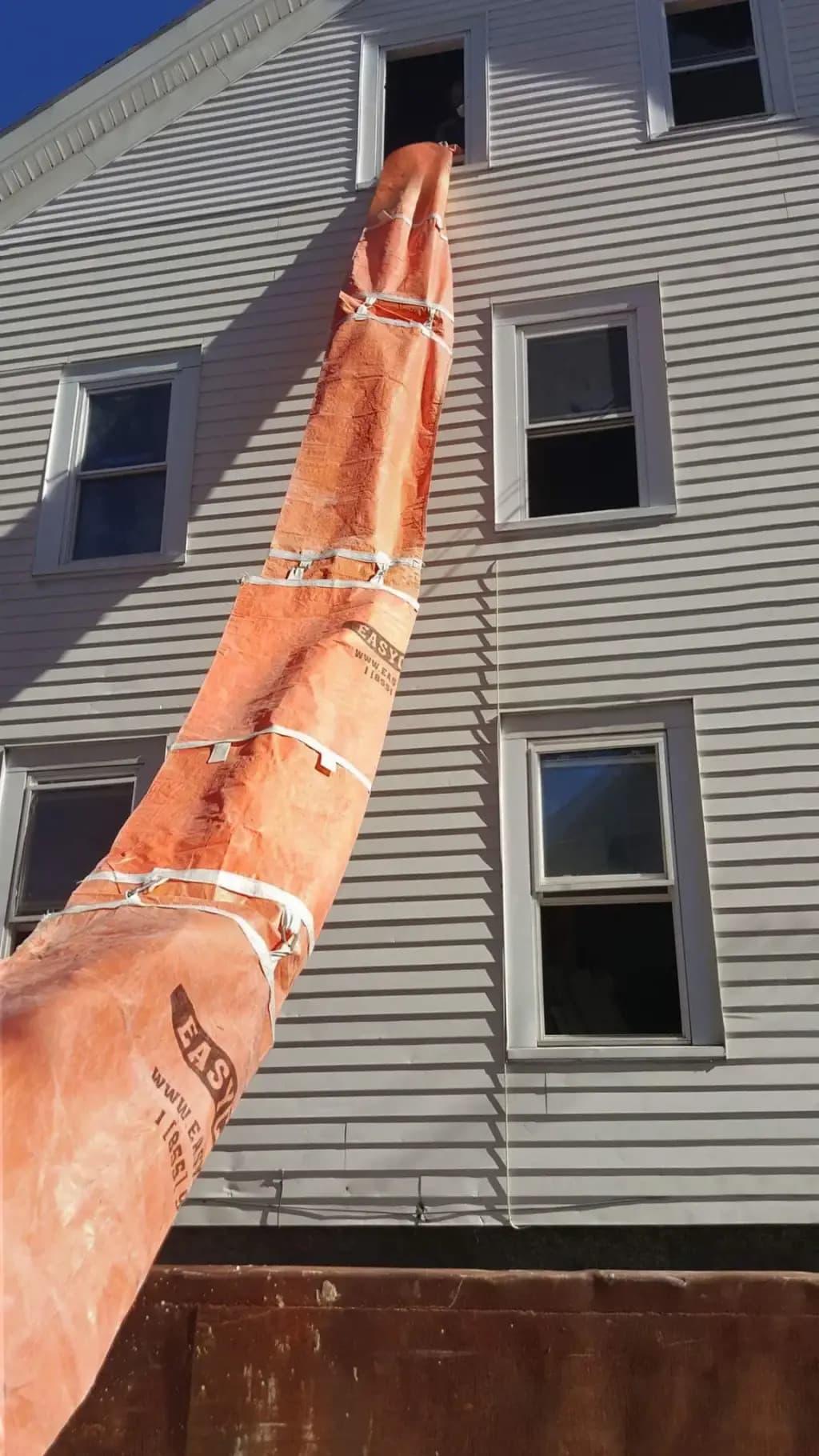
- Fabric debris chutes: Lightweight woven-poly sections that one person can hang from a window or roof edge in minutes. Some specialty rental yards offer them, but they're increasingly purchased outright because the per-use economics are far better. You can read more in our full guide to fabric trash chutes and how they work.
Average Trash Chute Rental Cost Per Day: The 2026 Numbers
Rental pricing varies by region, by chute length, and by whether you're renting from a scaffold company, an equipment rental house, or a specialty debris-removal supplier. That said, the ranges below reflect what contractors across the United States are actually paying in 2026 for standard residential and light-commercial projects.
Daily Rate Ranges by Chute Type and Length
- 10 ft fabric chute section (rental): $15–$30 per day, where available
- 25 ft fabric or rigid section: $40–$80 per day
- 50 ft combined system: $90–$160 per day
- Full rigid scaffold chute system (20–40 ft): $150–$350 per day, plus delivery and pickup fees that often run $75–$200 each way
- Weekly rates: Most rental yards offer a 4x-5x day rate for a full week — meaning the daily effective cost drops slightly but minimums still apply
It's worth noting that many rental companies don't offer fabric chutes at all — their inventory skews toward rigid systems sized for large commercial scaffolding setups. For a roofing crew doing a standard residential tear-off, that rigid system is overkill in every dimension: too heavy, too expensive, and too slow to set up and break down.
Hidden Costs That Change the Real Daily Rate
The advertised daily rate is rarely the total daily cost. Before you sign a rental agreement, add these line items to your estimate:
- Delivery fee: $75–$200 depending on distance and equipment weight
- Pickup fee: Often billed separately and equally
- Minimum rental period: Many yards charge for 3–5 days even if you only need the chute for one afternoon
- Damage deposit: $100–$500 held against loss or damage, refundable but tied up during the job
- Fuel surcharge: Increasingly common in 2026, running 5–10% of the total invoice
- Cleaning fee: Some companies charge if the chute comes back with concrete dust, adhesive, or heavy debris residue
When you add delivery + pickup + minimum rental period + deposit, a "$50/day" chute can realistically cost $400–$600 for a two-day residential job. That math is what's driving more contractors toward ownership rather than rental.
How Project Type Affects Your Daily Chute Cost
The type of work you're doing affects not just what chute you need, but how many days you'll actually need it — which directly multiplies the per-day rate into a total project cost. Here's how common job categories stack up.
Roofing Tear-Offs
A standard residential shingle tear-off runs 1–2 days for a small crew. If you can get a chute delivered day-of, your rental window is tight. But most rental yards need 24–48 hours' advance notice, and pickup might not happen until the following business day — meaning you're paying for 3+ days even on a one-day job. Our roofing trash chute guide goes deeper on sizing and placement for shingle work specifically.
Interior Gut Renovations
Gut renovations and selective demo work can run 3–10 days. Here, a rental may actually make sense financially if the daily rate is reasonable and the rental company can accommodate your timeline. The challenge is that interior work often requires specific window placement and lighter chute materials — again pointing toward fabric systems over rigid scaffolding chutes. See our detailed walkthrough in the guide to demolition chutes for interior gut work.
Multi-Unit and Commercial Renovations
Projects spanning multiple weeks — full building renovations, multi-unit apartment gut work, commercial tenant improvements — are where rental costs compound fastest. At $80–$150/day for a mid-sized system, a three-week rental can run $1,700–$3,000 before you add delivery, pickup, and damage fees. At that price point, ownership almost always wins. The comparison between commercial and residential debris chute needs is worth reading before you quote that next multi-week job.
Junk Removal and Estate Cleanouts
Junk removal jobs are often single-day or half-day events. The economics of renting a chute for a one-time cleanout rarely work out — delivery minimums eat the entire margin. This is precisely why many junk removal operators buy a 10 or 25 ft fabric chute and simply carry it on the truck as standard equipment.
Weekly and Monthly Rental Rates: When They Make Sense
Rental companies typically structure pricing in three tiers: daily, weekly (usually 5x the daily rate, billed as a flat fee), and monthly (often 3–4x the weekly rate). The weekly rate can represent genuine savings on longer jobs — but only if the chute is actually in productive use every day of that week.
Weekly Rate Benchmarks (2026)
- Short fabric section (up to 25 ft): $150–$300/week
- Mid-range system (25–50 ft): $300–$600/week
- Full rigid scaffolding chute: $600–$1,400/week, delivery not included
These numbers assume a reputable regional equipment rental company with an inventory of debris chutes. In smaller markets or rural areas, availability may be limited entirely, forcing contractors to source from farther away and pay higher delivery costs — or to buy outright and ship to the job site.
Monthly Rates and Long-Term Projects
For projects running 4+ weeks, monthly rental rates sometimes drop below the pure-daily math. But by that point, owning a reusable fabric chute system has usually become clearly cheaper on a per-job basis — especially since a quality fabric chute can be reused across dozens of jobs before it shows any meaningful wear. The local breakdown of debris chute rental costs in Fitchburg, MA gives a good sense of how regional pricing works in practice.
Renting vs. Buying: The Break-Even Analysis
This is the question every contractor who runs recurring jobs should work through before the next rental invoice arrives. The math is straightforward once you have three numbers: your average rental cost per job, your job frequency, and the purchase price of a comparable fabric chute system.
Sample Break-Even Calculation
- Average rental cost per job (all-in): $350 (includes delivery, pickup, 3-day minimum)
- Jobs per year requiring a chute: 20
- Annual rental spend: $7,000
- Purchase price of a 50 ft fabric chute system: Under $500 from EasyChute, shipped free
- Break-even point: Less than 2 jobs
Even on the most conservative estimate, a contractor doing more than 3–4 chute-requiring jobs per year comes out ahead by buying. And because a quality fabric chute folds into a compact box and weighs under 3 lbs per 10 ft section, there's no storage burden — it rides in the truck, hangs in the garage, or stacks in the shop without taking up meaningful space.
What "Reusable" Actually Means in Practice
The reusability question comes down to material and construction quality. Thin plastic bags or single-use poly sheeting obviously can't be reused. EasyChute's woven, coated poly fabric is designed for repeated use across different job types — shingle tear-offs, interior demo, junk removal, dumpster loading from elevation. When the job is done, you pull the chute, shake out residual debris, fold it, and store it. No cleaning invoice, no damage deposit, no pickup window to coordinate.
Regional Price Variation: Why Location Matters
Trash chute rental costs aren't uniform across the country. A contractor in a dense urban market like New York City or Boston pays significantly more for delivery logistics, permitting, and specialty equipment than one in a smaller metro. Meanwhile, rural contractors may find that no local rental company stocks debris chutes at all, making the delivered-to-your-door purchase model even more compelling.
Urban Markets (New York, Boston, Chicago)
Urban rentals carry premium pricing for good reason: traffic, parking restrictions, tight job sites, and specialized delivery vehicles all add cost. Expect to pay 20–40% above the national benchmarks listed above. For example, contractors working on Manhattan brownstones or Bronx walk-ups often find that rigid chute rentals aren't even practical — the access constraints demand the lightweight, window-hung approach. Guides like our trash chute resource for Lower Manhattan job sites and the Brooklyn debris chute guide address these access-specific challenges directly.
Suburban and Regional Markets
In suburban markets across New England, the Mid-Atlantic, and the Midwest, rental pricing tends to be closer to the national benchmarks. Delivery fees are lower, minimums are sometimes more flexible, and competition between rental yards keeps daily rates reasonable. That said, availability is still the limiting factor on short-notice jobs — most rental companies need lead time that a same-week roofing job simply doesn't allow.
Rural and Small-Market Contractors
In rural areas, the rental market for specialty debris equipment is thin to nonexistent. Contractors often improvise — tarps, wheelbarrows, manual carry — when a proper chute would save hours and reduce injury risk. OSHA's ergonomics guidelines are clear that repetitive heavy lifting and carrying construction debris up and down stairs is a significant injury pathway. Having your own chute on the truck eliminates that risk without depending on a rental company's inventory.
OSHA, Safety, and Cost Implications of Not Using a Chute
The cost of not using a debris chute is often invisible until something goes wrong. Carrying heavy loads of shingles, drywall, or demolition debris down ladders or through interior stairwells isn't just slow — it's a recognized hazard under OSHA's Construction Industry standards. A single recordable incident costs far more than a year's worth of chute rentals or a one-time chute purchase.
Direct Costs of Improper Debris Removal
- Worker injury claims: Back and shoulder injuries from carrying heavy debris are among the most common — and most expensive — construction site injuries
- OSHA citations: Failing to use proper debris containment on a multi-story job can result in fines that dwarf the cost of any rental
- Property damage: Tossing or dropping debris without a chute risks damaging roofing, landscaping, vehicles, or adjacent structures
- Schedule delays: Manual carry is slower than a properly rigged chute — every hour of delay on a fixed-price job is margin coming off the bottom line
Framed this way, the question isn't whether the daily rental rate is worth it — it's whether the cost of proper debris removal (by whatever method) is built into your job estimate. If it's not, that's the first fix to make.
Environmental Considerations and Responsible Debris Handling
Debris chutes don't just make jobs faster and safer — they make responsible debris sorting more practical. When material lands in a dumpster by chute rather than being thrown or carried in mixed loads, sorting for recyclables becomes easier at the bottom. The EPA estimates that construction and demolition debris accounts for more than 600 million tons of waste annually in the United States — a significant portion of which is recyclable or reusable material that ends up in landfills due to poor job-site sorting practices.
Using a chute that feeds cleanly into a designated dumpster gives crews the option to designate separate containers for concrete, wood, metal, and mixed waste — which can reduce disposal costs and support recycling diversion goals. Some municipalities now require this level of sorting on permitted projects, making a properly rigged chute a compliance tool as much as a productivity tool.
How to Choose the Right Chute Length for Your Job
Whether you're renting or buying, selecting the right chute length is the most important practical decision you'll make. Too short and debris misses the dumpster or requires repositioning; too long and the chute drags on the ground, loses velocity, and can clog. The goal is a clean, continuous drop from the work area into the container below.
Length Selection by Story Height
- 1 story (8–12 ft): A single 10 ft section is typically sufficient for a window or eave drop
- 2 stories (16–24 ft): A 25 ft section with appropriate overlap at the hanging point
- 3 stories (24–36 ft): Two connected 25 ft sections or a single 50 ft section
- 4+ stories: Multiple sections connected with 1.5 ft overlaps — EasyChute sections connect to any combined height
Our step-by-step EasyChute installation guide walks through the hanging, overlapping, and dumpster-positioning process in detail. And if you want to see it in real job-site conditions before committing, the EasyChute video library shows actual installations across different building types and heights.
What to Ask Before Renting a Trash Chute
If you do decide that rental is the right call for a specific job, go into the conversation with the rental company armed with the right questions. Many contractors get burned by minimum periods, hidden fees, or equipment that doesn't fit their job-site conditions because they didn't ask upfront.
Pre-Rental Checklist
- What is the minimum rental period — and is delivery/pickup included or billed separately?
- What is the total damage deposit, and when is it refunded?
- What is the maximum drop height the system is rated for?
- Is the chute compatible with my window or scaffold opening dimensions?
- What is the maximum debris weight per hour the system can handle?
- Is there a cleaning fee if the chute comes back with dust or debris?
- What's the pickup lead time — can I request same-day pickup when the job wraps?
- Are there fuel or mileage surcharges for my job-site location?
Answers to these questions will give you a true all-in daily cost — not just the headline rate on the rental sheet. For more context on what the full debris chute landscape looks like, the comprehensive debris chute guide covers the whole spectrum from residential to commercial applications.
The Case for Owning Over Renting: A Practical Summary
For contractors, roofers, and junk removal operators who run recurring jobs, ownership of a lightweight fabric chute system almost always outperforms the rental model on a per-job cost basis. The economics are clearest when you factor in:
- Minimum rental periods that inflate cost on short jobs
- Delivery and pickup fees that double or triple the advertised daily rate
- Scheduling friction when you need a chute on 24–48 hours' notice
- The compounding cost across a full season of jobs
EasyChute was built by working contractors — Tim Hogan and Leo Guarente, who ran into exactly these rental headaches in Massachusetts — specifically to give crews a durable, reusable option they could carry on the truck and deploy in minutes. At under 3 lbs per 10 ft section, one person can hang, use, and strike a full chute setup without help. No delivery truck, no pickup window, no damage deposit. Learn more on the About EasyChute page, or browse the full canvas and fabric chute options to find the right length for your work.
The EasyChute FAQ page also addresses the most common questions about sections, overlap connections, and load limits if you want to pressure-test the specs before ordering.
Frequently Asked Questions
How much does it cost to rent a trash chute per day?
Daily rental rates for trash chutes vary by chute type and length. Fabric-style debris chutes, where available from rental yards, typically run $15–$80 per day depending on length. Rigid scaffolding chute systems range from $150–$350 per day before delivery and pickup fees. When you add all fees and minimum rental periods, the true all-in daily cost for most residential or light-commercial jobs lands between $80 and $200 per effective use day. Many contractors find that purchasing a lightweight fabric chute pays for itself after just 2–3 jobs.
Is there a minimum rental period for trash chutes?
Yes — most rental companies impose a minimum rental period of 3 to 5 days, regardless of how long you actually use the equipment. This means a one-day roofing job can still generate 3 days of rental charges on the invoice. Always ask the rental company about their minimum period before booking, and factor it into your true daily cost calculation. Minimum periods are one of the most common sources of budget overruns on short debris-chute jobs.
Are there delivery fees on top of the daily rental rate?
Almost always, yes. Delivery and pickup are typically billed as separate line items, often running $75–$200 each way depending on equipment weight and distance to the job site. Some rental companies also add fuel surcharges of 5–10% on top of the base invoice. Before you commit to a rental, ask for a written quote that includes delivery, pickup, any deposit, and all applicable surcharges. The all-in number is often 50–100% higher than the advertised daily rate.
When does buying a debris chute make more sense than renting?
Buying makes financial sense for virtually any contractor who uses a chute more than 2–3 times per year. At that frequency, the cumulative rental cost — including delivery, pickup, and minimum periods — exceeds the purchase price of a quality fabric chute system. For roofing crews, renovation contractors, and junk removal operators running regular jobs, owning a lightweight fabric chute means no scheduling friction, no delivery wait, and no damage deposits. The break-even math typically favors ownership by a wide margin within the first season.
What size trash chute do I need for a two-story building?
For a standard two-story building with a floor-to-ground height of roughly 16–24 feet, a 25 ft chute section is typically the right choice. This gives enough length to clear the eave or window sill at the top and reach cleanly into the dumpster below without dragging. For taller buildings, sections can be connected — EasyChute sections overlap by 1.5 ft and connect to any combined height using carabiners or quick-connect hardware. When in doubt, measure from the hang point to the top of the dumpster and add 2–3 ft of working clearance.
Can a single worker install and remove a fabric trash chute?
Yes — that's one of the core advantages of a lightweight fabric chute system over rigid alternatives. A single 10 ft EasyChute section weighs under 3 lbs and folds into a compact box. One person can carry the full system to an upper floor, hang it using the four woven loops and standard carabiners, run it for the job, and strike it when finished — all without additional labor. This is a significant difference from rigid scaffolding chute systems, which typically require a team and specialized equipment to assemble and disassemble.
Are trash chutes available to rent in rural areas?
Availability is a real challenge in rural and smaller markets. Many general equipment rental companies don't stock debris chutes at all — their inventory focuses on larger construction equipment. When chute rental isn't available locally, contractors either improvise with less safe methods or pay significant freight costs to bring equipment from a distant yard. This gap in rental availability is one of the strongest arguments for buying a fabric chute system outright: it ships free to any U.S. job site, so rural contractors have the same access as those in major metros.
Ready to Stop Renting and Start Owning?
If you're running more than a handful of chute-requiring jobs per year, the rental model is likely costing you more than it should. EasyChute's fabric debris chutes ship free to any job site in the United States, deploy in minutes without a crew, and are built to be reused job after job. There's no delivery window to schedule, no pickup appointment to coordinate, and no damage deposit sitting in someone else's account while your project wraps up.
Start by reviewing the full line of construction chute options to match the right section length to your typical job, or reach out directly with questions about your specific project type. The break-even on your first order is usually faster than you'd expect.