
Roofing Trash Chute: The Complete Guide for Shingle Tear-Offs
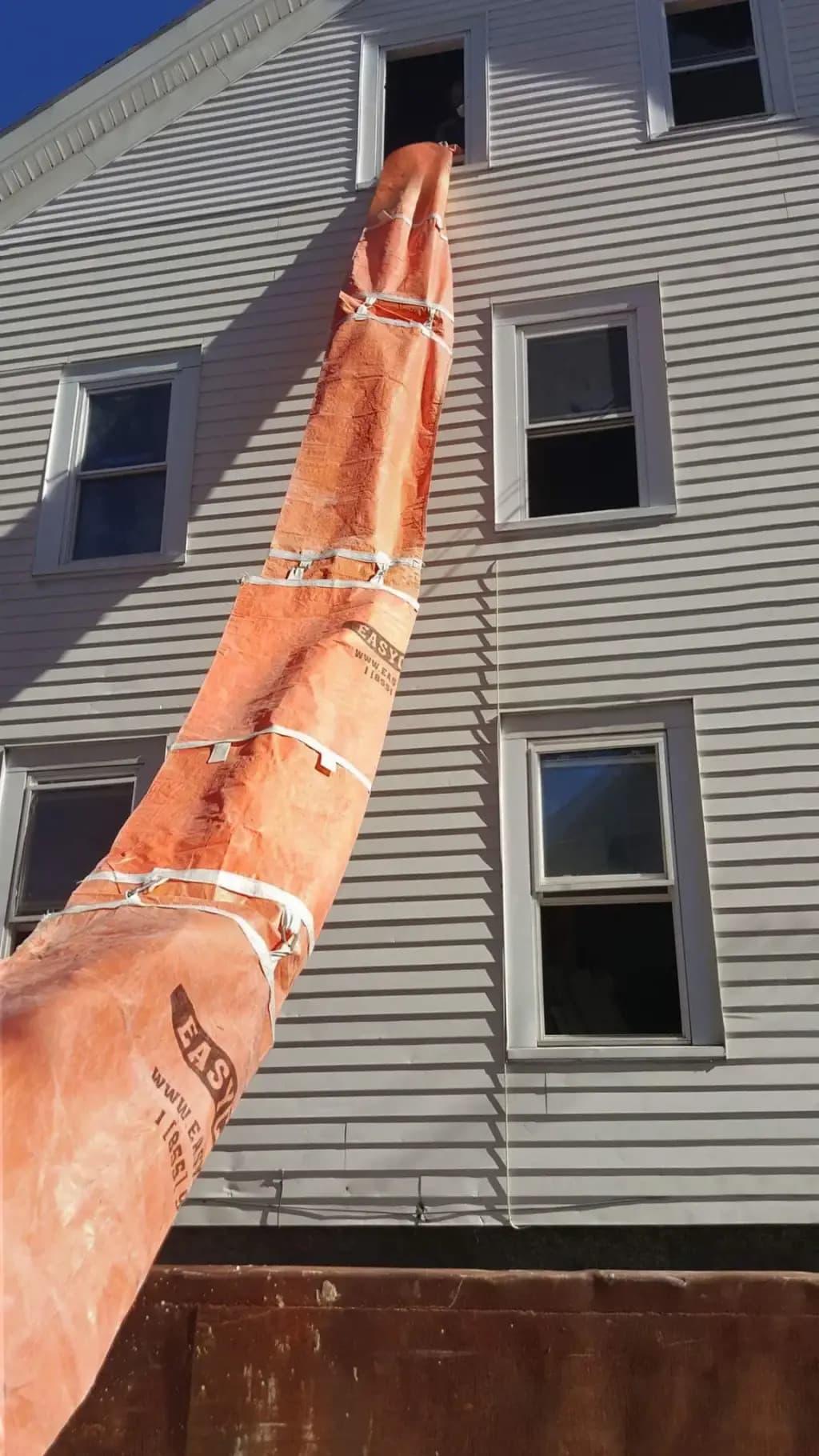
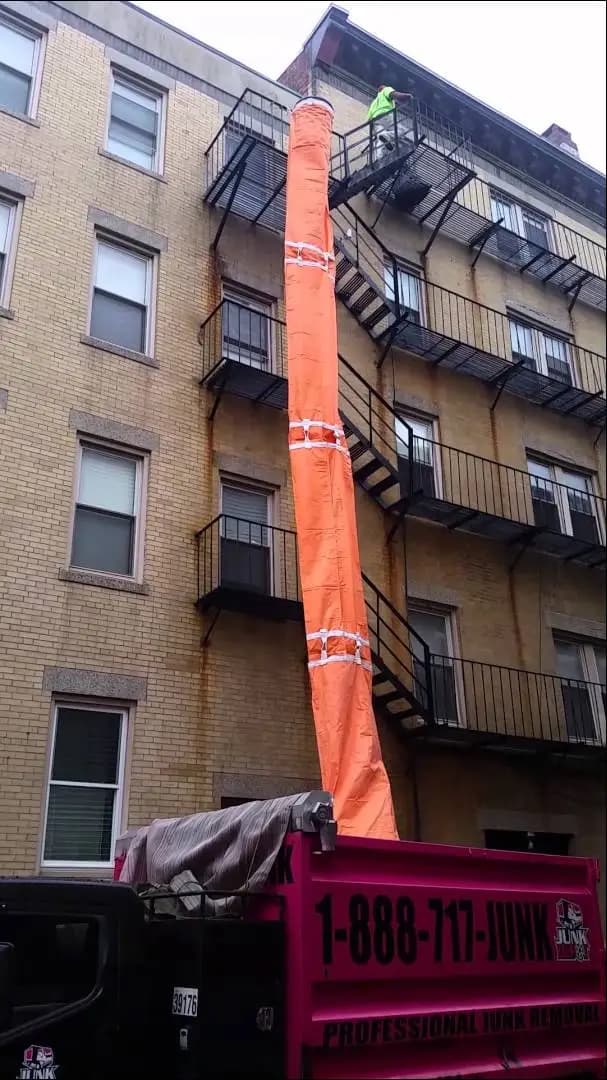
A roofing trash chute is an enclosed, flexible tube that runs from the roof edge down to a dumpster or debris pile on the ground. Instead of tossing shingles, felt paper, and nails over the side and hoping for the best, crews feed the debris into the top of the chute and it slides straight down — contained, directed, and out of the way of anyone working below. If you have ever watched old shingles scatter across a driveway or ricochet off a dumpster lid, you already understand the problem a roofing debris chute solves.
This page covers everything you need to know: what a roofing trash chute is, how it works, which types exist, how to size one for your building, and how to use one safely — including the OSHA rule that makes an enclosed chute legally required on taller drops. We will also show you where EasyChute's fabric chutes fit into the picture so you can order the right option and get back on the roof.
Shop EasyChute trash chutes
Free shipping on every order. See the full shop.

What Is a Roofing Trash Chute and Why Does It Matter?
A roofing trash chute is a form of debris chute designed specifically for the material that comes off a roof during a tear-off: asphalt shingles, wood shakes, underlayment, ice-and-water shield, roofing nails, gutters, and wood decking. The chute connects to the roof edge — typically at a rake or eave — and funnels that heavy, awkward material in a straight line to a waiting dumpster below.
Without a chute, roofing crews rely on tarps, pitchforks, and gravity, which means debris lands wherever it wants to. That creates three problems. First, it is dangerous for anyone on the ground — a bundle of shingles dropped from two stories hits hard. Second, it makes cleanup slower because material scatters well beyond the dumpster footprint. Third, on drops over 20 feet it may violate federal OSHA regulations (more on that below).
How a Roofing Trash Chute Works
The basic mechanics are straightforward. An enclosed tube — either rigid plastic, metal, or flexible fabric — hangs from the roof edge at an angle steep enough to let material slide freely. The crew on the roof feeds debris into the top opening. Gravity does the rest, carrying the load down the chute and out the bottom opening directly into the dumpster.
A few details make the difference between a chute that works and one that jams:
- Diameter: The opening has to be wide enough to pass a full shingle without folding it. A 22-inch internal diameter — the standard EasyChute uses — handles shingles flat and lets bulkier pieces pass without constant clearing.
- Overlap at joints: If sections connect without overlap, debris catches at every seam and dust escapes. EasyChute sections overlap 1.5 feet at each joint, keeping material moving and containing fine particles inside the tube.
- A hopper at the top: On most setups, the crew uses a simple hopper to funnel debris into the chute opening. A standard 32-gallon commercial trash can with its bottom removed works perfectly — no specialty equipment needed.
- Secure attachment: The chute has to be tied off at the top so it does not drift away from the dumpster as it fills. EasyChute sections have four woven connection loops at both the top and bottom for exactly this purpose.
Types of Roofing Trash Chutes
Walk into any equipment rental yard and you will find two broad categories: rigid chutes and flexible fabric chutes. Each has trade-offs worth understanding before you spend money.
Rigid Plastic and Metal Chutes
Traditional construction chutes are made of interlocking rigid plastic or galvanized steel sections. They are durable and self-supporting, which can be useful on very high buildings where a fabric chute needs careful anchoring. The downsides are real, though: rigid sections are heavy, bulky to transport, slow to set up, and require more storage space on the truck. They are also difficult to adapt when the roof pitch or dumpster position is not perfectly aligned with the chute axis.
Flexible Fabric Chutes
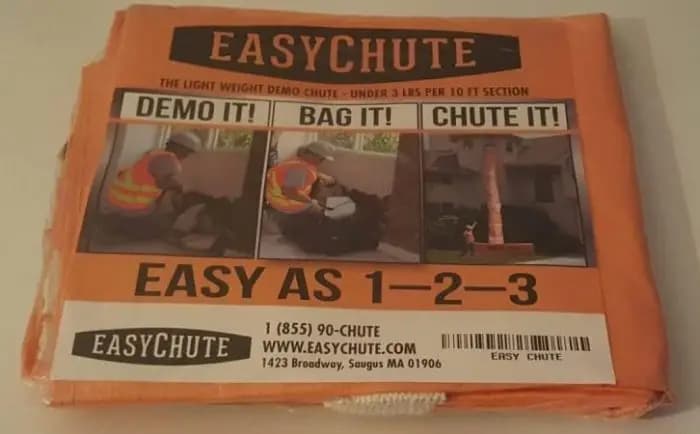
Fabric chutes — like the ones EasyChute manufactures — are made from woven, coated poly fabric that is tear-resistant and lightweight. A 10-foot section weighs under 3 pounds and folds down small enough to fit in a drawer or a small box. A full 50-foot section weighs under 15 pounds. That makes setup fast: one person can carry all the sections needed for a two-story house in a single bag, connect them loop-to-loop with carabiners or quick-connects, hang the assembly from the roof edge, and be ready to go in minutes — no outriggers, frames, hoists, or rental crew.
The flexibility of fabric also lets the chute conform to the building's geometry. If the dumpster has to sit at a slight angle from the drop point, the lower portion of the chute adjusts naturally. Middle shortening straps let you fine-tune the overall length so the discharge end lands cleanly in the dumpster rather than above it or inside the wall.
For roofing specifically, fabric chutes excel on residential and light commercial tear-offs where the crew needs to move efficiently, transport the chute between jobs, and reuse it job after job without replacing expensive rigid sections. You can read more about how fabric options compare in our overview of fabric trash chutes.
How to Size a Roofing Trash Chute
Getting the length right is the most important decision you will make. A chute that is too short won't reach the dumpster; one that is much too long piles up slack and can cause jams.
The general rule: measure the vertical drop from your planned attachment point at the roof edge to the top of your dumpster, then add a few feet so the discharge end reaches comfortably inside the container. Do not measure along the roof slope — measure straight down.
EasyChute sections give you clear reference points:
- 10 ft section — approximately one story. Good for single-story additions, low-slope shed roofs, or as an add-on section to fine-tune a longer run. Available in Lite-Duty ($99) or Heavy-Duty ($149).
- 25 ft section — approximately two and a half stories. The go-to choice for most two-story residential tear-offs. $277.
- 50 ft section — approximately five stories. Covers mid-rise apartment buildings, commercial flat roofs, and taller structures. $596.
Sections connect loop-to-loop so you can combine them. A 25-foot and a 10-foot section together cover a three-and-a-half-story building. Because EasyChute sections are reusable job after job, building a small inventory of sections pays for itself quickly on any roofing crew that does regular tear-offs.
Roofing Debris and the OSHA 20-Foot Rule
Safety is not optional on a roofing job, and federal OSHA regulations make one requirement explicit: under OSHA 29 CFR 1926.252(a), when material is dropped more than 20 feet to any point outside the exterior walls of a building, an enclosed chute must be used. No open tossing, no tarps, no ramps — an enclosed chute.
A standard two-story house has an eave height well above 20 feet from grade. That means most residential roofing tear-offs already meet the threshold where a roofing trash chute is not just a good idea — it is an OSHA requirement. EasyChute is designed to meet or exceed applicable OSHA regulations.
A few practical safety notes beyond the regulation:
- Establish a drop zone and keep ground workers out of it while debris is moving.
- Secure the chute at the top before loading it — a loose chute can swing into windows or scaffolding.
- Check each joint connection before starting. Loop-to-loop connections with carabiners are simple to inspect visually.
- Keep the dumpster positioned so the chute discharges inside it, not over the rim. Use the middle shortening straps to dial in the exit height.
If you are working in a municipality that requires permits for roofing work or dumpsters placed on public streets, check with your local building department for the specific rules that apply to your job site. Requirements vary by city and county.
Setting Up a Roofing Trash Chute: Step by Step
- Measure the drop. Stand at the roof edge and measure straight down to the top of your dumpster. Add a couple of feet for the discharge end to reach inside.
- Select and connect sections. Match your measurement to the appropriate EasyChute section or combination of sections. Connect bottom loops of the upper section to the top loops of the lower section using carabiners or quick-connects, overlapping 1.5 feet at each joint.
- Attach the hopper. Remove the bottom of a 32-gallon commercial trash can and set it over the top opening of the chute. This gives the crew a wide funnel to toss material into without precision.
- Hang and secure. Tie the top loops to a stable anchor point at the roof edge — a scaffold rail, a roof anchor, or a structural member. Confirm the chute hangs plumb and the discharge end is positioned inside the dumpster.
- Adjust the length. Use the middle shortening straps if the chute is slightly too long. The goal is for the exit to sit a foot or two inside the dumpster lip.
- Brief the crew. Everyone on the ground stays clear of the drop zone. Feed material steadily rather than in large dumps, which can cause jams.
For a deeper look at best practices during a tear-off, see our guide on removing roofing debris with a roofing debris chute. For region-specific workflows, we have detailed breakdowns for crews working in Milwaukee and the Pacific Northwest.
Where to Order a Roofing Trash Chute
EasyChute ships every order free to job sites anywhere in the United States — no minimums, no freight surcharges. Orders go to residential addresses, commercial properties, or directly to the job site. If you have questions about which section size fits your project, call us at 855-902-4883 (Monday–Friday, 8 AM–10 PM Eastern) or email orders@easychute.com. You can also browse the full lineup at our online shop or visit the FAQ page for common setup questions.
Frequently asked questions
Do I legally need a roofing trash chute, or is it just recommended?
Under OSHA 29 CFR 1926.252(a), an enclosed chute is required any time material is dropped more than 20 feet to a point outside the exterior walls of a building. Most two-story roofs already exceed that height from grade, so a roofing trash chute is legally required on the majority of residential tear-offs — not just a best practice.
What size EasyChute section do I need for a typical two-story house?
The 25-foot section is the most common choice for a two-story residential tear-off, covering approximately two and a half stories of vertical drop. If the discharge end needs to reach a bit further into the dumpster, you can combine it with a 10-foot section. Measure straight down from the roof edge to the top of your dumpster before ordering.
Can I use the same chute for multiple jobs?
Yes — EasyChute sections are designed to be reused job after job. The woven, coated poly fabric is tear-resistant, and the loop-and-carabiner connection system is simple to assemble and disassemble quickly. Because sections fold down small and weigh just a few pounds, storing and transporting them between jobs is straightforward.
How do I attach the chute to the roof edge without damaging the shingles or fascia?
EasyChute sections have four woven connection loops at the top that tie off to any stable anchor point — a scaffold rail, a roof anchor strap, or a structural member along the eave. No outriggers, frames, or special hardware are required. Many crews run a length of rope through the top loops and tie off to a secure anchor set back from the edge.
What kind of debris can a roofing trash chute handle?
EasyChute chutes are built for common roofing tear-off material: asphalt shingles, wood shakes, roofing felt and underlayment, ice-and-water shield, wood decking scraps, and loose nails. Feed material steadily rather than in large concentrated loads to keep the chute flowing cleanly and avoid jams at the joints.
More about trash chutes
Related guides
- Milwaukee Roofing Cleanup: Shingle Flow + Dumpster Control
- Rain-Ready Roofing Debris Chute Setup for Seattle Tear-Offs (Contractor Guide)
- Rain-Ready Roofing Debris Chute Workflow in Portland (Contractor Tear-Off Guide)
- Removing Roofing Debris with a Roofing Debris Chute: Complete Contractor's Setup & Safety Guide for 2026