
Construction Chute: How Contractors Move Debris Safely from Upper Floors
A construction chute is a tubular sleeve — typically made of rigid plastic, steel, or flexible fabric — that channels demolition and renovation debris straight from an upper floor into a dumpster below. Instead of carrying heavy loads of drywall, shingles, or plaster down a ladder or staircase, workers drop material into the top of the chute and gravity does the work. The result is a faster, safer debris-removal process with fewer trips, less mess, and a dramatically lower risk of a falling-object incident on the ground.
This page covers everything a contractor, roofer, or property manager needs to know: how construction chutes work, what types are available, how to size and anchor one correctly, the OSHA rule that makes a chute mandatory on taller drops, and how EasyChute's lightweight fabric chutes compare to traditional options. If you already know what you need, head straight to the EasyChute shop and order with free shipping anywhere in the US.
Shop EasyChute trash chutes
Free shipping on every order. See the full shop.
How a Construction Chute Works
At its simplest, a construction chute is a gravity-fed tube. Workers on an upper floor load debris into a hopper or opening at the top, and the material travels down the enclosed sleeve and out the bottom into a waiting dumpster or debris pile. The enclosure matters: an open slide or unguided toss scatters dust and material over a wide area. An enclosed chute keeps debris contained and directed, protecting workers on the ground and pedestrians nearby.
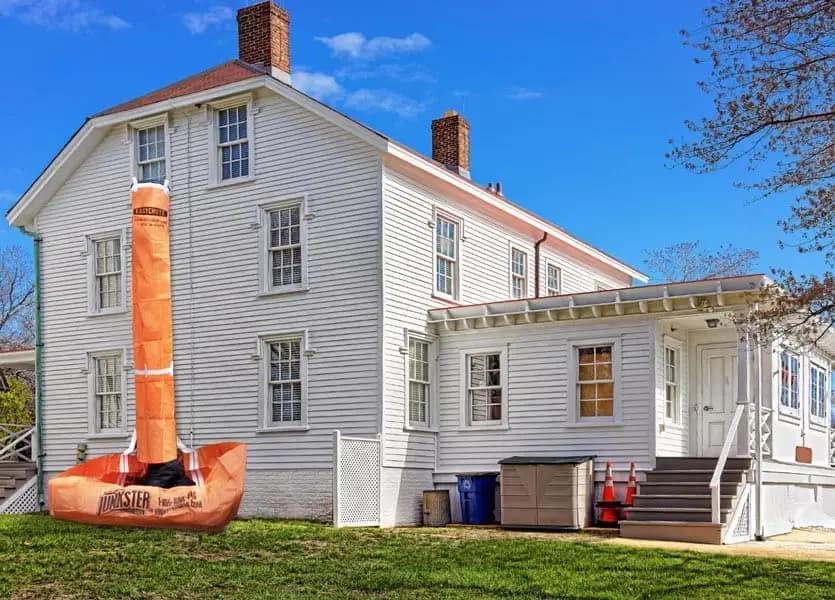
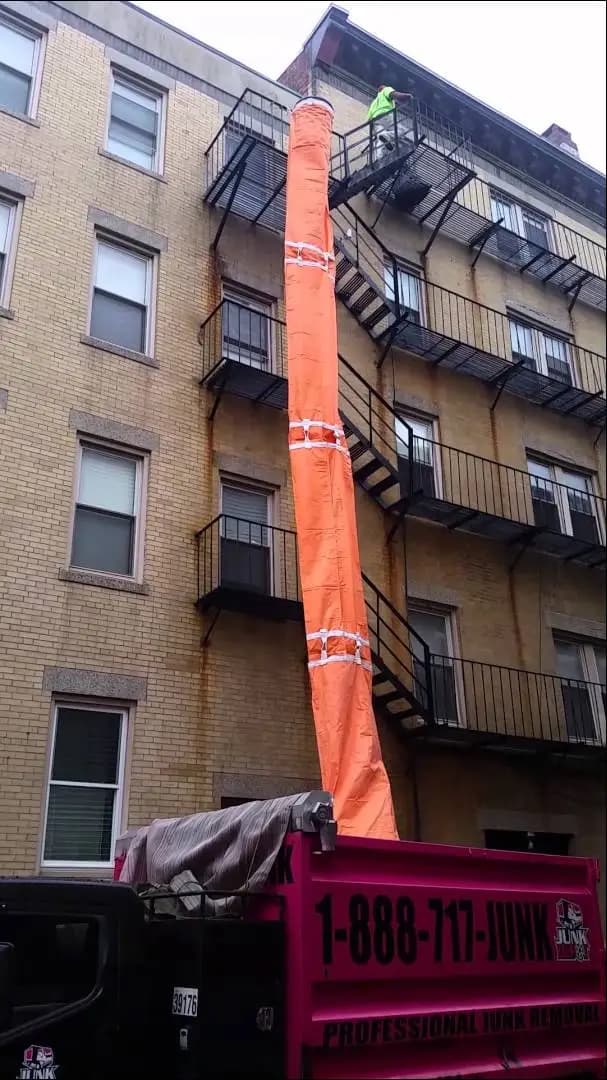
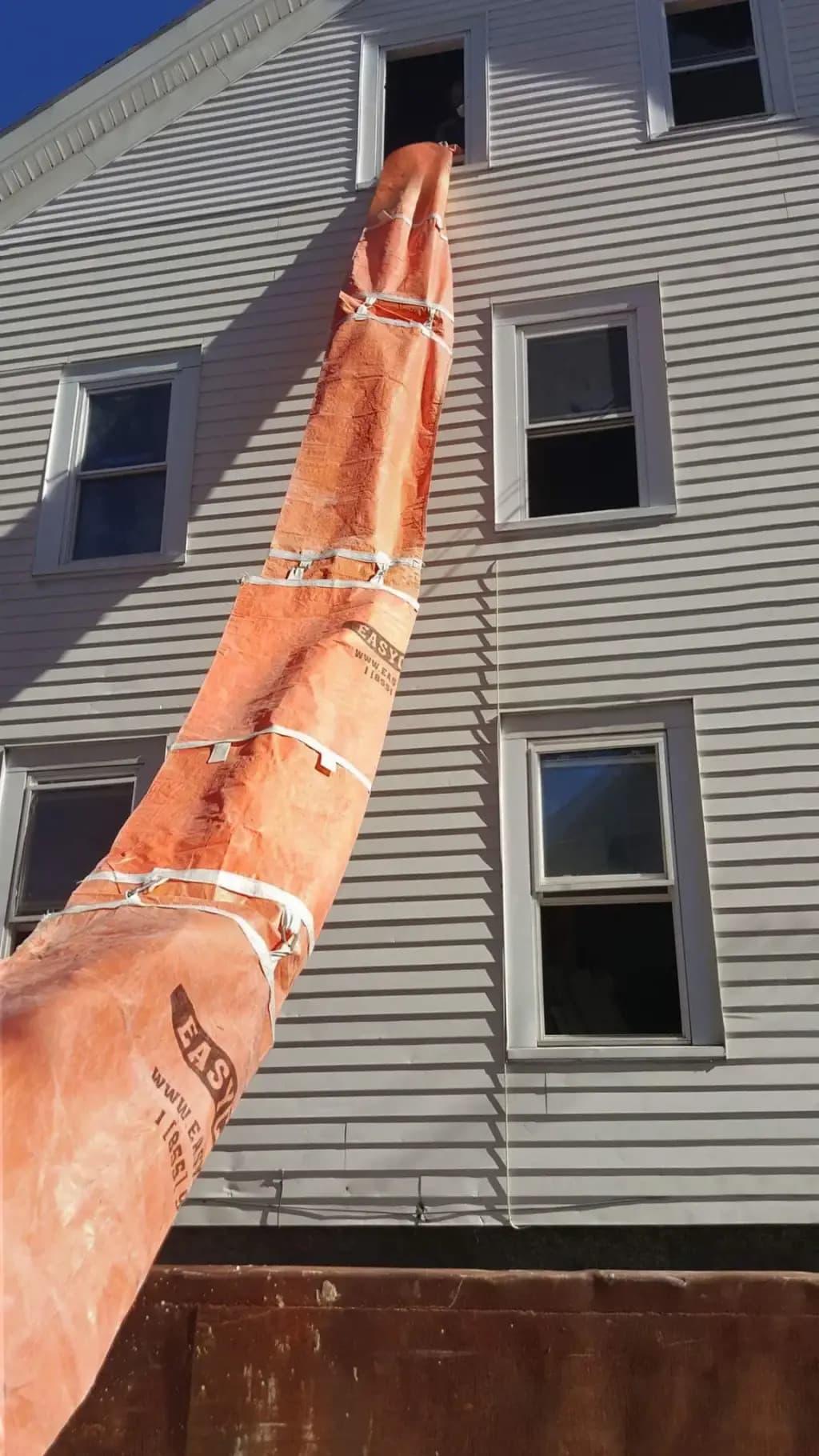
Most chutes hang vertically — or at a slight angle — from a window opening, roof edge, scaffold, or fire escape. The top section is anchored to a stable structure, and additional sections are connected below it to reach the dumpster. A hopper at the entry point (often just a large trash can with the bottom cut out) gives workers a safe, wide funnel to load material without overfilling the chute opening.
Types of Construction Chutes
Walk any large-city job site and you will see several different chute styles. Each has trade-offs worth understanding before you buy or rent.
Rigid Plastic Sectional Chutes
Molded plastic sections snap or pin together. They are common on mid-rise and high-rise projects, stand up to heavy aggregate and concrete debris, and can be configured in a straight vertical run or with angled diverter sections. The downside: each section is bulky and relatively heavy, storage takes real space, and transport usually requires a dedicated truck or trailer.
Steel Chutes
Heavy-gauge steel chutes are the workhorse of large demolition projects. They handle very heavy or abrasive material — broken masonry, concrete chunks, heavy steel framing — that would damage a lighter chute. Weight and storage requirements are significant, and rental or freight costs can add up quickly on smaller jobs.
Fabric Debris Chutes
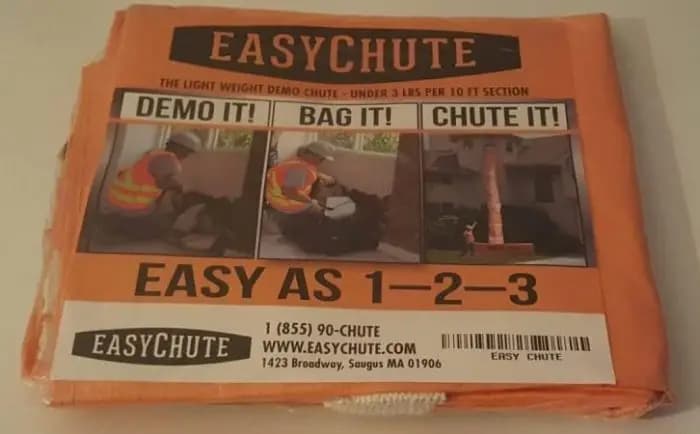
Woven, coated poly fabric chutes — like those made by EasyChute — offer a different set of advantages. They are extremely lightweight, fold into a compact bundle, and can be carried to the job site in the back of a pickup truck or even a passenger car. They are purpose-built for the most common renovation and remodeling debris: drywall scraps, plaster and lath, roofing shingles, wood framing offcuts, and insulation. For residential remodeling, roofing jobs, gut renovations, and light commercial work, a fabric trash chute hits a practical sweet spot between performance and portability. Learn more about how fabric chutes compare to other materials on our construction chute buying guide.
How to Size Your Construction Chute Run
Getting the length right is the single most important purchasing decision. A chute that is too short leaves a dangerous gap between the outlet and the dumpster. A chute that is far too long can bunch up and restrict flow. Follow these practical guidelines:
- Measure the drop. Stand at the loading point and measure vertically to the top of the dumpster or debris pile on the ground. That is your minimum chute length.
- Use sections to match the building. EasyChute sections are available in 10 ft, 25 ft, and 50 ft lengths. A 10 ft section covers roughly one story; a 25 ft section covers about two and a half stories; a 50 ft section covers about five stories.
- Account for the overlap. EasyChute sections connect loop-to-loop and overlap by 1.5 ft at every joint to keep debris and dust inside the chute. Factor that into your total length when connecting multiple sections.
- Use middle shortening straps to fine-tune. Each EasyChute section includes middle shortening straps so you can take up slack and get the outlet right where you need it — without buying a different section or cutting anything.
For a two-story house gut renovation where you are loading from a second-floor window, a single 25 ft section is usually the right call. For a three- or four-story apartment building, a 50 ft section or two connected 25 ft sections will typically cover the run. If you are not sure, the EasyChute team is available by phone at 855-902-4883 (Mon–Fri, 8 AM–10 PM Eastern) or by email at orders@easychute.com — they can help you think through the sizing before you order.
Anchoring and Setup
A construction chute is only as safe as its anchor point. Here is a reliable setup sequence that works on most residential and light commercial projects:
- Choose your anchor point. A window opening, roof edge, scaffold rail, or fire escape railing all work. The anchor point must be structurally sound and capable of supporting the weight of the loaded chute.
- Attach the top section. EasyChute has four woven connection loops at the top of each section — two at the front and two at the back. Use those loops to tie or clip the chute to the anchor point. Carabiners and quick-connects work well for the loop-to-loop connections between sections.
- Add a hopper. A standard 32-gallon commercial trash can with the bottom cut out makes an effective hopper at the loading point. It gives workers a wide funnel and keeps debris from bouncing off the edge of the chute opening.
- Position the dumpster. Place the dumpster directly below the chute outlet. Leave enough clearance that the outlet does not drag against the dumpster rim, which can restrict flow.
- Brief your crew. Make sure everyone on the job knows the loading rate and the type of material allowed. Loading too fast or dropping oversized chunks can cause blockages.
EasyChute weighs under 3 lbs for a 10 ft section and under 15 lbs for the full 50 ft section, so one person can carry and set up the entire chute without a hoist, outrigger, or rental crew. No frames or special hardware required.
OSHA and the 20-Foot Rule
Safe use of a construction chute is not just good practice — on many jobs it is a legal requirement. OSHA standard 29 CFR 1926.252(a) states that when material is dropped more than 20 feet to any point outside the exterior walls of a building, an enclosed chute must be used. This means that on any multi-story job where debris leaves a window or roof edge more than 20 feet above grade, an open toss or unenclosed slide is not compliant — a proper enclosed chute is mandatory.
EasyChute meets or exceeds applicable OSHA regulations. The sleeve is fully enclosed along its entire length, and the 1.5 ft overlap at every joint prevents gaps where debris or dust could escape. If you have questions about specific compliance requirements on your project, always check with your local building department and safety officer — requirements can vary by jurisdiction and project type.
For more on safe debris removal practices, see our page on construction debris removal.
Choosing the Right EasyChute Section
EasyChute offers two duty ratings and three section lengths. Here is a quick reference:
- EasyChute Lite-Duty Trash Chute — 10 ft Section — $99: A single-story drop for residential remodeling, roofing, or light renovation work. Under 3 lbs and fits in a drawer.
- EasyChute Heavy-Duty Trash Chute — 10 ft Section — $149: Same compact footprint, heavier-duty fabric construction for more demanding debris loads on a one-story run.
- EasyChute Trash Chute — 25 ft Section — $277: Covers roughly two and a half stories. The go-to choice for a standard two- or three-story residential renovation.
- EasyChute Trash Chute — 50 ft Section — $596: Covers roughly five stories. Right for mid-rise work, larger apartment building renovations, or any job where you want a single continuous run without mid-chute connections.
All sections are made from woven, coated poly fabric that is tear-resistant and reusable job after job. Every order ships free to any address in the United States — whether that is a residential job site, a commercial project, or a contractor's yard. Browse the full lineup at easychute.com/shop.
What EasyChute Is Built For
EasyChute is designed specifically for the debris types that dominate residential and light commercial renovation: drywall and plaster, roofing shingles, wood framing scraps, insulation, and lath. If your job involves heavy aggregate, broken concrete, or masonry rubble, a heavier rigid or steel chute may be more appropriate. For everything else — and that covers the vast majority of remodeling, roofing, and renovation work — an EasyChute debris chute gives you a compliant, practical, easy-to-handle solution at a straightforward fixed price.
Created by Tim Hogan, a remodeling contractor who needed a better way to move debris, and Leo Guarente of Junkster Bag and Junk Depot, EasyChute was built from real job-site experience. It is manufactured and shipped from Saugus, Massachusetts, and delivered free to job sites from Maine to Hawaii.
Frequently asked questions
What is a construction chute and when do I need one?
A construction chute is an enclosed tube that channels debris from an upper floor to a dumpster on the ground. OSHA requires an enclosed chute when material is dropped more than 20 feet outside a building's exterior walls — but even on shorter drops, a chute makes the job faster and keeps the site cleaner and safer.
How do I know what length chute to order?
Measure the vertical distance from your loading point to the top of the dumpster. EasyChute's 10 ft section covers about one story, the 25 ft section covers about two and a half stories, and the 50 ft section covers about five stories. You can also connect sections together using the built-in woven loops and carabiners, with a 1.5 ft overlap at each joint.
Does EasyChute require any special equipment or a crew to set up?
No. EasyChute hangs from a window opening, roof edge, scaffold, or fire escape using its built-in woven connection loops — no outriggers, frames, hoists, or rental crew needed. Even the 50 ft section weighs under 15 lbs, so one person can carry and install the whole chute.
Can I use EasyChute for roofing shingles and plaster?
Yes. EasyChute is specifically built for the debris types common in renovation and remodeling: roofing shingles, drywall, plaster and lath, wood scraps, and insulation. The tear-resistant woven, coated poly fabric handles these materials job after job and is fully reusable.
Does EasyChute ship to my state, and are there any shipping fees?
EasyChute ships free to any address in the United States — every order, every product, no minimum. Orders are placed online at fixed prices with no quote process required. Call 855-902-4883 or email orders@easychute.com if you have questions before ordering.