
If you've spent any time managing debris removal on a job site, you already know that throwing material off a roof or hauling it down three flights of stairs by hand is a liability — physically and legally. A debris chute solves that problem. But here's the question that trips up a lot of contractors: does the job you're running — commercial or residential — change how you think about chute selection, setup, and workflow?
The short answer is yes. Commercial renovation sites and residential renovation sites have very different constraints. The building type, the volume of debris, the access points, the crew size, the site rules, and even the dumpster placement all vary enough that a one-size-fits-all approach will leave you frustrated and potentially non-compliant. This guide breaks down every meaningful difference so you can make the right call before the first section goes up.
Why Debris Chutes Matter Regardless of Job Type
Before getting into the differences, it's worth grounding the whole conversation in why chutes are worth the investment in the first place. Whether you're gutting a commercial office suite or stripping shingles off a colonial in the suburbs, the physics of moving debris downward are the same: gravity is free, but human labor isn't.
Carrying debris down stairs by hand introduces serious ergonomic risk. OSHA's ergonomics guidelines specifically flag repeated heavy lifting as a primary driver of musculoskeletal injuries on construction sites. When crews are making multiple trips per hour carrying 40-pound loads down flights of stairs, fatigue accumulates fast and injuries follow.
Beyond worker safety, manual hauling is simply slow. A debris chute turns a two-person, 20-minute carry into a one-person, 2-minute drop. Over the course of a full workday, that time compounds into real labor savings — often enough to cover the cost of the chute on the first job alone.
- Safety: Keeps workers off ladders and stairs while carrying loads.
- Speed: Dramatically reduces the time per debris load.
- Site cleanliness: Debris lands in the dumpster, not scattered across the yard or sidewalk.
- Professionalism: Shows clients and inspectors that you run a tight site.
Now let's look at how those benefits play out differently depending on whether you're in a commercial or residential environment.
Defining the Job Types: What Counts as Commercial vs Residential Renovation
These categories aren't always clean. A gut renovation on a 6-unit apartment building has elements of both. That said, the working definition most contractors use is straightforward.
Commercial Renovation
Commercial jobs typically include office buildings, retail spaces, restaurants, industrial facilities, mixed-use buildings, hotels, and multi-story commercial structures. These sites tend to have larger floor plates, more debris per square foot, stricter site-safety requirements, and more stakeholders involved (general contractors, subcontractors, property managers, inspectors).
Residential Renovation
Residential jobs include single-family homes, townhomes, duplexes, and small multi-family buildings (typically up to 3-4 units). The scale is smaller, the access is simpler, and the crew size is usually leaner. The debris volume per job is lower, but the variety of debris types — roofing, drywall, flooring, old fixtures — is often high.
It's also worth noting the in-between category: mid-rise residential. A 6-story apartment building being renovated unit by unit is residential in name but commercial in complexity. Those projects often demand the same planning rigor as a commercial site.
Debris Volume and Chute Sizing: Commercial Jobs Need More Length
One of the most practical differences between commercial and residential work is the sheer volume of debris — and how high above the dumpster the material is originating.
On a 2-story residential renovation, a single 25-foot fabric trash chute section might be all you need. The debris is coming off one upper floor, and the dumpster is parked in the driveway 15 feet below the window. Simple and effective.
On a commercial renovation on the 8th floor of a downtown office building, you're looking at an 80-100 foot drop to street level. That means stacking multiple chute sections — a combination of 50-foot and 25-foot sections, for example — and securing each junction point carefully. The construction chute planning process is more involved, and the hanging points need to be engineered into the job from day one.
Section Length Planning by Building Height
- 1-2 story residential (10-25 ft drop): One 10-ft or 25-ft section is typically sufficient.
- 3-4 story residential or small commercial (30-50 ft drop): One 50-ft section or two 25-ft sections connected.
- 5-8 story commercial (50-80 ft drop): A 50-ft and 25-ft combination, or multiple 25-ft sections.
- High-rise commercial (80+ ft drop): Multiple 50-ft sections connected, with intermediate anchor points strongly recommended.
EasyChute sections connect with a 1.5-foot overlap, so stacking is straightforward. The key is planning anchor points at each floor level where you have a window, parapet, or scaffold rail to work with. Don't assume you can anchor only at the top — intermediate support keeps the chute from swaying and reduces wear at the connection points.
Hanging and Anchoring: Commercial Sites Require More Forethought
On a residential job, hanging a chute is usually a 10-minute task. You lean out a second-floor window, clip the loops to a railing or a couple of nails in the fascia, and you're done. The simplicity is part of what makes lightweight fabric chutes so practical for residential crews.
Commercial sites are a different story. The anchor options vary dramatically depending on building type:
- Office buildings with fixed windows: You may need to anchor to a scaffold system rather than a window frame.
- Buildings with parapets: Parapets are excellent anchor points — run a strap or steel rod across the top and clip the chute loops to that.
- Buildings with open scaffold systems: This is the ideal commercial setup. Anchor each section to the scaffold at the appropriate floor level.
- Industrial buildings with large open bays: Anchor points are plentiful, but debris volume is high — plan for a wider intake funnel at the top.
EasyChute's fabric sections hang from four woven loops at the top, and ordinary carabiners or quick-connects clip through them. That design means you're not locked into one anchor strategy. If a commercial site requires you to rig to a scaffold rail instead of a window, the chute accommodates that without modification. See the step-by-step setup guide for detailed rigging instructions for different anchor scenarios.
When to Use Intermediate Anchor Points
For drops over 40 feet, plan at least one intermediate anchor point midway. This reduces lateral movement, prevents the chute from bellowing out in wind, and distributes the load so the top anchor isn't taking the full weight of the debris in transit. On commercial high-rises, intermediate anchoring at every other floor is a reasonable baseline.
OSHA Compliance and Site Safety Rules: Commercial Sites Run Tighter
Commercial renovation sites typically operate under a general contractor with a formal safety plan. If you're a subcontractor bringing your own chute onto a commercial job, you need to confirm it fits within that safety plan before you hang it.
OSHA's construction industry standards address debris removal and falling object hazards specifically. Any debris chute setup on a commercial site will likely be reviewed against those standards — either informally by the GC's safety officer or formally during an inspection.
Key Compliance Considerations for Commercial Sites
- Exclusion zones: Commercial sites almost always require a marked exclusion zone at the base of the chute. No workers or pedestrians should be in the dumpster drop zone when debris is moving.
- Covered walkways: If public pedestrians pass near the chute base, a canopy or covered walkway may be required by local ordinance.
- Signage: "Danger — Falling Debris" or similar signage at the dumpster and along the perimeter of the exclusion zone.
- Debris containment at the bottom: The chute outlet should terminate inside or directly over the dumpster opening, not over open ground.
Residential jobs are generally more relaxed on formal compliance requirements, but the smart move is to treat every job with the same discipline. If a homeowner's neighbor or a mail carrier is in range of falling debris, the same exclusion zone principle applies.
Residential Jobs: Speed and Simplicity Win
What residential renovation sites give you is simplicity. Single access point, one or two floors of height, a dumpster in the driveway, and a small crew that all report to you directly. That's the environment where the value proposition of a lightweight fabric chute is most immediately obvious.
A single contractor can carry a 10-foot EasyChute section — which weighs under 3 pounds — up to the second floor, clip it to a window frame or railing, and be moving debris in under 10 minutes. No rental logistics, no delivery truck, no assembly crew required. At the end of the day, the chute folds into a small box, goes in the truck, and shows up at the next job tomorrow.
Best Residential Applications for Fabric Trash Chutes
- Roofing tear-offs: Run the chute from the roof edge to the dumpster below. Shingles, underlayment, and nails drop straight in. See the dedicated roofing trash chute guide for shingle-specific setup tips.
- Interior gut work: Hang the chute from a second-floor window and feed drywall, insulation, and framing scrap through it.
- Kitchen and bath remodels: Old cabinets, tile, fixtures — all go down the chute rather than down the stairs by hand.
- Window and door replacement: The opening you just created to remove the old window is the perfect anchor point for the chute.
For a detailed look at the demolition side of residential gut work, the demolition chutes guide covers the full workflow for interior selective demo.

Commercial Jobs: Crew Coordination and Multi-Point Setup
Commercial renovation sites with multiple floors in active demo create a coordination challenge that residential jobs rarely present. You may have different trades working on different floors simultaneously, with debris coming from multiple levels at the same time.
In that environment, a single chute running from the top floor to the dumpster isn't necessarily the right answer. You may need multiple chutes — one per floor — or a staged approach where debris is collected at a central point on each floor before being fed into the chute at a designated level.
Multi-Floor Commercial Debris Workflow
- Designate a debris collection point per floor. Each floor's crew brings debris to one window or opening — this is your chute intake point for that level.
- Run the main chute from the highest active floor to the dumpster. Anchor it at the top and at each floor it passes.
- Use a secondary collection chute or debris bag on lower floors. Lower floors feed into the main chute through the designated intake.
- Schedule debris runs to avoid simultaneous loading. Especially on narrower chutes, loading from two floors at once creates jams and increases wear.
- Post a signaler at the dumpster level. On busy commercial sites, have someone at the base confirming the dumpster isn't overflowing and the exclusion zone is clear before each load.
This level of planning is overkill for a 2-story residential job, but on a 10,000-square-foot commercial gut renovation, it's what separates an efficient site from a chaotic one.
Debris Type Differences: What You're Moving Changes the Game
The type of material you're dropping through the chute matters for both performance and safety. Commercial and residential renovations tend to produce somewhat different debris profiles.
Common Residential Debris
- Asphalt shingles and roofing nails (high abrasion)
- Drywall and plaster (heavy, high-dust)
- Carpet and padding (bulky but soft)
- Old cabinets and trim (variable size and weight)
- Ceramic and porcelain tile (sharp edges, heavy)
Common Commercial Debris
- Suspended ceiling tiles (lightweight, large panels)
- Commercial flooring — VCT, carpet tiles, epoxy (heavy by the pallet)
- Office partitions and demountable walls (large, awkward shapes)
- Concrete and masonry from core drilling or saw cuts (very heavy, abrasive)
- Mechanical and electrical scrap — ductwork, conduit, wire (irregular shapes)
EasyChute's heavy-duty sections are built from woven, coated poly fabric that handles high-abrasion materials like roofing and masonry debris without tearing. For commercial jobs involving concrete or heavy masonry, the heavy-duty section specification is the right call. The canvas trash chute comparison guide explains the difference between fabric types if you're weighing material options.
One common mistake: contractors try to push large, rigid objects — like full sheets of drywall or a full suspended ceiling panel — through a chute without breaking them down first. Break material into manageable pieces before feeding the chute. This protects the fabric, prevents jams, and keeps the debris moving at a controlled speed.
Dumpster Placement and Site Logistics
Dumpster placement is easy on a residential job: the truck drops it in the driveway, and you position your chute above it. Done.
Commercial sites in urban or dense suburban environments are a different challenge entirely. Dumpsters may need to be placed in a street lane (requiring a permit), in a loading dock, or in a tight alley. The building's footprint and surrounding pedestrian traffic dictate where the dumpster goes — and the chute has to reach it.
This is where chute length planning becomes critical. If your dumpster placement is 30 feet out from the building face due to a setback requirement, a straight vertical drop isn't enough — you need to angle the lower section of the chute to reach the dumpster. Fabric chutes are flexible enough to be angled slightly at the bottom, but severe angles reduce debris flow and can cause material to pile up partway down. Plan your dumpster placement to minimize the horizontal offset from the chute base.
Urban Commercial Site Checklist
- Confirm dumpster permit requirements with the city or borough before scheduling delivery.
- Measure horizontal distance from building face to planned dumpster location.
- Identify anchor points at each floor the chute will pass.
- Confirm exclusion zone dimensions and mark them on the site plan.
- Brief all subcontractors on chute usage protocol before work begins.
For urban-specific guidance, the debris chute resources for Lower Manhattan and Midtown Manhattan job sites cover permit and placement considerations in dense commercial environments.
Cost Comparison: Buying vs Renting for Commercial and Residential Use
Rental chutes have traditionally been the default on commercial sites — large, heavy steel or hard-plastic modular chutes delivered by a specialty rental company, set up by their crew, and billed by the week. For a 6-month commercial renovation, that rental bill adds up to a significant line item.
Lightweight fabric chutes like EasyChute flip that model. Because a 10-foot section weighs under 3 pounds and ships free, the buy-once-reuse-forever approach makes financial sense at almost any scale.
Residential Cost Case
A residential contractor running 3-4 roofing or gut-renovation jobs per month would spend a substantial amount on traditional chute rental over a year. Owning a 25-foot or 50-foot fabric chute section means that cost disappears after the first few uses. The chute goes from job to job in the back of the truck at zero incremental cost.
Commercial Cost Case
For commercial contractors, the math is similar but involves larger section combinations. A commercial crew running multiple floors might invest in two or three 50-foot sections and a couple of 25-foot sections — enough to cover high-rise work without renting. That inventory travels with the crew and gets deployed on every eligible job. The rental cost comparison for Fitchburg contractors shows how the numbers typically break down over a 12-month period.
The reusability factor is the differentiating argument. EPA data on construction and demolition debris shows that the C&D waste stream is massive — hundreds of millions of tons per year — which means debris removal is a persistent, recurring need. A tool you use 50 times has an effective cost per use that approaches zero.
Labor Efficiency: How Chute Use Scales Differently by Job Type
On a residential job, one person can often run the chute solo. Carry debris to the window, feed it in, repeat. The speed difference vs carrying material downstairs is dramatic, and the crew size requirement drops.
On a large commercial site, the efficiency gain is multiplied across a bigger crew. If 10 workers are generating debris simultaneously on three floors, a well-planned chute system means none of them are spending time hauling material downstairs — everyone stays on-task at their floor level, feeding the chute as debris accumulates.
That's a force multiplier. Five minutes of saved labor per worker per hour, across 10 workers across an 8-hour day, is 400 minutes — nearly 7 hours of recovered productive time per day. On a 60-day commercial renovation, that's a meaningful number.
The ergonomic dimension matters equally. Repeated stair climbs with heavy loads are a recipe for back injuries and worker's comp claims. Eliminating those trips protects your crew and your insurance costs simultaneously. The OSHA ergonomics framework treats this kind of job redesign — removing the hazardous task rather than training workers to do it more carefully — as the highest-order intervention.
Reusability and Storage: Practical Differences Between Job Types
Reusability is where fabric chutes truly separate themselves from traditional alternatives regardless of job type. But the storage and logistics implications differ.
For a residential contractor, storage is simple. A 25-foot EasyChute section folds into a small box that fits in a truck cab or storage bin. The whole inventory for a typical residential operation — a couple of sections in various lengths — might take up the same space as a bag of tools.
For a commercial contractor with a larger fleet of vehicles or a warehouse, storage is even less of a concern. The bigger consideration is organization: labeling which sections belong to which kit, tracking condition after heavy-use jobs, and scheduling periodic inspection for any wear points at the connection overlaps or loop attachment points.
Inspection Checklist Between Uses
- Check all four hanging loops for fraying or stitching separation.
- Inspect the full length of the fabric for punctures, tears, or abrasion thinning.
- Confirm the coated inner surface is intact and not cracking or peeling (which can reduce debris flow).
- Verify that connection overlap areas are clean and undamaged before stacking sections.
- Clean out any debris that accumulated in a fold or seam before storage.
A fabric chute that's inspected and stored properly after each job will last through many reuses. One that's thrown wet into a pile and forgotten about will show wear far sooner.
Special Considerations for Multi-Family and Mixed-Use Buildings
Multi-family and mixed-use buildings — the category that sits between residential and commercial — create their own planning challenges. These are often older buildings with narrow windows, shared stairwells, occupied units below the work zone, and limited exterior access.
In a building like this, the chute may need to run along the exterior face rather than directly below the work-floor window. Occupied units below mean noise and dust from the debris drop is a real concern for residents — which argues for scheduling debris runs during daytime hours and using the chute's enclosed design to contain dust rather than letting it scatter during open handoffs.
Urban contractors working in markets like the Bronx and Brooklyn have navigated these constraints extensively. The debris chute guides for Tremont, Bronx and Brooklyn renovations address the specific challenges of occupied multi-story buildings in dense neighborhoods.
The EPA's recycling guidelines are also relevant here — mixed-use renovation often generates a separable waste stream (metals, concrete, wood), and having a chute that drops debris cleanly into a container makes sorting more practical than debris scattered across a floor or yard.
Frequently Asked Questions
Can I use the same fabric debris chute on both commercial and residential jobs?
Yes. EasyChute's modular sections work on both commercial and residential sites. The difference is in how many sections you connect and how you plan the anchor points. A residential job might need one 25-foot section. A 10-story commercial gut renovation might require two 50-foot sections connected. The fabric, loops, and connection method are identical — only the configuration changes. Visiting the EasyChute FAQ covers common setup scenarios in more detail.
Do I need a permit to hang a debris chute on a commercial renovation site?
It depends on the jurisdiction and the specific site conditions. Most commercial renovation projects in urban areas require a general debris management plan as part of the building permit. Whether a chute itself triggers a separate permit varies by city. The chute setup typically falls under your existing site safety plan rather than requiring a standalone permit. Always confirm with the GC's safety officer and your local building department before hanging a chute on the exterior of a commercial building.
How long does it take to set up a debris chute on a commercial vs residential site?
On a residential site, one person can hang a single chute section in under 10 minutes. On a commercial site with multiple sections and multiple anchor points, plan for 30-60 minutes of setup time for the full chute run, depending on building height and anchor complexity. That time investment is paid back many times over during the debris removal phase of the job. Watching the EasyChute video library shows the actual setup process in real time.
What debris types are safe to run through a fabric chute?
Asphalt shingles, drywall, insulation, carpet, tile, broken concrete pieces, wood framing scrap, and general construction debris all move through fabric chutes well. The key is breaking material into manageable pieces before feeding the chute — no full sheets of drywall, no large rigid panels whole. Very heavy materials like concrete should be broken into smaller chunks. For high-abrasion materials, use heavy-duty sections rather than lite-duty to extend the chute's service life.
How many reuses can I expect from a fabric debris chute?
With proper use and inspection between jobs, EasyChute sections are designed for many reuses across multiple jobs. The lifespan depends on the abrasiveness of the debris, how well the sections are stored, and whether they're inspected for wear regularly. Contractors who run the same section through hundreds of residential roofing jobs have reported long service lives. Following the inspection checklist after each use — checking loops, fabric integrity, and the coated interior — is the best way to maximize reuse count.
Is a debris chute required by OSHA on commercial construction sites?
OSHA does not specifically mandate the use of a debris chute, but it does require that debris removal methods protect workers and others from falling-object hazards. Dropping debris freely from an upper floor without containment violates those protections. A properly installed debris chute is widely recognized as a compliant method of controlled debris removal. Sites that handle debris by other means — such as bagged manual carries — must still demonstrate that those methods meet OSHA's falling-object standards.
Can a single contractor set up a debris chute on a commercial site alone?
For single-section setups on low-rise commercial buildings (3 stories or fewer), a single experienced contractor can hang the chute alone using the four-loop system and standard carabiners. For multi-section configurations on taller buildings, a second person is strongly recommended — both for efficiency and safety. One person can manage the top anchor while the second confirms positioning at intermediate anchor points and the base. The installation guide outlines when two-person setup is advisable.
Ready to Order the Right Debris Chute for Your Jobs?
Whether you're running residential roofing tear-offs every week or managing a 12-floor commercial gut renovation, the right debris chute setup starts with knowing your building height, your debris type, and your anchor options. EasyChute's modular fabric sections — available in 10-foot, 25-foot, and 50-foot lengths — connect to any height, ship free to your job site, and weigh under 3 pounds per section so one person can carry, hang, and strike the whole system in minutes.
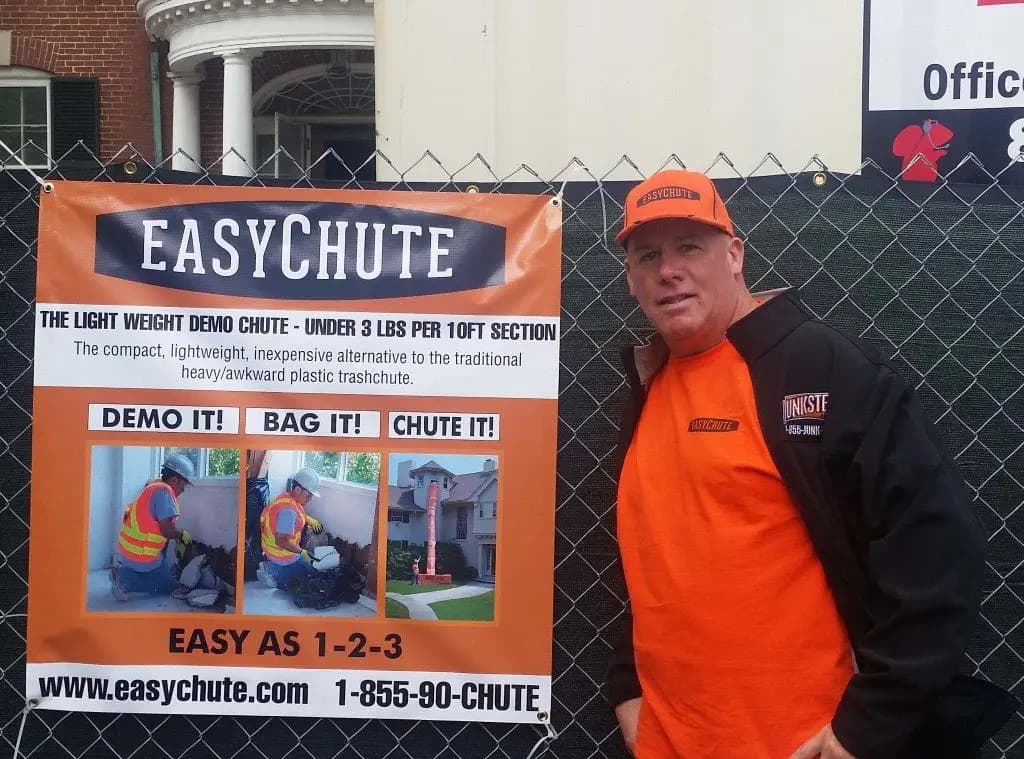
EasyChute was built by contractors for contractors, out of Massachusetts, and ships across the United States. If you're ready to stop renting and start owning a chute that travels with your crew from job to job, reach out to EasyChute or browse the full product lineup at all services to find the section configuration that matches your work. Demo it. Bag it. Chute it.