
If you're a contractor working in New York City or anywhere across the state, you already know that debris removal is one of the most expensive, time-consuming, and physically demanding parts of any job. When you're on the fourth floor of a brownstone in Brooklyn or gutting a prewar apartment in Upper Manhattan, getting debris from the work zone down to the dumpster is a serious logistical challenge — and the cost of doing it wrong eats directly into your margin.
Debris chutes are the standard solution. But when most contractors search for a debris chute rental cost estimate, they find vague numbers, upsell fees, and minimum rental periods that don't match the reality of how construction schedules actually work. This guide cuts through all of that.
We'll break down exactly what debris chute rentals cost in New York, what drives those costs up, what the hidden fees look like, and — critically — why a growing number of contractors across the state have made the switch from renting to owning a lightweight, reusable fabric chute system instead.
What Is a Debris Chute and Why New York Contractors Need One
A debris chute is a vertical tube or channel — typically made from metal, plastic, or fabric — that channels demolition debris, roofing shingles, drywall, concrete rubble, and other construction waste from an upper floor directly into a dumpster or waste container below. The alternative is hand-carrying debris down stairs, using a bucket brigade, or tossing material out of windows — all of which create serious safety risks and slow crews down significantly.
In New York, the problem is especially pronounced. You're dealing with:
- Narrow brownstones and row houses with tight stairwells
- Walk-up apartment buildings with no service elevator
- Multi-story commercial gut renovations with strict site safety plans
- Roofing tear-offs in dense neighborhoods where debris can't be tossed onto the street
- DOB and OSHA compliance requirements that mandate controlled debris handling
According to OSHA's Construction Industry safety standards, uncontrolled debris handling on multi-story sites is one of the leading contributors to struck-by injuries — a category that consistently ranks among the top four causes of construction fatalities. A proper debris chute isn't a luxury; it's a site safety requirement on most New York job sites above two stories.
To understand your options more fully, start with our complete guide to what a debris chute is, how it works, and how to choose the right one.
How Debris Chute Rentals Work in New York
Debris chute rental in New York typically operates through scaffolding companies, equipment rental houses, or specialized construction supply vendors. Here's how the standard process works:
The Standard Rental Model
- You call or submit a quote request to a rental company.
- They ask for the building height, number of sections needed, delivery address, and job duration.
- They quote a weekly or monthly rate, plus delivery, pickup, and damage deposit fees.
- Equipment arrives on a truck — usually requiring a loading dock or street access.
- You or the company installs the chute (installation labor may be extra).
- At job end, you schedule pickup — sometimes waiting days for a truck to become available.
Typical Rental Equipment Types
Most rental companies in the New York metro area offer one of two types of debris chutes:
- Steel or aluminum sectional chutes: Heavy-gauge metal sections that lock together. Durable but heavy, requiring two or more workers to handle each section. Standard on major high-rise projects.
- Plastic or polyethylene chutes: Lighter than steel, still rigid, more common on mid-rise residential work. Easier to handle but still bulky to transport and store.
Fabric chutes — including EasyChute's woven poly design — are increasingly popular as a purchase alternative rather than a rental item. We'll cover that comparison in depth later in this guide.
Debris Chute Rental Cost Estimates in New York: Breaking Down the Numbers
Rental pricing in New York varies by vendor, borough, season, and job site access. Here are realistic cost ranges based on current market conditions in 2026:
Weekly Rental Rates by Chute Type
- Standard plastic chute (10-story equivalent, ~100 ft): $350–$550 per week
- Heavy-duty aluminum chute (100 ft): $600–$900 per week
- Steel chute system with hopper (100 ft): $900–$1,400 per week
- Minimum rental period: Most vendors require a 2-week minimum, regardless of your actual job duration
Delivery and Pickup Fees
- Delivery to NYC (Manhattan, Brooklyn, Bronx, Queens): $150–$400 depending on borough and access
- Pickup fee: $150–$350 (sometimes bundled, often not)
- Emergency or expedited delivery: Add 50–100% to the standard delivery rate
- Street-only delivery surcharge: Common in dense boroughs where the truck cannot access a loading dock
Damage Deposits and Insurance
- Most rental companies require a refundable damage deposit of $200–$600 on top of rental fees.
- Some require proof of additional insured status on your GL policy, which may require a certificate of insurance from your broker — adding administrative time and cost.
- Damage to sections (dents, warped connectors) is charged at replacement cost, which can run $80–$150 per section.
Total Cost Example: 3-Week Renovation in Brooklyn
Let's model a realistic project: a 4-story brownstone gut renovation in Bay Ridge, Brooklyn, using a standard plastic chute system for three weeks:
- Rental rate: $420/week × 3 weeks = $1,260
- Delivery fee: $250
- Pickup fee: $225
- Damage deposit (refundable, eventually): $300
- Total out-of-pocket: $2,035 for one job
That's before any damage charges. And it's before the two days you lose waiting for delivery and pickup scheduling to align with your project timeline.
The Hidden Costs Rental Companies Don't Advertise
The line-item fees above are just the visible part of the rental cost equation. Experienced New York contractors know that the real cost of renting debris chutes runs considerably higher once you factor in time, labor, and scheduling friction.
Waiting Time at Job Start and End
Equipment rental companies in New York operate on their own schedule. During busy construction seasons — spring and fall — lead times on debris chute delivery stretch to 3–5 business days. If your project starts Monday but the chute doesn't arrive until Thursday, your crew is either hand-carrying debris (slowly and dangerously) or sitting idle. That waiting time has a dollar value: at $45–$65 per hour per laborer, three days of workaround costs add hundreds to the real project cost.
Crew Labor to Handle Heavy Equipment
Steel and aluminum debris chute sections are not lightweight. A typical 5-foot metal section can weigh 30–60 lbs. Installing a 10-story chute means your crew handles 20+ sections — a task that takes two or more workers several hours and creates real ergonomic risk. OSHA's ergonomics guidelines are clear about cumulative lifting risk on job sites. That labor time isn't free, and the injury risk isn't zero.
Scheduling Conflicts at Job End
When your project wraps up, you need to schedule pickup — but the rental company books pickups on their route, not your timeline. It's common to pay an extra week's rental simply because the pickup truck can't come until day 15 and your minimum is 14 days anyway. That "one extra day" costs you a full additional week.
Inspection and Disputed Damage Charges
When equipment comes back, it gets inspected. Rental companies have financial incentive to flag any wear as billable damage. Dents, scratches, missing connectors, bent hanging brackets — each one becomes a line item. Getting your full deposit back often requires a dispute process that costs you time and energy even when you win.
Why New York Contractors Are Switching from Renting to Owning
Rental makes sense when you need something once. But debris chutes aren't a one-job tool — they're a recurring need on nearly every project. If you're a contractor who runs 10, 20, or 30 jobs per year that involve multi-story debris removal, renting is structurally expensive compared to owning a reusable system.

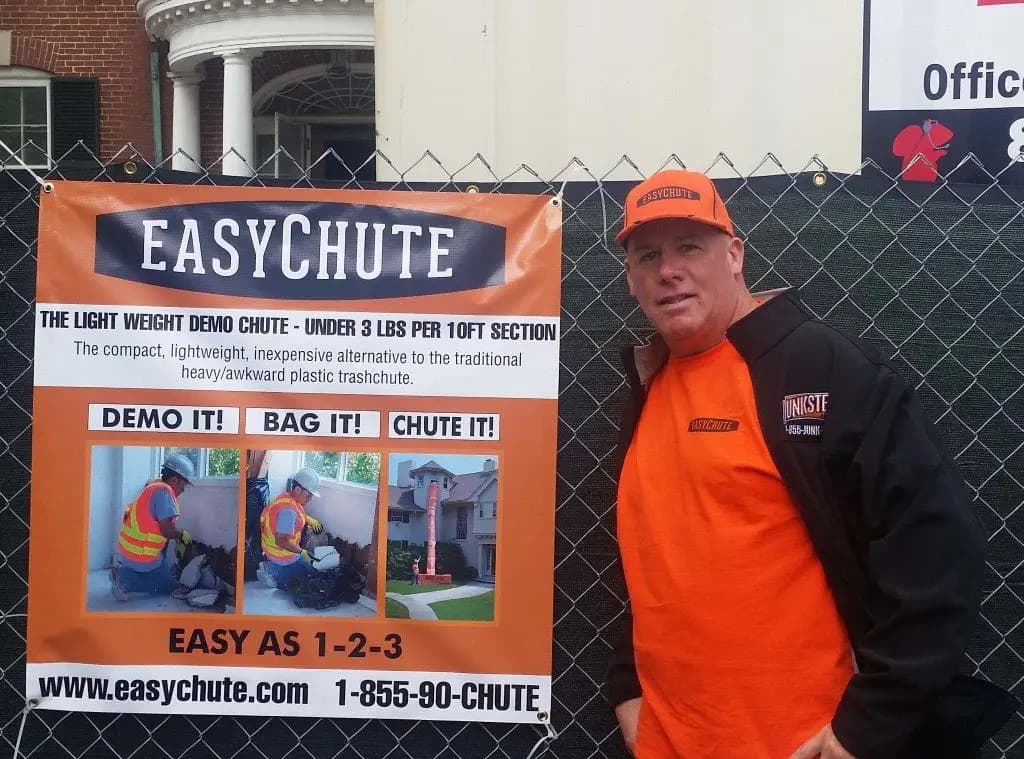
This is exactly the problem that EasyChute was designed to solve. Founded in Massachusetts by contractor Tim Hogan and junk removal owner Leo Guarente, EasyChute built a lightweight, reusable fabric trash chute specifically for contractors and roofers who were tired of paying rental fees, waiting on deliveries, and wrestling with heavy metal equipment. The result is a system that one person can carry, hang, and strike — start to finish — in minutes.
The EasyChute System at a Glance
- Sections available in 10 ft (lite-duty and heavy-duty), 25 ft, and 50 ft lengths
- A 10 ft section weighs under 3 lbs and folds into a small box
- Sections connect with a 1.5 ft overlap — no tools, no special hardware
- Hangs from four woven loops using standard carabiners or quick-connects
- Works from windows, roof edges, scaffold openings, or any elevated opening
- Ships free to job sites across the United States
- Fixed pricing — no quotes, no negotiation, no hidden fees
To see the system in action before you commit, check out EasyChute videos showing the trash chute in real job site conditions.
Renting vs. Owning: A Real Cost Comparison for New York Contractors
Let's run the numbers honestly. Assume you're a mid-size contractor running 15 debris-removal jobs per year in the New York metro area, each averaging 2.5 weeks of chute use:
Annual Cost of Renting
- Average rental cost per job (all-in): $1,800
- Jobs per year requiring a chute: 15
- Total annual rental spend: $27,000
- Total labor hours lost to delivery/pickup logistics (est. 4 hrs/job): 60 hours × $55/hr = $3,300
- True annual cost of renting: ~$30,300
Annual Cost of Owning an EasyChute System
- Initial purchase of chute sections to cover your typical job height: one-time cost (see fixed pricing on the product pages)
- Replacement sections or additions as needed: minimal
- Setup and strike time per job: 20–30 minutes of one person's time
- Storage: folds into a small box, fits in any work van or trailer
- Ongoing annual cost after initial purchase: near zero
Even on a conservative model, ownership pays for itself within the first two to three jobs. Every job after that is pure margin improvement. For a detailed look at how fabric chutes work and when they're the right tool, read our guide to fabric trash chutes: what they are, how they work, and when to use one.
Specific New York Use Cases: When Debris Chutes Are Non-Negotiable
Not every job requires a formal debris chute, but in New York, the conditions that make a chute mandatory come up constantly. Here are the most common scenarios:
Roofing Tear-Offs in Dense Neighborhoods
Whether you're stripping a row house in Greenpoint or a flat-roof commercial building in the Bronx, tossing shingles off a roof in a dense urban neighborhood isn't safe or legal. A roofing trash chute channels shingles, underlayment, nails, and flashing directly into the dumpster with no debris scatter. For a complete breakdown of this use case, see our guide to roofing trash chutes for shingle tear-offs.
Interior Gut Renovations in Walk-Up Buildings
Walk-up apartments are the backbone of New York's residential housing stock. When you're demoing a kitchen or gutting a bathroom on the third or fourth floor with no elevator access, the stairwell becomes your only route — until you hang a chute out the window. This is where lightweight fabric systems have a massive advantage over rental equipment: you can carry the entire chute system up four flights of stairs in one hand.
Multi-Story Commercial Demolition
Selective demo on commercial floors generates enormous volumes of drywall, framing lumber, flooring, and ceiling material. Controlling where that debris goes — and ensuring it doesn't create fall hazards for workers below — is both a site safety and liability issue. Our guide to demolition chutes for interior gut work and selective demo covers the specific requirements in detail.
High-Rise Projects
At extreme building heights, the physics and logistics of debris removal change significantly. The 432 Park Avenue trash chute case study illustrates how debris chutes scale to skyscraper conditions — and what that means for your planning at any height above 10 stories.
OSHA, DOB, and Site Safety Requirements That Affect Debris Chute Decisions
In New York, compliance isn't optional. Here's what you need to know about the regulatory environment that shapes debris chute requirements:
OSHA General Industry and Construction Standards
Federal OSHA construction standards require that debris be contained to prevent struck-by hazards at lower levels. On any multi-story project where debris is being dropped from height, uncontrolled chucking of material out of windows violates general duty clause requirements and can result in citations. Using a properly anchored chute satisfies the controlled debris handling standard.
New York City Department of Buildings (DOB) Requirements
NYC DOB site safety plans for major renovation or demolition projects typically require a formal debris management plan. For Class 1 and Class 2 demolition permits, the site safety coordinator's plan must address debris removal methodology. A debris chute satisfies this requirement far more cleanly than manual carry-out methods.
Contractor Liability and Insurance Considerations
Beyond regulatory compliance, using a debris chute is a liability management tool. If a worker or passerby is struck by falling debris during a job, the lack of a containment system will be central to any negligence claim. Documented use of a proper debris chute strengthens your defense significantly.
The EPA's data on construction and demolition debris underscores how significant the volume of C&D waste is nationally — and proper chute use is part of responsible, compliant debris management from both a safety and environmental standpoint.
How to Choose the Right Debris Chute System for Your New York Jobs
Whether you're evaluating rental options or considering a purchase, here's a practical decision framework:
Step 1: Determine Your Typical Drop Height
Measure — or estimate — the vertical distance from your typical work floor to the dumpster level. This determines how many sections you need. EasyChute sections connect in any combination: a three-story residential job might need 25–30 ft; a six-story brownstone might need 50–60 ft. EasyChute's 10 ft, 25 ft, and 50 ft sections give you the flexibility to configure for any height without over-buying.
Step 2: Assess Your Debris Type and Volume
- Shingles and roofing material: Moderate weight per piece, high volume. Heavy-duty sections are the right choice.
- Drywall and framing: Lighter weight, manageable with lite-duty sections on lower heights.
- Concrete, masonry, or tile: Dense, heavy material — confirm section ratings before loading heavy chunks.
- Mixed C&D debris: Standard heavy-duty sections are the safest default.
Step 3: Consider Your Hanging Point
EasyChute hangs from four woven loops using carabiners or quick-connects — compatible with window frames, scaffold pipe, roof edges with anchor points, and most standard job site attachment hardware. If your site has unusual structural conditions, review the step-by-step EasyChute installation guide before ordering to confirm fit.
Step 4: Calculate Your Break-Even Point
Take your average all-in rental cost per job and divide it by the EasyChute purchase price for the section configuration you need. That's your break-even job count. For most New York contractors, break-even happens within the first two to three uses. Everything after that is savings.
Practical Tips for Getting the Most Out of Any Debris Chute System
Whether you rent or own, here are field-tested practices for maximizing efficiency and safety:
Always Position the Dumpster Directly Below the Exit Point
It sounds obvious, but dumpster placement matters enormously. A chute angled more than 15 degrees off vertical loses directional control at the bottom. Work with your dumpster company to place the container as close to directly below the chute exit as site conditions allow.
Never Overload the Chute Entry
Feed debris steadily rather than dumping large loads at once. Overloading the entry creates blockages mid-chute, which are frustrating and sometimes dangerous to clear at height. Train your crew to feed material in controlled volumes — a few shovels or a few shingles at a time.
Inspect Connections After Every Shift
Vibration from debris impact can loosen connection overlaps over the course of a shift. A quick visual inspection of each section connection at the start and end of each workday takes two minutes and prevents mid-job failures.
Keep the Landing Zone Clear
The area immediately around the dumpster below the chute exit must be a no-entry zone during active debris loading. Mark it with cones, tape, or barrier fencing. This is non-negotiable from both an OSHA compliance and basic safety standpoint.
Store Fabric Sections Properly Between Jobs
Fold EasyChute sections cleanly and store them in their original box or a dry storage bag. Avoid leaving coated poly fabric in direct UV exposure for extended periods when not in use. Proper storage extends section life significantly across many reuses.
Debris Chute Rental vs. EasyChute: Side-by-Side Comparison
Here's a direct comparison to help you make the right decision for your operation:
- Setup time: Rental (heavy metal) = 2–4 hours with a crew | EasyChute = 20–30 minutes, one person
- Weight per section: Rental = 30–60 lbs per section | EasyChute = under 3 lbs per 10 ft section
- Transport: Rental = dedicated truck delivery required | EasyChute = fits in a work van or truck bed
- Cost per job: Rental = $1,500–$2,500 all-in | EasyChute = $0 after initial purchase
- Lead time to get on-site: Rental = 3–5 business days | EasyChute = ships to job site, free
- Reusability: Rental = returned after every job | EasyChute = reused job after job, indefinitely
- Height flexibility: Rental = fixed sections, limited configurations | EasyChute = mix and match 10 ft, 25 ft, 50 ft sections for any height
- Hidden fees: Rental = delivery, pickup, deposit, damage charges | EasyChute = fixed price, no hidden costs
For a comprehensive look at canvas and fabric chute options and how they compare on durability and application, see our guide to canvas trash chutes: what they are, how they work, and how to choose the right one.
Frequently Asked Questions
How much does debris chute rental cost in New York City?
Debris chute rental in New York City typically runs $350–$900 per week depending on chute type (plastic vs. aluminum), plus delivery fees of $150–$400, pickup fees of $150–$350, and a damage deposit of $200–$600. Most vendors require a 2-week minimum rental. All-in costs for a typical 3-week residential renovation project in a dense borough like Brooklyn or the Bronx commonly land between $1,800 and $2,500 per job. Expedited delivery during peak construction season can add another 50–100% to delivery costs.
Is it cheaper to rent or buy a debris chute for a New York contractor?
For contractors running more than two or three debris-removal jobs per year, buying a reusable fabric chute system is almost always cheaper than renting. Rental costs $1,500–$2,500 per job all-in. A fabric chute system like EasyChute is purchased once at a fixed price and reused on every subsequent job at no additional cost. Break-even typically occurs within the first two to three uses. After that, every job saves you the full rental cost — directly improving job margin without changing any other part of your operation.
What are the hidden fees in debris chute rentals that contractors miss?
Beyond the base weekly rental rate, New York contractors commonly encounter several hidden fees: delivery and pickup charges (billed separately and sometimes doubled for dense boroughs), damage deposit holds that take weeks to refund, inspection-based damage charges for normal wear, extra weeks billed when pickup scheduling doesn't align with your project end date, and administrative time managing certificates of insurance required by some rental vendors. When you add lost crew productivity waiting for delivery or working around missing equipment, the true cost of rental often exceeds the invoice by 30–40%.
How long does it take to set up a debris chute on a New York job site?
Setup time varies significantly by chute type. Heavy metal rental chutes typically require a two-person crew and 2–4 hours to unload from the delivery truck, carry sections to the work level, and assemble them. EasyChute's lightweight fabric system takes one person roughly 20–30 minutes to hang from a window, roof edge, or scaffold opening using standard carabiners. The difference matters on fast-turnaround projects where every hour of crew time is billable. A step-by-step installation walkthrough is available in EasyChute's setup guide.
Do I need a permit for a debris chute in New York City?
For major demolition or renovation projects in New York City, the Department of Buildings requires a site safety plan that addresses debris handling. Whether a formal chute permit is required depends on the project classification, building height, and scope of work. Class 1 and Class 2 demolitions typically require the most detailed debris management documentation. For smaller residential jobs, a chute may be covered under your existing renovation permit. Always confirm specific permit requirements with your site safety coordinator or expediter before starting work — requirements vary by project type and borough.
What type of debris can I run through a fabric debris chute?
EasyChute's woven, coated poly fabric sections handle most common construction debris: roofing shingles, underlayment, drywall, framing lumber, insulation, flooring materials, and general C&D waste. For very heavy, dense materials like large chunks of concrete, brick, or masonry, use heavy-duty sections and feed material in smaller, controlled loads rather than dumping in bulk. The key is managing load volume at the entry — feeding material steadily rather than overloading the chute in one pass. For detailed guidance, the EasyChute FAQ covers material compatibility questions in depth.
Can one person operate a debris chute on a New York construction site?
Yes — EasyChute's lightweight fabric design is specifically built for single-person setup and operation. A 10 ft section weighs under 3 lbs and folds small enough to carry up multiple flights of stairs in one hand. One person can carry, hang, and connect sections from windows or scaffold openings without additional crew. During active debris loading, one person feeds material at the entry while another monitors the dumpster below and keeps the landing zone clear. This two-person operation during active use is a safety best practice, even though setup and strike can be done solo.
Ready to Stop Renting and Start Saving on Every Job?
Every debris chute rental you pay for in New York is money that could stay in your margin. EasyChute gives you a lightweight, reusable, one-person-deployable system that ships free to your job site — no delivery scheduling, no damage deposits, no hidden fees, and no waiting on a truck to show up before your crew can work.
Built by contractors who ran the same numbers you're running right now, EasyChute is designed to pay for itself in the first few jobs and save you money on every project after that. Whether you're doing roofing tear-offs in Queens, gut renovations in Bushwick, or commercial demo anywhere across the state, the system configures to your height, hangs from what you have on-site, and comes down in minutes when the job is done.
Visit the EasyChute contact page to ask questions or place an order, or learn more about the company and the contractors who built it on the About EasyChute page. If you want to review common questions before you buy, the EasyChute FAQ has answers to the most common contractor questions about sizing, setup, and compatibility.
Demo it. Bag it. Chute it.