
At 1,396 feet tall, 432 Park Avenue is one of the most recognizable buildings on the Manhattan skyline — and one of the most demanding construction environments imaginable. Whether you are doing interior renovation work on a penthouse floor, managing a build-out in the lower residential units, or coordinating a large-scale gut renovation on any of the 96 stories, debris removal is not an afterthought. It is a critical safety and logistics problem that starts on day one and does not stop until the last bag of drywall dust hits the dumpster below.
This guide breaks down how trash chutes work in extreme high-rise environments like 432 Park Avenue, what contractors and renovation crews need to know before hanging a chute at serious height, and why lightweight fabric debris chute systems are becoming the go-to choice for urban job sites where every square foot of vertical space carries a cost.
Why 432 Park Avenue Is a Special Case for Debris Removal
Most contractors who work general residential or light commercial jobs think of debris chutes as a roofing accessory — something you hang off a two-story colonial to slide shingles into a dumpster. That mental model does not scale to supertall construction. At 432 Park Avenue and buildings like it, the variables multiply fast.
You are dealing with extraordinary drop heights. Interior fit-out floors may be hundreds of feet above street level. Even mid-tower renovation floors sit at heights that dwarf a standard 10-story apartment building. The physics of debris in free fall at that height, the wind forces acting on any hanging equipment, and the tight street-level footprint of the dumpster placement all create challenges that demand a systematic approach.
The Unique Logistics of Supertall Renovation Work
- Elevator dependency: At 432 Park, construction elevators or service lifts are the primary vertical transport. When those lifts are occupied or restricted, crews carrying debris bags down 50 or 60 flights is not just slow — it is a serious ergonomic and safety hazard.
- Floor-by-floor staging: Debris often accumulates faster than it can be moved. Without a chute system in place, job sites resort to staging debris on each floor, creating trip hazards and congestion.
- Street-level access constraints: Midtown Manhattan street access is tightly controlled. Dumpster placement windows are narrow. Any debris removal system needs to be precise enough to drop material into a defined target zone.
- Building management requirements: Luxury residential towers like 432 Park have strict rules about how and when contractors can move material through common areas. A window or scaffold-based chute system keeps debris out of the lobbies and corridors entirely.
How Trash Chutes Work at Extreme Heights
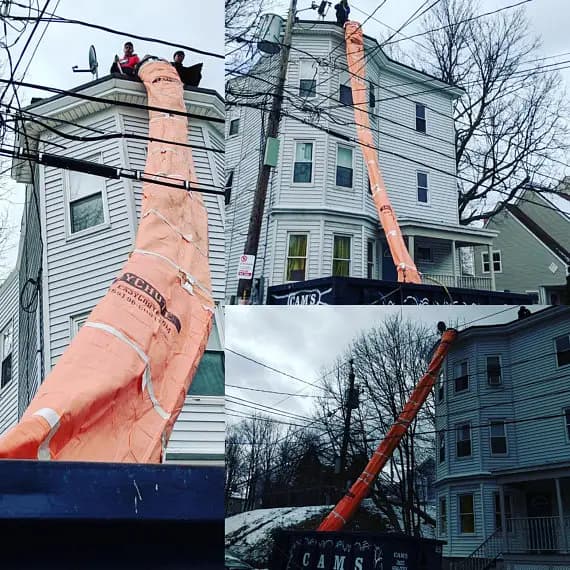
A debris chute is a gravity-fed tube — typically made from woven fabric, coated poly, or in older installations, steel — that hangs vertically from a building opening and channels demolition material straight down into a dumpster or waste container below. The basic principle is simple: hang the chute, feed debris in at the top, let gravity do the work.
At extreme heights, however, the execution requires more planning. Sections need to connect securely, the chute needs to stay vertical under wind load, and the bottom of the chute needs to be properly directed into the waste container so material does not scatter across a city sidewalk.
Section-by-Section Assembly for Long Drops
Modern fabric chutes like EasyChute's system are designed to connect modularly. A 10-foot section overlaps 1.5 feet with the next section, creating a continuous channel. For a 15-story drop (roughly 150 feet), you would chain together sections to reach the required length. The 25-foot and 50-foot sections are purpose-built for exactly this kind of extended reach — fewer connections, faster rigging.
- A 50-foot section handles roughly a 4- to 5-story vertical drop in a single piece.
- Multiple 50-foot sections can be chained for drops exceeding 100 feet.
- Each connection point uses a 1.5-foot overlap, so the math is straightforward: plan your total drop, subtract for overlap, order accordingly.
For a detailed look at how the hanging and connection system works, the EasyChute step-by-step setup guide walks through the full rigging process from first loop to bottom funnel.
Wind Load Considerations at Height
At the elevations common in a supertall like 432 Park Avenue, wind is a real factor. A fabric chute will move in the wind — that is actually a feature, not a defect, since rigid steel chutes can act as sails and create dangerous lateral forces on the anchor points. Woven poly fabric has enough flexibility to shed wind load while still channeling debris effectively. The key is securing the hanging loops with rated carabiners or quick-connects at each floor opening and not allowing the chute to swing freely over pedestrian areas below.
OSHA Requirements That Apply to High-Rise Chute Use
Debris removal on a construction site is not exempt from federal safety standards. The OSHA Construction Industry standards address debris handling, chute use, and the protection of workers and the public below. Any crew operating a trash chute on a Midtown Manhattan job site — whether at 432 Park or a neighboring residential tower — needs to be aware of the core requirements.
Key OSHA Rules for Debris Chute Operations
- Enclosed chutes required: When debris is dropped more than 20 feet to any exterior point of a building, OSHA requires the chute to be enclosed on all sides. Fabric chutes that form a continuous tube meet this requirement.
- Restricted zones below: The area into which a chute discharges must be restricted from pedestrian and worker access. Barricades and signage are required at street level.
- Tight-fitting doors: Any opening in a chute used to introduce debris must have a gate or door that fits tightly enough to prevent blowout of material.
- Load limits: No material that is too large for the chute diameter should be forced in. Oversized material creates blockages and can cause blowouts at connection points under load.
Running a debris chute operation that checks all these boxes is not just about compliance — it is about protecting your crew, the building's other occupants, and the public on the sidewalk below.
The Volume of Debris Generated in High-Rise Renovation
It is worth pausing to appreciate the scale of the material problem. The EPA estimates that construction and demolition debris accounts for more than 600 million tons of material generated in the United States annually. A single floor renovation in a supertall like 432 Park Avenue — stripping flooring, drywall, mechanical equipment — can generate thousands of pounds of debris per day.
Without an efficient chute system, that volume of material becomes a manual labor problem. Workers carrying heavy bags down service stairs or waiting for elevator access creates bottlenecks that slow the entire job. A properly rigged chute system can clear a floor's daily debris in a fraction of the time, keeping the project on schedule and the crew working productively rather than hauling.
What a Single Gut-Renovation Floor Generates
- Flooring removal (hardwood, tile, subfloor): 500 to 2,000+ lbs depending on floor size
- Drywall demolition: 300 to 1,000 lbs per standard apartment unit
- Mechanical and plumbing removal: variable, but often 200 to 800 lbs
- Ceiling material and insulation: 100 to 400 lbs
- Miscellaneous debris (old fixtures, cabinets, trim): highly variable
Multiply that by multiple floors running simultaneously and the daily debris volume becomes staggering. A construction chute that can handle continuous feed from an upper floor to a ground-level dumpster is not a convenience — it is a production tool.

Choosing the Right Chute Section Length for a High-Rise Job
EasyChute offers 10-foot, 25-foot, and 50-foot sections in both lite-duty and heavy-duty configurations. For a job at 432 Park Avenue or any supertall Manhattan building, the section selection depends on where the chute is being anchored and how far the drop runs to the dumpster below.
When to Use 10-Foot Sections
The 10-foot section is the building block of any chute setup. At under 3 pounds, it is designed to be carried, hung, and connected by one person without scaffolding or specialized rigging. For high-rise work, 10-foot sections are most useful for the top segment — where you need to position the entry point precisely at a window or scaffold edge — and for fine-tuning total length when the math does not work out to an even number of longer sections.
When to Use 25-Foot and 50-Foot Sections
For the main body of a long-run high-rise chute, the 25-foot and 50-foot sections dramatically reduce the number of connection points and speed up rigging time. Fewer connections mean fewer potential weak points and a faster setup when you are working against a tight site-access window. If you are dropping debris 10 or more stories, build the majority of your run with 50-foot sections and use a 10-foot or 25-foot section to cap the top and bottom of the assembly.
See the full breakdown of options on the fabric trash chute guide — it covers section weights, diameter specs, and what duty rating fits what debris type.
Hanging a Chute from a High-Rise Window or Scaffold
The anchor system is where high-rise chute rigging diverges most sharply from a standard residential setup. At a two-story house, you might hook the top loop of a chute over a roof edge bracket and call it done. At a 30th-floor window in a building like 432 Park, the hanging system needs to be both secure and compliant with building management requirements that often prohibit penetrations into the facade.
Non-Penetrating Anchor Options
- Window frame anchors: A crossbar placed inside the window opening creates a solid anchor point without any fasteners into the building structure. The chute's top loops attach to the crossbar via carabiners.
- Scaffold rail connection: When working from a scaffold, the chute loops attach directly to the scaffold structure at each floor level, providing intermediate support points that keep the chute running vertically.
- Quick-connects for speed: On jobs where the chute needs to be repositioned floor to floor as work progresses upward, quick-connect hardware lets one person detach and re-anchor the top loops in minutes rather than re-rigging the entire assembly.
The EasyChute video library shows real-world rigging setups across different building types — worth reviewing before your first high-rise install to understand what the hanging process looks like in practice.
Street-Level Dumpster Placement and Bottom of Chute Management
Everything that goes in the top of the chute needs to land somewhere specific at the bottom. In Midtown Manhattan, that somewhere specific is a licensed dumpster positioned in a permitted location — and the city's Department of Transportation controls those permits tightly. At 432 Park Avenue and neighboring sites, dumpster placement is typically in a designated curb lane or loading dock area during approved hours.
Keeping the Bottom of the Chute on Target
- The bottom of the chute should hang no more than 3 to 4 feet above the top edge of the dumpster container. Too high, and debris scatter increases. Too low, and accumulated material in the dumpster can back up into the chute and cause a blockage.
- A barricade zone around the dumpster keeps workers and passersby out of the debris fall zone. OSHA requires this for any exterior chute discharge point.
- If the dumpster needs to be rotated or swapped during the day, the bottom of the chute can be temporarily secured aside and re-directed once the new container is in position.
Reusability: The Economic Case for Fabric Chutes on Repeat Urban Jobs
One of the most common misconceptions in the contractor market is that a debris chute is a disposable item — something you buy for a job and throw away when the job is done. That thinking makes no sense for urban renovation crews who are running back-to-back projects in Manhattan, Brooklyn, and surrounding boroughs.
EasyChute's woven, coated poly fabric is designed for repeated use across multiple jobs. A single section can be folded into a small box for storage and transport, carried in a work van without a dedicated equipment trailer, and deployed again on the next project within minutes. For a crew that runs three or four interior renovation jobs per month in buildings like those along Park Avenue or in the surrounding Midtown corridor, the per-job cost of the chute system drops with every deployment.
Compare that to the alternative: renting a steel chute system for every job, paying delivery fees and pickup fees, and working around the rental company's schedule. The economics of owning a lightweight fabric chute system shift decisively in favor of ownership over any multi-job horizon.
For crews working the full range of New York City job types, the Midtown Manhattan trash chute guide and the Upper Manhattan renovation chute resource both cover site-specific logistics for high-density urban environments.
Common Mistakes Contractors Make on High-Rise Chute Jobs
Even experienced crews make avoidable errors when they first scale up to supertall or high-rise chute work. Here are the most common problems — and how to get ahead of them.
Mistake 1: Underestimating Total Section Length Needed
Crews often calculate the floor-to-ground drop and order exactly that many feet of chute. What they forget is that the top of the chute needs to reach the entry point inside the window opening — not just hang flush with the exterior wall. Add 5 to 8 feet of section length to your calculated drop to ensure the entry end reaches comfortably into the work area and the bottom end positions correctly over the dumpster.
Mistake 2: No Intermediate Anchor Points on Long Runs
A chute hanging free for 10 or more stories will swing significantly in wind. Intermediate anchor points — attaching the chute to the building at every two or three floors — keep the assembly tracking vertically and reduce dynamic load on the top anchor. If scaffold is in place, use it. If not, plan for window-frame connections at intermediate floors.
Mistake 3: Forcing Oversized Material
The diameter of a fabric chute is designed to handle standard demolition debris — drywall chunks, broken tile, roofing material, bagged waste. Forcing in a full section of 2x10 lumber or an intact toilet creates a blockage that can be difficult to clear at height and can damage the chute fabric at the connection points. Break material down before it goes in.
Mistake 4: Skipping the Barricade at Street Level
It seems obvious, but under time pressure on a busy urban site, street-level barricading gets deprioritized. This is both an OSHA violation and a serious liability exposure. Set the barricade first, before any material goes into the chute. It takes ten minutes and it stays in place for the duration of the chute operation.
The New York contractors debris chute mistake guide covers additional site-specific pitfalls for urban job sites across the five boroughs.
432 Park Avenue in Context: What All High-Rise Renovation Crews Share
432 Park Avenue gets attention because of its height and its profile as a luxury residential supertall. But the debris removal challenges it represents are not unique to that address. Any building above 10 stories — whether it is a 1960s co-op on the Upper East Side, a prewar rental in Midtown West, or a newer tower in Long Island City — creates the same fundamental problem: gravity works downward, debris accumulates upward, and moving it without a chute system is slow, labor-intensive, and hard on workers' bodies.
According to OSHA's ergonomics guidance, repeated lifting and carrying of heavy loads — exactly what happens when workers hand-carry debris bags down service stairs — is one of the leading causes of musculoskeletal injury on construction sites. A chute system is not just a time-saver; it is an injury-prevention tool that protects the crew doing the work.
Crews working in Manhattan brownstones and row houses face a scaled-down version of the same problem. The Brooklyn debris chute guide and the Lower Manhattan renovation chute resource cover how the same section-based fabric chute system adapts to 3- and 4-story buildings with the same ease it brings to high-rise work.
Ordering the Right System Before the Job Starts
EasyChute ships free to job sites across the United States. Sections are priced at fixed rates and available in the combinations that make sense for your specific drop height and debris volume. Because the sections are lightweight and fold into small boxes, they can ship directly to a Manhattan job site address, to a staging yard, or to a contractor's home base — wherever makes the most logistical sense for your operation.
For a high-rise job like those at 432 Park Avenue or comparable towers, the smart move is to have the right section inventory on hand before mobilization. Trying to order additional sections mid-job when you realize the drop is longer than expected costs you time and potentially a full day of production while you wait for delivery.
The canvas trash chute guide and the main debris chute resource both include sizing guidance that helps you map your specific job requirements to the right section combination before you place the order.
Frequently Asked Questions
Can a fabric trash chute handle the drop height at a building like 432 Park Avenue?
Fabric debris chutes are engineered for extended vertical drops by chaining sections together. For supertall buildings, the chute is typically anchored at the working floor, not from the roof, so the actual drop length is the floor-to-dumpster distance — not the full building height. A series of 50-foot and 25-foot sections connected with 1.5-foot overlaps can handle drops of 100-plus feet without issue, provided intermediate anchor points are used to keep the chute tracking vertically in wind.
What OSHA rules apply to debris chute use on a high-rise Manhattan job site?
OSHA's construction standards require that debris dropped more than 20 feet to any exterior point must travel through an enclosed chute. The discharge area at street level must be barricaded and restricted from public access. Chute openings used to introduce debris must have tight-fitting gates or covers. Oversized material that could cause blowouts or blockages must not be forced into the chute. All of these requirements apply regardless of building height or building type.
How many sections do I need for a typical high-rise floor renovation?
Calculate the vertical distance from your working floor's window opening to approximately 3 to 4 feet above the dumpster rim. Add 5 to 8 feet for the inside reach of the top entry. Build that total from 50-foot sections as the main run, then use 25-foot or 10-foot sections to fine-tune the top and bottom. A 10th-floor drop (roughly 100 feet) might use two 50-foot sections and one 10-foot section, accounting for overlaps.
Is a permit required to hang a trash chute from a window in Manhattan?
Permit requirements are set by the New York City Department of Buildings and can vary by building type, project scope, and whether the chute extends over a public sidewalk. Most gut-renovation projects in New York City require a sidewalk shed permit if debris is being discharged over or adjacent to a public walkway. Always check with the project's general contractor and the building's management office before rigging a chute on a Manhattan high-rise. EasyChute's system itself does not require penetrations into the building facade, which simplifies the permit picture significantly.
How do I keep the chute from swinging in wind at high elevation?
Intermediate anchor points are the primary solution. Attach the chute to the building structure at every two or three floor intervals using the fabric loops and standard carabiners. If scaffold is in place, connect to the scaffold rails at each level. The woven poly fabric naturally sheds wind load more effectively than rigid steel sections, but long unsupported runs will still move in strong gusts. Anchoring at multiple points keeps the chute vertical and prevents the swinging that can misdirect debris at the bottom.
Can one person set up an EasyChute system on a high-rise job?
Yes — that is a core design principle. Each 10-foot section weighs under 3 pounds and folds into a small box. A single crew member can carry sections to the working floor, hang the top loops from a window crossbar or scaffold rail, and connect additional sections as the chute is let down floor by floor. The quick-connect hardware option makes repositioning even faster. For very long runs, a second person at a lower floor to guide the bottom of the chute into position is helpful but not required for the rigging itself.
Does EasyChute ship directly to Manhattan job sites?
Yes. EasyChute ships free to job sites across the United States, including Manhattan addresses. Because the sections are compact and lightweight, they can be delivered to a building's loading dock or staging area without freight truck requirements. Orders are placed online at fixed prices — no quotes required, no rental agreements. For a high-rise job where timing is critical, ordering a few days before mobilization ensures the chute is on-site when the demo crew is ready to begin.
Ready to Equip Your High-Rise Job with the Right Debris Chute?
Whether you are managing a floor renovation inside a supertall like 432 Park Avenue or running back-to-back gut jobs in Midtown's dense residential towers, the debris removal system you choose affects your crew's safety, your project timeline, and your bottom line on every job.
EasyChute's lightweight fabric sections — available in 10-foot, 25-foot, and 50-foot lengths — are designed by contractors for the real conditions of urban construction work. They ship free, hang in minutes, and go back in the box when the job is done, ready for the next one.
Visit the EasyChute FAQ for specific setup and ordering questions, browse the EasyChute video library to see the system in action on real job sites, or head to the contact page to reach the team directly with questions about your specific project. The right chute setup for your high-rise job is one order away.