
Every contractor who works above ground eventually faces the same question: what is the fastest, safest, most cost-effective way to get debris from an upper floor into the dumpster? Two answers come up most often — a purpose-built debris chute or a temporary scaffolding-mounted chute system. They both move material downward, but that is roughly where the similarities end.
This guide breaks down both systems across every dimension that matters on a real job site: cost, setup time, labor, safety compliance, weight capacity, reusability, and how they fit different project types. By the end, you will know exactly which system belongs on your next project — and which one could quietly eat your margin if you choose wrong.
What Is a Debris Chute, and How Does It Work?
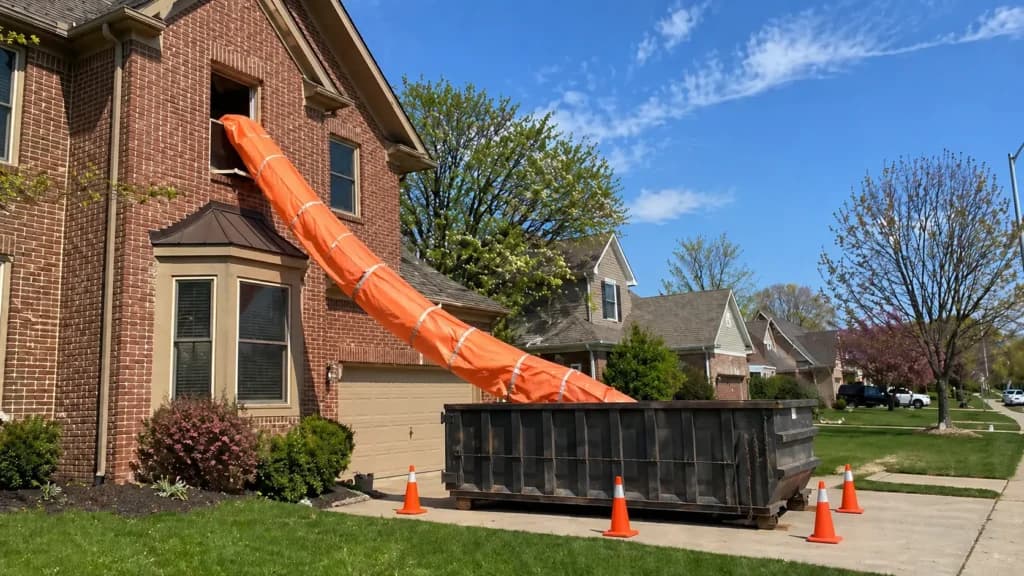
A debris chute is a gravity-fed tube or sleeve that channels demolition material — shingles, drywall, concrete chunks, lumber scraps, insulation — from an upper work area straight down into a dumpster or waste container at ground level. The core concept is simple: hang the chute from an opening, drop debris in, let gravity do the rest.
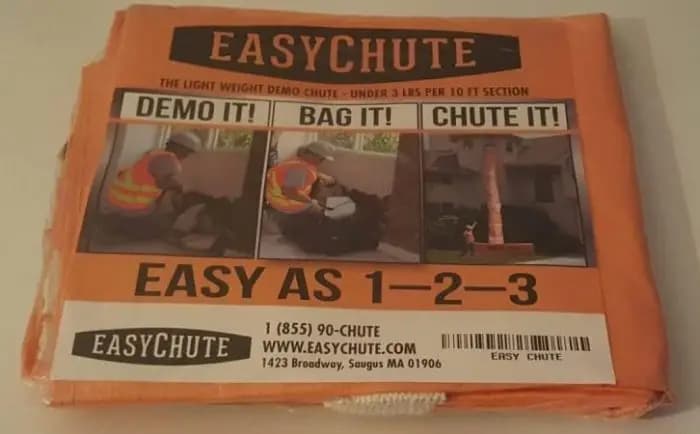
Modern debris chutes like EasyChute's fabric system are made from woven, coated poly fabric. Sections come in 10 ft, 25 ft and 50 ft lengths and connect with a 1.5 ft overlap, so you can build a chute to match almost any building height. Four woven loops at the top of each section let you hang the chute with ordinary carabiners or quick-connects — no specialized hardware, no welding, no scaffold rental.
Key Features of a Modern Fabric Debris Chute
- Lightweight: a 10 ft section weighs under 3 lbs
- Folds into a small box for storage and transport
- One person can hang and strike the chute in minutes
- Reusable across dozens of job sites
- Works from windows, roof edges, scaffold openings, or demo cutouts
- Ships free to job sites across the United States
The installation process is straightforward enough that a single crew member can manage it without pausing the rest of the job. That labor efficiency is a major advantage over more elaborate systems — and it is one of the first things that separates a lightweight debris chute from a scaffold-integrated chute setup.
What Is a Temporary Scaffolding Chute System?
A temporary scaffolding chute is a debris management system that is physically mounted to, or integrated with, an erected scaffold structure. Rather than hanging independently from a building opening, these systems rely on the scaffold frame for support. They are commonly found on large commercial projects, high-rise exterior renovations, and municipal jobs where scaffold is already mandated by contract or code.
Scaffolding chute systems typically use rigid or semi-rigid formed plastic or metal sections that bolt or clamp onto scaffold uprights and horizontals. Because the scaffold itself is load-rated and engineered, the chute system can be anchored at multiple points along the structure — which provides stability when debris volumes are extremely high or when material is unusually heavy.
How Scaffolding Chutes Are Typically Configured
- Rigid plastic or galvanized metal sections bolted to scaffold frame
- Often requires a scaffold erector or qualified rigger for installation
- Anchored at every scaffold bay, typically every 5 to 7 ft vertically
- May include a swing-arm intake funnel at each work deck level
- Requires scaffold to already be standing before the chute can be installed
- Teardown follows scaffold strike sequence — the two operations are linked
Scaffold-mounted systems work well on the specific job types they were designed for. Outside of those contexts, they often introduce cost and complexity that a simpler debris chute handles just as effectively at a fraction of the investment.
Cost Comparison: Debris Chute vs Scaffolding Chute
Cost is usually the first filter contractors apply, and the difference here is not marginal — it is significant enough to change how you bid a job.
Debris Chute Costs
A standalone fabric trash chute is a purchase, not a rental. You buy the sections you need, they ship free, and you reuse them on every subsequent job. A 10 ft section is priced to be accessible for a small contractor, and a 50 ft section can serve a five-story building without stacking multiple rental fees. Because EasyChute sells at fixed online prices, there are no surprise quotes or availability surcharges.
Compare that to a rental model, where contractors are paying a daily or weekly rate plus delivery and pickup charges. On a two-week project, those fees compound fast — often exceeding the purchase price of a chute you would then own outright.
Scaffolding Chute Costs
Scaffolding chute costs are almost never quoted in isolation, because the scaffold itself is the larger line item. You are paying for:
- Scaffold erection labor (a licensed scaffold crew in most jurisdictions)
- Scaffold rental by the week or month
- Scaffold strike and removal at project end
- The chute system rental or purchase on top of all of the above
- Any permits required for scaffold in public right-of-way
In urban markets, scaffold rental alone can run several thousand dollars per week for a mid-rise building. Add the chute integration, and the debris management component of your budget is a significant line item before a single shingle hits the dumpster. For projects that do not already require scaffold for access or fall protection, that cost is very hard to justify when a lightweight hanging chute accomplishes the same result.
Setup Time and Labor Requirements
Time on a job site is money. The fewer hours your crew spends rigging equipment, the more hours go into the actual work you are billing for.
How Fast Can You Set Up a Fabric Debris Chute?
An EasyChute can be hung by one person in a matter of minutes. You run the section out, attach the carabiners to an anchor point at the window or roof edge, and let it drop. If you need more height, snap on another section. The whole process for a standard residential or light commercial job is typically under 15 minutes from van to ready-to-use.
Striking the chute at end of day or end of project is equally fast. Disconnect the carabiners, fold the section into its box, and load it into your vehicle. No scaffold crew, no sequencing, no waiting on a crane to lift metal sections off a frame.
Scaffolding Chute Setup Time
Installing a scaffold-integrated chute is inseparable from the scaffold erection timeline. Even on a small building, scaffold erection typically takes a full crew a half-day to a full day. The chute is then installed as a secondary operation, often by the same scaffold crew or a separate rigger — adding additional labor hours before your debris plan is even operational.
That delay matters on shorter-duration jobs. A roofing crew doing a two-day tear-off does not have the schedule flexibility to wait for scaffold to be erected the morning before they can start stripping shingles. For more on how roofers handle debris chute setup efficiently, see the roofing trash chute guide.
Safety and OSHA Compliance
Both system types can meet OSHA construction safety standards when used correctly. The compliance considerations are different for each, and understanding them helps you brief your crew and satisfy site safety officers without guesswork.
Debris Chute Safety Considerations
- Anchor point rating: the loop attachment points must be anchored to a structure rated for the debris load — always verify before hanging
- Dumpster placement: position the dumpster directly below the chute exit so there is no lateral scatter of falling material
- Ground clearance zone: establish and mark a no-entry exclusion zone around the dumpster opening while debris is moving
- Section overlaps: use the full 1.5 ft overlap between sections to prevent gaps where debris could exit mid-chute
- Wind load: in high-wind conditions, monitor the chute's lateral movement and secure additional tie-off points as needed
OSHA ergonomics guidance also supports using gravity-assist equipment like debris chutes — moving heavy material through a chute instead of carrying it down ladders or stairs dramatically reduces cumulative lifting loads on workers, which is a real injury-prevention benefit on demolition-heavy jobs.
Scaffolding Chute Safety Considerations
Scaffold-mounted chutes benefit from the engineered structure they hang from, which can support higher debris volumes and provides predictable anchor points at every bay. However, they introduce additional safety obligations:
- Scaffold inspection requirements before each shift in many jurisdictions
- Fall protection protocols for workers accessing chute intake points at each deck level
- Load ratings for both the scaffold system and the chute hardware must be verified together
- Debris blockage creates a more serious problem in rigid systems — clearing a blockage in a metal chute 40 ft up is a significant safety operation
For most residential and light commercial projects, the simpler compliance profile of a hanging fabric chute is a practical advantage, not a compromise.
Weight Capacity and Debris Type Compatibility
What you are demolishing matters enormously when choosing your debris management system. Not all materials behave the same in a chute, and not all chutes handle every material equally well.
What Fabric Debris Chutes Handle Well
- Asphalt shingles and roofing underlayment
- Drywall and plaster
- Insulation batts and blown-in material
- Light lumber and trim pieces
- Carpet, flooring material, and packaging waste
- General construction waste and mixed demo debris
EasyChute's heavy-duty 10 ft sections are purpose-built for higher-impact debris streams. For more on matching the right chute type to your project, the canvas trash chute guide covers material selection in detail.
When Scaffolding Chutes Have a Capacity Edge
Scaffold-mounted systems can handle extremely heavy or bulky debris streams — think concrete masonry, steel decking scraps, or large-format tile from a commercial stripping operation. The rigid structure and multiple anchor points allow the system to absorb impact loads that would put stress on a fabric system's attachment points if volumes are unusually high and concentrated. This is a genuine advantage in heavy industrial demolition, but it applies to a relatively narrow slice of contractor work.
For the vast majority of residential renovation, roofing, and light commercial gut work, fabric chutes are more than adequate — and EPA data on construction and demolition debris shows that the dominant material types in C&D waste streams (wood, drywall, asphalt shingles, and mixed debris) are exactly what fabric chutes are optimized for.
Reusability and Long-Term Value
One of the strongest arguments for a standalone fabric debris chute is what happens after the first job. A scaffold-mounted chute system is rented for the duration of the project and then returned. You have zero asset at the end. A purchased debris chute is part of your fleet — it goes on the next job, and the one after that.
Calculating the Real Cost Per Job
If you pay for a chute today and use it on 20 jobs over the next two years, your cost per use drops dramatically with every project. By contrast, a scaffold rental fee is a full-cost expense on every single job where you need it. The break-even point between buying and renting typically comes faster than most contractors expect — often within the first two or three uses.
Reusability also has a secondary benefit: your crew already knows how to hang it. There is no learning curve on job three or job ten. Setup gets faster, not slower, as familiarity builds. For a more detailed look at how contractors approach chute selection across different project types, the commercial vs residential debris chute guide is worth reviewing.
Storage and Transport Advantages
A fabric debris chute folds into a compact box and weighs almost nothing relative to its working length. A 10 ft section under 3 lbs is a tool you can keep in a truck bed or cargo van without dedicating a trailer to it. Rigid scaffolding chute sections require dedicated storage space, a truck or flatbed for transport, and either a yard or a scaffold company's warehouse between jobs. For independent contractors and small crews, that logistics difference is real and meaningful.
Project Types: Which System Fits Where
The choice between a debris chute and a scaffolding chute is often decided by the project type before any other factor.
Use a Standalone Debris Chute For:
- Residential roofing tear-offs — single or multi-family
- Interior gut renovations — kitchen, bath, full floor demo
- Window or door replacement with upper-floor debris
- Light commercial strip-out and tenant improvement work
- Junk removal from second- or third-floor units
- Any project where scaffold is not already on-site for access purposes
Use a Scaffold-Integrated Chute For:
- High-rise exterior facade restoration where scaffold is mandated
- Multi-year commercial projects with continuous debris generation
- Municipal or government contracts specifying integrated scaffold waste management
- Heavy industrial demo with concrete, masonry, or steel at high volume
The honest answer for most contractors reading this is that the second list describes a minority of your work. The first list covers the overwhelming majority of residential and light commercial project types — and for all of those, a lightweight hanging chute is simpler, faster, and cheaper. The construction chute guide walks through these project scenarios in more detail.
Urban Job Sites: Density, Access, and Permit Complexity
In dense urban environments — think Brooklyn brownstones, Bronx walk-ups, or Manhattan gut renovations — the logistics of debris removal get harder, not easier, with more equipment on the sidewalk. Scaffold permits, sidewalk closure permits, and curb lane permits for dumpsters are all separate processes with their own timelines and fees.
A fabric debris chute dramatically simplifies this picture. It hangs from the building, it drops into a dumpster that is already parked, and it adds no footprint to the sidewalk or street beyond what you already have. For urban projects specifically, that footprint advantage can mean the difference between a smooth permit process and a weeks-long delay waiting for DOT approvals for a sidewalk shed and scaffold structure.
EasyChute ships to job sites across the United States, so whether you are working in Brooklyn, lower Manhattan, or anywhere else with tight access, the chute arrives ready to use — no local supplier to coordinate with, no pickup logistics, no minimum rental period.
Common Mistakes Contractors Make When Choosing Between the Two
Experience across job sites reveals a few recurring errors that cost contractors time and money. Knowing them upfront is straightforward protection for your budget and schedule.
Mistake 1: Defaulting to Scaffold Because It Feels More Professional
Scaffold is a highly visible piece of equipment. It signals that a job is serious, organized, and well-resourced. Some contractors default to scaffold-mounted chute systems for the same reason — it feels like the "real" way to manage debris. On many project types, that instinct adds cost without adding capability. A fabric chute that channels debris cleanly into a dumpster is just as professional and demonstrably more efficient for the project type it serves.
Mistake 2: Not Accounting for the Full Scaffold Cost in the Bid
Contractors who choose scaffold-integrated chutes sometimes only account for the chute rental in their debris management budget — and forget that the scaffold erection, inspection, and strike are also part of that line item. When the full scaffold cost is correctly attributed to the debris management decision, the cost differential with a purchased chute system becomes very clear.
Mistake 3: Underestimating How Fast a Fabric Chute Sets Up
Contractors who have never used a fabric debris chute sometimes assume it must be complicated because scaffold systems are. The first time you hang an EasyChute, the simplicity is the surprise. Watch the EasyChute installation videos before your first job to understand the actual setup sequence — most experienced contractors are set up and running in under 10 minutes.
Mistake 4: Not Securing the Ground-Level Exclusion Zone
Whether you use a fabric chute or a scaffold-mounted system, the area beneath the chute exit must be treated as an active fall-zone hazard. Debris moves fast under gravity, and even a dumpster with an open top creates a splash zone for smaller fragments. Barrier tape, cones, and signage are non-negotiable — not for the inspector, but for the people on the ground. The debris chute setup mistakes guide covers this and other site-safety errors in detail.
Environmental and Waste Diversion Considerations
Responsible debris management is not just an OSHA issue — it also intersects with how waste is sorted and diverted from landfills. EPA waste and recycling data consistently shows that construction and demolition debris is one of the largest material streams in the United States, and much of it is recoverable if managed carefully.
A well-positioned debris chute actually supports better waste diversion. When debris drops cleanly into a designated dumpster below, it is easier to sort by material type at ground level — shingles to one container, drywall to another, wood framing to a third. That sorting is much harder when debris is hand-carried down stairs and thrown into a single mixed pile. Using a fabric chute efficiently, with thoughtfully staged containers below, helps crews separate materials in ways that support EPA recycling guidelines for C&D materials.
Making the Decision: A Practical Framework for Contractors
Rather than treating this as a philosophical debate, use a simple decision framework based on three questions.
- Is scaffold already required on this job for access or fall protection? If yes, evaluate scaffold-integrated chute options since the structure will already be there. If no, start with a standalone chute.
- What is the debris material and volume? For standard residential and light commercial materials at any typical building height, a fabric chute handles the job. For extreme-volume concrete or steel in a heavy industrial setting, assess whether the scaffold system's added capacity is genuinely needed.
- How many jobs will this equipment serve? If you are buying for one project, a scaffold-integrated system makes no sense unless it is mandated. If you are building a fleet asset you will use repeatedly, a purchased fabric chute system delivers the best long-term cost per use.
Most contractors will find that questions one through three all point in the same direction for the majority of their work. The EasyChute FAQ addresses many of the specific edge cases that come up in this decision — it is worth reviewing before you commit either way on a large job.
Frequently Asked Questions
Can I use a fabric debris chute on a job site that also has scaffold?
Absolutely. A fabric debris chute can hang from scaffold anchor points just as easily as from a building opening. If scaffold is already erected for access or fall protection, you can use the existing structure to hang an EasyChute and avoid the cost of a separate scaffold-integrated chute rental. The two systems are not mutually exclusive — a lightweight fabric chute can be the most cost-effective debris management solution even on a scaffolded job site.
How high can a fabric debris chute reach?
EasyChute sections connect end-to-end with a 1.5 ft overlap, so you can build a chute to match virtually any building height. The 10 ft, 25 ft, and 50 ft section options give you flexibility to configure the right total length for three-story, five-story, or taller buildings. For most residential and light commercial projects in the United States, a combination of 10 ft and 25 ft sections covers the full range of working heights contractors encounter.
Is a scaffold-mounted chute system required by OSHA on any project type?
OSHA construction standards do not specifically mandate scaffold-mounted chute systems for most project types. OSHA requires that debris be managed in a way that protects workers and the public from falling material hazards — a properly installed fabric debris chute with an appropriate ground-level exclusion zone meets that requirement on most residential and light commercial projects. Always consult your specific project specifications and any applicable local codes, as requirements can vary by jurisdiction and contract type.
How does a fabric debris chute compare to renting a chute by the day?
When you rent a chute by the day, you pay a per-day fee for every day the chute is on-site, plus delivery and pickup charges. On a two-week project, those costs can easily exceed the purchase price of a chute you would then own and reuse indefinitely. EasyChute sells at fixed prices with free shipping, so after two or three jobs the asset has effectively paid for itself — and every subsequent job has near-zero debris chute cost. See the full breakdown in the trash chute rental cost guide.
What debris types should NOT go into a fabric debris chute?
Fabric debris chutes are optimized for light to medium-weight construction waste: shingles, drywall, insulation, light lumber, carpet, and mixed demo material. Very heavy, concentrated loads — like large individual concrete blocks or steel beams — should not be dropped as single pieces into any chute system, fabric or rigid, without confirming the system's rated capacity. Broken-up concrete at reasonable fragment sizes is generally manageable; use judgment about piece size relative to the chute diameter and the attachment point's load rating.
Can one person set up an EasyChute, or do I need a crew?
One person can carry, hang, and strike an EasyChute without assistance. A 10 ft section weighs under 3 lbs, so there is no significant lift involved. The carabiner attachment system is designed for single-operator use. On taller chute configurations where you are connecting multiple sections, a second set of hands speeds up the process, but it is not a requirement. This single-operator capability is one of the most practical advantages for small crews and owner-operators who run lean on labor.
Do I need a permit to use a debris chute on a residential renovation?
Permit requirements for debris chutes vary by municipality. In most jurisdictions, a dumpster permit is required for placing a container in a public right-of-way — the chute itself typically does not require a separate permit if it is attached to the building and does not encroach on the sidewalk or street. In dense urban areas, check with your local building department or DOT before setup. Using a fabric chute that hangs from the building rather than from a street-level structure generally simplifies the permitting picture significantly compared to a full scaffold system.
Ready to Choose the Right Chute for Your Next Job?
The comparison is clear for most contractors: a lightweight, reusable fabric debris chute outperforms a temporary scaffolding chute system on cost, setup speed, labor requirements, and long-term value — for every project where scaffold is not already mandated for other reasons.
EasyChute was built by contractors for contractors. Tim Hogan and Leo Guarente designed this system because they ran the same jobs you run and needed a debris solution that was fast, durable, and cost-effective enough to own outright. The result is a chute that one person can hang in minutes, reuse on dozens of jobs, and ship free to any job site in the United States.
Explore the full debris chute product lineup, check the FAQ for any remaining questions, or contact EasyChute directly to talk through the right configuration for your project. Demo it. Bag it. Chute it.