

Index
- Understanding Trash Chute Pricing in 2026
- 25ft Section Costs: Sizing and Budget Expectations
- 50ft and Extended Section Pricing Models
- Modular vs. Fixed Chute Systems: Cost Breakdown
- Material Choices: Canvas vs. Poly Impact on Total Cost
- Labor Installation Costs by Section Complexity
- Hidden Costs Contractors Often Miss
- Capacity Scaling and Multi-Section Pricing
- ROI and Cost-Per-Square-Foot Analysis
- Budget Planning Checklist for 2026 Projects
- Financing and Rental vs. Purchase Decisions
- Frequently Asked Questions
- Get Started with EasyChute Pricing
Understanding Trash Chute Pricing in 2026
Trash chute costs in 2026 vary significantly based on section size, material grade, and project duration. As a contractor, you need to understand the baseline: smaller sections (25 feet or less) typically cost less upfront but may require more units to handle high-volume projects, while larger sections (50 feet and beyond) command higher per-unit prices but offer economies of scale on tall buildings.
The construction industry saw modest inflation in debris disposal equipment pricing through 2025 and into 2026. However, standardized modular systems like those offered by EasyChute have stabilized costs by reducing custom fabrication and installation time. Understanding how section size affects your total project budget is essential for accurate bidding and client proposals.
25ft Section Costs: Sizing and Budget Expectations
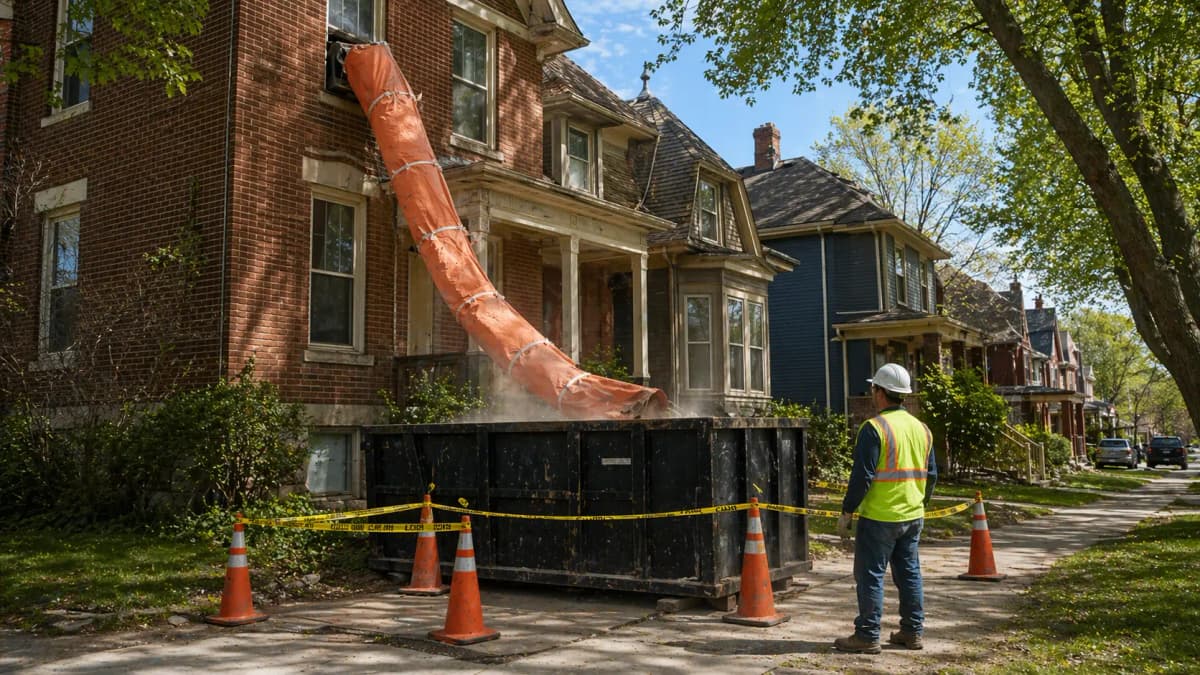
A standard 25ft trash chute section is the entry point for most small to mid-sized renovation and demolition projects. In 2026, a single 25ft section typically ranges from $800 to $1,500 depending on material grade and delivery distance. This price covers the chute itself, hardware, and basic tie-off components.
- Canvas chutes: $800–$1,100 per 25ft section; lighter weight, easier installation, best for temporary projects under 6 weeks.
- Poly chutes: $1,100–$1,500 per 25ft section; more durable, weather-resistant, ideal for longer-term or outdoor deployments.
- Lite-duty poly: $950–$1,250; intermediate durability for moderate-volume debris (residential remodels, interior demo).
The 25ft section setup guide walks through installation on smaller buildings, townhouse rows, and ground-to-roof deployments. Most contractors find that a single 25ft section handles 8–12 tons of debris before requiring takedown and reset, depending on debris density.
50ft and Extended Section Pricing Models
A 50ft modular chute (typically two stacked 25ft sections) ranges from $1,800 to $3,200 in 2026, depending on material and coupling hardware. The per-foot cost is slightly lower at scale, reflecting material and logistics efficiency. Commercial buildings and high-rise demolition projects often require 75ft to 100ft+ configurations, which can exceed $4,500.
- 50ft canvas stack: $1,800–$2,200; best for short-term, single-use projects.
- 50ft poly stack: $2,400–$3,200; preferred for 2–3 month deployments, multi-phase renovations, and weather-prone sites.
- 75ft+ custom rigs: $3,500–$5,500+; typically quotation-based, including custom tie-off points and reinforced couplings.
Pricing for extended sections reflects the cost of additional tie-off anchors, reinforced joints, and increased labor for safe installation. A 50ft section guide details capacity assumptions and stability requirements for taller deployments.
Modular vs. Fixed Chute Systems: Cost Breakdown
Modular systems, like EasyChute’s segmented design, allow you to add or remove sections as the job scope changes. A fixed chute system, by contrast, is custom-fabricated to exact height and capacity, requiring longer lead times and higher upfront engineering costs. In 2026, modular systems cost 15–25% less than fixed alternatives for projects under 6 months.
- Modular upfront: Buy or rent individual 25ft sections; scale up or down weekly; total cost depends on duration and added sections.
- Fixed system upfront: Higher engineering and fabrication cost ($2,500–$6,000) but lower per-day operational cost for very long projects (12+ months).
- Rental hybrid: Rent individual sections month-to-month; ideal for unpredictable timelines or budget constraints.
The modular trash chute cost calculator helps you estimate the total outlay for multi-section deployments. Most contractors find that modular systems save money on projects lasting 4–16 weeks.
Material Choices: Canvas vs. Poly Impact on Total Cost
Material selection is one of the most direct drivers of chute cost and long-term value. Canvas chutes are lighter, cheaper, and faster to install, but poly chutes last longer and withstand weather, impact, and repeated use. For budget-conscious contractors, canvas makes sense on short jobs; for build-and-hold operators, poly is the better investment.
- Canvas pricing: 20–30% lower initial cost; lifespan of 1–2 years with proper storage and maintenance.
- Poly pricing: 20–30% higher upfront; lifespan of 3–5 years; repairs and replacements are easier due to patching kits.
- Hybrid approach: Buy one durable poly chute; use it across multiple projects; amortize the cost over 4–5 years and multiple deployments.
For a detailed cost-benefit analysis, review the canvas vs. poly materials comparison. Most mid-size contractors own one heavy-duty poly chute and rent canvas sections for peak-season jobs.
Labor Installation Costs by Section Complexity
Installation labor is a separate line item often overlooked in initial bids. A simple 25ft section on a residential renovation may require 2–3 hours of labor; a 75ft multi-section rig on a commercial building can take 8–12 hours, including tie-offs, stabilization, and safety inspections. In 2026, installation labor ranges from $300 to $800 depending on site complexity and local wage rates.
- Residential single section: 2–3 hours, $300–$450 labor cost.
- Multi-story two-section installation: 4–6 hours, $500–$700 labor cost.
- High-rise or confined spaces: 10–16 hours (including safety rigging), $1,000–$1,600 labor cost.
- Takedown and reset: Add 1–2 hours and $200–$400 to budget for mid-project repositioning.
Labor costs vary by location and union requirements. Always confirm your local prevailing-wage rates before finalizing a project bid.
Hidden Costs Contractors Often Miss
Beyond the chute purchase and installation labor, several costs sneak up on unprepared contractors. Tie-off hardware, safety inspections, landfill tipping fees, and temporary anchoring improvements can add $500–$1,500 to a project budget. Understanding these upfront prevents scope creep and budget overruns.
- Tie-off hardware: Anchors, chains, bolts, and connectors; typically $150–$400 per site.
- Landfill and disposal: Tipping fees vary by debris type and local facility; expect $25–$75 per ton.
- Temporary structural supports: If the building lacks adequate anchor points, steel brackets or temporary posts may be required; $300–$800.
- Safety inspections and permits: Local codes may require third-party inspection; $200–$600.
- Weather protection or wind screens: In exposed or high-wind areas, additional bracing or barriers; $400–$1,000.
- Insurance rider: Some policies require a debris chute hazard endorsement; typically $100–$250 per project.
Review the renovation debris chute cost estimate checklist to ensure you capture every line item before sending a proposal.
Capacity Scaling and Multi-Section Pricing
A key advantage of modular systems is the ability to scale capacity without paying for a larger fixed chute. Capacity grows linearly as you stack sections—each 25ft section adds roughly 8–12 tons of usable capacity depending on debris type. For high-volume projects, scaling is cheaper than renting or purchasing multiple smaller chutes.
- One 25ft section: ~8–12 tons capacity; suitable for single-family homes, small demo.
- Two 25ft sections (50ft): ~16–24 tons capacity; multi-story residential or small commercial.
- Three 25ft sections (75ft): ~24–36 tons capacity; large commercial renovation or partial demo.
- Four+ sections (100ft+): 32+ tons capacity; full high-rise demolition or multi-building projects.
Use the trash chute capacity calculator to estimate how many sections you’ll need based on project scope. Oversizing by one section is often cheaper than renting or repositioning mid-project.
ROI and Cost-Per-Square-Foot Analysis
To justify chute investment or rental to clients, calculate cost per square foot of renovation or demo area. A typical formula: (chute rental or purchase cost + installation + disposal) ÷ (project square footage) = cost per sq. ft. for debris management. In 2026, this ranges from $0.15 to $0.75 per square foot depending on project type.
- Small residential remodel (1,000–5,000 sq. ft.): $0.30–$0.50 per sq. ft. for chute cost.
- Mid-size commercial (10,000–50,000 sq. ft.): $0.20–$0.35 per sq. ft.
- Large demolition (50,000+ sq. ft.): $0.15–$0.25 per sq. ft. due to economies of scale.
Compare this to alternative debris removal (dumpster rentals, hand-hauling labor). Chutes often outperform alternatives on tall buildings because they reduce manual labor and site congestion. Modular chutes offer the best ROI for contractors with recurring projects, as the cost is amortized across multiple jobs.
Budget Planning Checklist for 2026 Projects
Use this checklist to lock down chute costs before you bid a project:
- Determine total building height or debris drop distance.
- Estimate debris volume and density (light demolition, heavy concrete, mixed).
- Choose section size(s): 25ft, 50ft, 75ft, or custom.
- Select material: canvas, lite-duty poly, or heavy-duty poly.
- Verify local tie-off anchor availability or budget for temporary supports.
- Confirm landfill tipping fees with your disposal contractor.
- Add labor hours for installation, mid-project reset, and takedown.
- Budget for permits, inspections, and insurance riders.
- Calculate rental vs. purchase break-even (typically 3–4 months of rental = purchase cost).
- Include a 10–15% contingency for weather delays, debris-type changes, or extended timelines.
The cost estimate checklist provides a detailed template you can adapt for each project.
Financing and Rental vs. Purchase Decisions
In 2026, contractors have three main paths: buy a permanent chute, rent for a single project, or use a hybrid approach. Buy-vs.-rent analysis depends on your project frequency and capital availability.
- Purchase: $1,200–$2,000 for a 25ft section; best if you deploy it 3+ times per year.
- Rent (weekly): $200–$350 per week per section; good for one-off projects or seasonal use.
- Rent (monthly): $600–$1,000 per month per section; breakeven occurs around month 2–3 of a purchase.
- Lease-to-own: Some providers offer 12–24 month leases that credit 50% of payments toward eventual purchase.
For recurring contractors, ownership is usually cheaper long-term. For seasonal or specialty work, debris chute rental preserves cash and eliminates storage liability.
Frequently Asked Questions
How much does a basic 25ft trash chute cost in 2026?
A standard 25ft trash chute costs $800–$1,500 depending on material. Canvas chutes run $800–$1,100; poly chutes $1,100–$1,500. Additional costs for installation labor ($300–$450), tie-off hardware, and permits can add $500–$800. Total for a ready-to-deploy system: typically $1,600–$2,700.
What is the price difference between canvas and poly chutes?
Canvas chutes are 20–30% cheaper upfront ($800–$1,100 per 25ft) but last 1–2 years. Poly chutes cost 20–30% more ($1,100–$1,500) but last 3–5 years. If you deploy frequently, poly’s longer lifespan and durability yield better ROI. For one-time projects, canvas saves money.
Do I need additional tie-off hardware, and how much does it cost?
Yes. Tie-off hardware (anchors, chains, bolts, connectors) typically costs $150–$400 per site. If your building lacks existing anchor points, budget for temporary steel brackets or posts ($300–$800). Always verify local building codes; some jurisdictions require certified rigging inspections ($200–$600).
How do modular sections compare to fixed chutes on price?
Modular systems cost 15–25% less than fixed chutes for projects under 6 months because you buy or rent exactly what you need and scale up incrementally. Fixed chutes have higher upfront engineering costs ($2,500–$6,000) but lower per-day costs for very long projects (12+ months). Most contractors prefer modular for flexibility.
What is the cost-per-square-foot for using a trash chute on my project?
Typical cost ranges from $0.15–$0.75 per square foot of project area, depending on building height, debris type, and location. Residential remodels (1,000–5,000 sq. ft.) average $0.30–$0.50 per sq. ft.; large commercial or demolition projects benefit from economies of scale and drop to $0.15–$0.25 per sq. ft. Use the capacity calculator to refine your estimate.
Is it cheaper to rent or buy a trash chute?
Rent if the project is under 3 months or you only do 1–2 projects per year. Weekly rental is $200–$350 per section; monthly is $600–$1,000. A 25ft section purchase costs $1,200–$2,000, so rental breaks even after 3–4 months of continuous use. For contractors with regular work, buying and amortizing across multiple projects usually costs less.
What hidden costs should I budget for besides the chute itself?
Plan for: tie-off hardware ($150–$400), landfill tipping fees ($25–$75 per ton), temporary structural supports ($300–$800), safety inspections ($200–$600), weather protection if needed ($400–$1,000), and insurance riders ($100–$250). These can total $500–$1,500 and are often overlooked in initial bids. Use the cost estimate checklist to capture every line.
Get Started with EasyChute Pricing
Understanding trash chute costs by section size empowers you to bid accurately, manage project budgets, and communicate value to clients. Whether you’re a first-time contractor evaluating your first chute or an experienced operator scaling a fleet, the key is matching section size to project scope and choosing the right material and financing model for your workflow.
Start with our modular trash chute cost calculator to estimate total outlay for your next project. Then cross-reference with the trash chute sections guide to confirm capacity and any debris chute mistakes to avoid.
For compliance and safety, review OSHA construction safety standards and consult EPA construction and demolition debris facts to ensure proper waste classification and disposal. Safe debris management starts with the right equipment—and the right size for the job.
Contact EasyChute today for a site-specific quote, debris chute rental terms, or to discuss the best section configuration for your project. We’re here to help you bid confidently and deploy on time.