

Index
- Upfront Cost Breakdown: Canvas vs. Poly
- Material Properties & Performance
- Durability & Longevity: Which Lasts Longer?
- Maintenance & Operating Costs Over Time
- Environmental Impact & Recyclability
- Real-World ROI: Project-Based Scenarios
- How Material Choice Affects Contractor Workflow
- Weather & Site Conditions: Material Performance
- Resale & Rental Value in 2026
- Choosing Your Material: A Decision Framework
- Frequently Asked Questions
- Get Started with the Right Chute
Upfront Cost Breakdown: Canvas vs. Poly
The headline difference between canvas and poly chutes in 2026 comes down to initial purchase price. Canvas chutes typically cost 30–40% less at point of sale, making them the default choice for price-conscious contractors on tight single-project budgets. A standard 25-foot canvas chute system runs $800–$1,200 delivered, while equivalent poly systems range from $1,400–$1,900.
However, raw material cost tells only half the story. You must account for ancillary expenses:
- Fastening hardware: Canvas requires more frequent tie-off reinforcement and replacement hardware; poly systems often ship with longer-life stainless fasteners.
- Protective covers: Canvas degrades in UV exposure and moisture, so contractors often buy weather tarps ($150–$300) to extend canvas life.
- Repair kits: Canvas patches and adhesive kits ($50–$100 per project) are common consumables; poly systems rarely need mid-project repairs.
- Freight & handling: Canvas is lighter but bulkier; poly is denser and more compact in storage, sometimes reducing freight cost on bundled orders.
For a single 3-week residential project, canvas wins on cash-on-hand. For contractors running 8–12 projects per year, the true cost picture shifts dramatically.
Material Properties & Performance
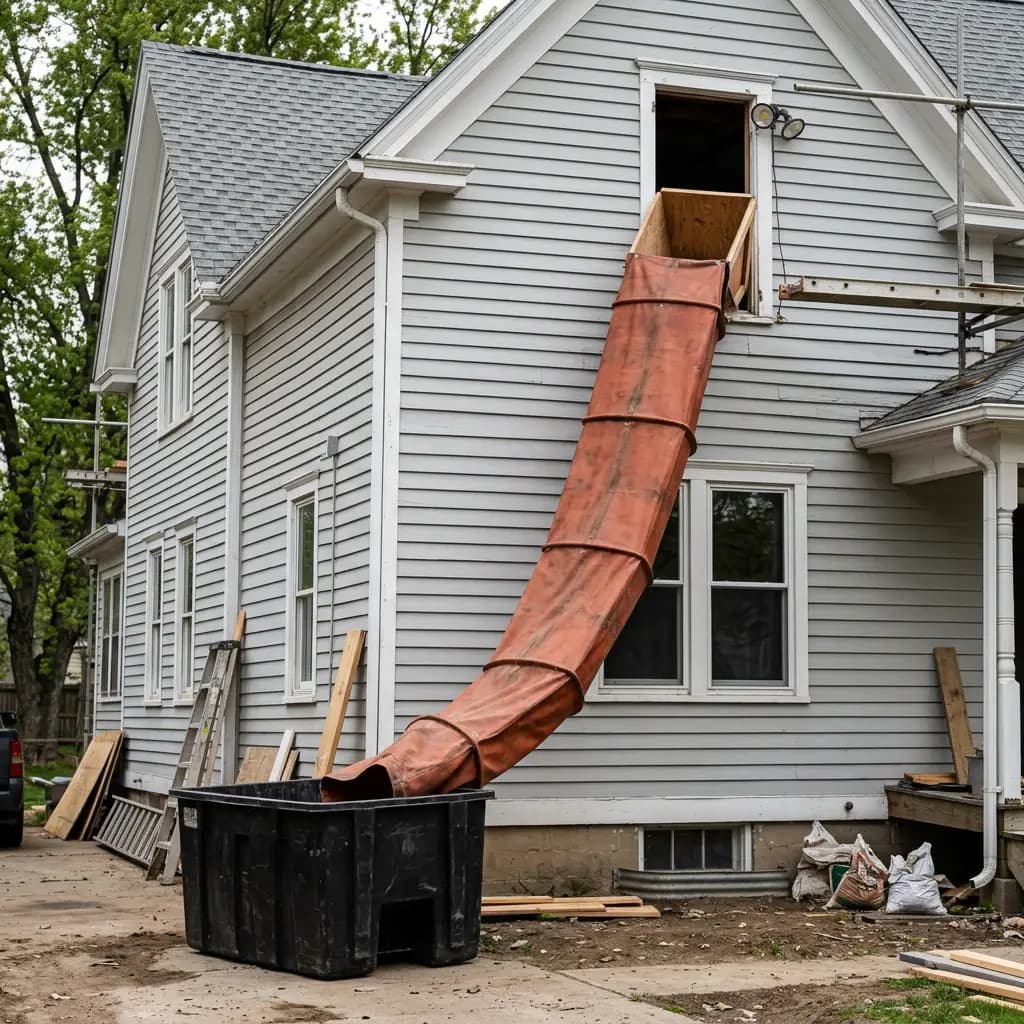
Canvas is woven natural or synthetic fiber—typically cotton-poly blends or pure canvas—treated with water-resistant coatings. Poly (polyethylene or reinforced polypropylene) is an engineered plastic with inherent moisture resistance and greater tear strength.
Canvas strengths:
- Lower upfront cost
- Easier to patch on-site with basic tools
- Lighter weight for manual positioning
- Quieter operation (less noise deflection)
Canvas weaknesses:
- Absorbs moisture and mold risk in damp conditions
- UV degradation (loses tensile strength in 2–4 seasons of outdoor storage)
- Coating wears away, reducing water-repellency
- Seams are vulnerable; stitching can rot
Poly strengths:
- Inherent moisture and UV resistance (certified materials last 5–7 years outdoors)
- No seam rot; welded/heat-fused joints
- Consistent flow characteristics (lower friction = faster debris descent)
- Color-coded for safety; bright orange meets OSHA visibility standards
Poly weaknesses:
- Higher upfront cost
- Harder to repair mid-project (requires heat tools or adhesive designed for plastic)
- Can become brittle in extreme cold (below 0°F) or degrade faster in intense UV zones (desert Southwest)
Durability & Longevity: Which Lasts Longer?
In controlled warehouse storage, canvas and poly can both last 10+ years. In field conditions—the reality for most contractor-owned equipment—the gap widens.
Canvas lifespan in field conditions:
- 2–3 seasons (6–9 months active use per year) with basic protective storage
- 1–2 seasons if exposed to full sun or stored in damp conditions
- Coating failure often occurs by year 2, leading to seam breakdown
Poly lifespan in field conditions:
- 5–7 seasons (4–5 years active + storage) with standard care
- Can extend to 8–10 years if stored indoors during winter or in climates with moderate UV
- End-of-life typically occurs from small punctures or age-related creep, not coating failure
A contractor who owns equipment and runs 10 projects per year will replace a canvas system 2–3 times during the span a poly system lasts. This is where total cost of ownership inverts the upfront advantage.
Maintenance & Operating Costs Over Time
Canvas requires proactive seasonal maintenance. Poly is more forgiving but still needs care.
Canvas maintenance routine (per season):
- Inspect seams and stitching for rot or separation.
- Apply UV-protective coating ($30–$60 per application) every 12 months.
- Clean debris residue to prevent mold; allow full air-dry before storage.
- Store in cool, dry location; damp storage accelerates decay.
- Budget for seam repair kits ($50–$150) every 1–2 seasons.
Canvas maintenance cost: $150–$400 per year (excluding labor).
Poly maintenance routine (per season):
- Rinse with water to remove construction dust and debris.
- Inspect for punctures or creasing; store flat or loosely coiled.
- No coating reapplication needed; UV protection is built-in.
- Store indoors or under cover; prolonged outdoor UV will eventually degrade, but slower than canvas.
Poly maintenance cost: $0–$80 per year (cleaning supplies only).
Over a 5-year lifespan, canvas accumulates $750–$2,000 in maintenance spend; poly accumulates $0–$400. When you factor in the likelihood of an emergency mid-project repair (canvas), the real-world gap is even wider.
Environmental Impact & Recyclability
Both materials have environmental footprints, but they diverge at end-of-life.
Canvas (natural/cotton-poly blend) is biodegradable if untreated, but most commercial canvas is coated with synthetics that slow decomposition. Recycling options are limited; most canvas chutes end up in landfill. However, natural-fiber canvas has a lower embodied-carbon footprint during manufacturing compared to petroleum-based poly.
Poly (polyethylene/polypropylene) is petroleum-derived and slower to biodegrade, but it is recyclable into pellets for secondary products. Major manufacturers now offer take-back programs; EPA construction and demolition debris data show a growing trend toward material recovery in the waste stream. Some contractors donate worn poly chutes to resale platforms; canvas typically cannot command resale value after 2–3 years of field use.
From an operational sustainability lens, a poly chute that lasts 5–7 years generates fewer replacement units and thus a smaller cumulative waste footprint than 2–3 canvas replacements in the same period.
Real-World ROI: Project-Based Scenarios
Let’s model total cost of ownership across three contractor profiles:
Scenario 1: Single-Project Contractor (1 project, 3 weeks)
- Canvas: $1,000 upfront + $50 protective cover + $0 maintenance (short duration) = $1,050 total
- Poly: $1,600 upfront + $0 cover + $0 maintenance (short duration) = $1,600 total
- ROI winner: Canvas (saves $550). Contractor can resell canvas for $100–$200 after project, netting $850–$950 true cost.
Scenario 2: Medium-Volume Contractor (6 projects/year, 3-year window)
- Canvas: Initial $1,000 + 3 replacement cycles ($1,000 each) + 3 years maintenance ($300/yr) = $4,900 total
- Poly: Initial $1,600 + 0 replacements (still in service) + 3 years maintenance ($40/yr) = $1,720 total
- ROI winner: Poly (saves $3,180). Poly chute retains $500–$800 resale value at year 3.
Scenario 3: High-Volume Contractor (12 projects/year, 5-year window)
- Canvas: Initial $1,000 + 5 replacement cycles ($1,000 each) + 5 years maintenance ($300/yr) = $7,500 total
- Poly: Initial $1,600 + 1 replacement (year 5) at $1,600 + 5 years maintenance ($40/yr) = $3,400 total
- ROI winner: Poly (saves $4,100). Both systems have nearing end-of-life resale value by year 5.
The breakeven point occurs around project 4–5 for most contractors. If you operate fewer than 4 projects annually, canvas may remain cost-effective; if you run 5+, poly typically wins on total cost.
How Material Choice Affects Contractor Workflow
Beyond dollars, material choice impacts your operational efficiency.
Canvas workflow friction:
- Setup time increases if you inspect seams before each deployment (recommended).
- If a seam fails mid-project, you must halt debris disposal, apply emergency patch, and allow adhesive cure time (4–8 hours).
- Worker confidence may drop if visible wear is evident; client perception of professionalism can suffer.
- Storage logistics: damp conditions during winter storage lead to spring surprise mold and coating breakdown.
Poly workflow advantage:
- Setup is faster; no pre-deployment inspection needed (poly defects are obvious).
- Mid-project failure is rare; if a small puncture occurs, it can often be taped and ignored until season-end.
- Worker confidence is higher; bright orange and professional appearance boost job-site credibility.
- Storage is simpler; poly tolerates garage, warehouse, or outdoor shed conditions without degradation.
Contractors on tight schedules or those managing client perception premium pay for poly’s reliability. Those focused purely on material cost and with stable indoor storage may stick with canvas.
Weather & Site Conditions: Material Performance
Regional climate and site exposure dramatically shift the equation.
Canvas performs worse in:
- High-humidity regions (Southeast, Pacific Northwest): mold and seam rot accelerate within 1 season.
- Intense UV zones (Southwest desert, high-altitude): coating fails within 2 seasons; tensile strength drops 50%+ by year 3.
- Cold climates with spring thaw: freeze-thaw cycles crack coatings and weaken stitching.
- Rainy project sites: prolonged moisture exposure during active use; canvas can develop odor and mildew within weeks if not fully dried between uses.
Poly performs better in:
- All climate zones; material properties are consistent regardless of humidity.
- High-UV environments: certified poly formulations include UV inhibitors and remain serviceable for 5+ years in Southwest conditions.
- Cold climates: poly stays flexible down to 0°F; canvas becomes brittle and prone to cracking.
- Extended rainy periods: poly sheds water and dries quickly; no mildew or odor risk.
A contractor in Florida, Oregon, or Arizona gains outsized advantage from poly. A contractor in mild, dry climates (e.g., inland California foothills, parts of the Mountain West) may find canvas acceptable if stored carefully.
Resale & Rental Value in 2026
The secondary market for chutes is growing as contractors seek to reduce equipment ownership burden.
Canvas resale:
- Year 1: 20–30% of original cost (buyer assumes high maintenance risk).
- Year 2+: <10% or unsaleable; potential buyers see cost of restoration exceeding used price.
- Rental market: Almost nonexistent; rental companies avoid canvas due to repair liability and storage challenges.
Poly resale:
- Year 1–2: 50–60% of original cost; steady demand from contractors re-entering the market or scaling up.
- Year 3–4: 30–40% of original cost; still functional and preferred by buyers over new canvas at a discount.
- Rental market: Growing; short-term rental platforms and equipment-leasing companies now offer poly chutes at $200–$400/month, making ownership less necessary for occasional-use contractors.
If you plan to own equipment for 3–5 years and then sell, poly retains tangible residual value. This hidden income stream can offset $400–$600 of the upfront cost premium over the chute’s life.
Choosing Your Material: A Decision Framework
Use this decision tree to align material choice with your business model:
Choose canvas if:
- You run 1–3 projects per year (lowest total cost over project lifespan).
- You operate in mild, dry climates and have secure indoor winter storage.
- You have capital constraints and must minimize upfront spend.
- You resell or donate equipment after each project (avoid long-term maintenance burden).
Choose poly if:
- You run 5+ projects per year (breakeven point where poly cost advantage compounds).
- You operate in humid, high-UV, or cold climates where canvas degrades rapidly.
- You value workflow efficiency and want to minimize mid-project repairs.
- You plan to own equipment for 3+ years and benefit from resale or rental income.
- You want to offer clients a more professional, visible-safety appearance (bright orange color and no visible wear).
Most established contractors with multiple crews and regular project pipelines choose poly. Solo operators and first-time contractors often start with canvas and upgrade to poly once volume justifies it.
For detailed guidance on your specific setup, explore our poly debris chute options, or review the renovation debris chute cost estimate checklist to model your exact spending patterns.
Frequently Asked Questions
Can I switch between canvas and poly chutes mid-project?
Yes, but not without friction. Chutes are designed as modular systems with standard connector hardware, so a poly chute can be retrofitted in place of canvas if your initial choice fails. However, you’ll lose time, require a delivery, and may incur rush fees. Most contractors avoid this scenario by choosing their material upfront based on project length and site conditions. If in doubt, first-time contractors should consult with your equipment provider before the job starts.
Do poly chutes meet OSHA construction safety standards?
Yes. Both canvas and poly chutes, when installed correctly, comply with OSHA construction safety standards. The material itself is not a regulatory factor; proper anchoring, slope angle, and debris containment are. Poly’s bright orange color and consistent appearance meet OSHA visibility requirements better than weathered canvas. Always confirm your chute setup with your safety manager or local building department.
What is the typical weight capacity difference between canvas and poly?
When new, canvas and poly chutes of equivalent diameter have nearly identical design weight capacities (typically 500–2,000 lbs per section depending on design). However, canvas capacity degrades as coatings wear and seams weaken. After 1–2 seasons, canvas may lose 20–30% of rated capacity due to material fatigue. Poly retains rated capacity throughout its service life. For mission-critical projects, consult the weight capacity guide early.
Is it cheaper to rent a chute than buy one?
For single-project contractors, rental is often cheaper ($250–$500 for a 3-week project) than buying canvas or poly. For contractors running 4+ projects per year, ownership breaks even. Rental also eliminates storage and maintenance burden. Many contractors in 2026 adopt a hybrid model: rent for seasonal or one-off jobs, own poly for recurring work. Compare local rental rates against your annual project volume to decide.
How do I dispose of or recycle a worn-out chute?
Canvas chutes typically go to landfill unless your local waste facility has a scrap-textile program. Poly chutes can be recycled into resin pellets through specialty recyclers or collected by manufacturer take-back programs. Many equipment dealers accept used poly chutes as trade-in credit toward new purchases. Check EPA recycling overview for regional options. Resale platforms (used-equipment marketplaces) are growing; a serviceable poly chute from years 1–3 often finds a buyer before disposal becomes necessary.
Can canvas chutes be upgraded to poly components?
Generally no. Canvas and poly use different joinery and fastening designs optimized for each material’s flex and stress patterns. Mixing materials mid-system can create leak points and uneven descent. A worn canvas chute is typically replaced in full rather than retrofitted. If you own canvas and want to transition to poly, plan for a complete system replacement, though you may recover some resale value from the old chute.
What is the learning curve for maintaining each material?
Canvas requires active knowledge: seam inspection, coating reapplication techniques, moisture management. A contractor new to canvas should budget 2–3 projects to develop proficiency and avoid expensive mid-project failures. Poly is more forgiving; the learning curve is 1 project. This is another hidden advantage for contractors juggling multiple jobs: poly’s lower maintenance literacy reduces training burden on crews.
Get Started with the Right Chute
Your choice of canvas vs. poly is not a trivial decision—it cascades through procurement, operations, resale, and environmental impact. By anchoring your decision in your annual project volume, climate zone, and storage capacity, you can confidently select the material that aligns with your bottom line.
If you’re ready to dive deeper into chute specifications, review our debris chute installation guide for setup best practices, or explore buying options online and connect with our team to confirm the right fit for your next project.
High-volume contractors often benefit from maintenance and cleaning tips to extend poly chute service life. For construction debris chute systems and comprehensive chute sizing, we’re here to help you plan every phase.
Contact EasyChute at +1 (855) 902-4883 or email ordering@easychute.com to discuss your material choice and get a personalized cost estimate for your 2026 projects.