

The phrase kitchen counter trash chute gets searched for two very different reasons. The first group of searchers wants a built-in countertop trash drop — the kind you cut into a kitchen island or cabinet so you can sweep crumbs and scraps straight into a bin below. The second group are contractors, remodelers, and junk removal crews who are working on a kitchen — gut-renovating it, tearing out old cabinets, replacing countertops — and need a debris chute to move construction waste from an upper floor down to a dumpster. This guide covers both, clearly separates them, and explains exactly which solution fits your situation so you don't waste time or money on the wrong product.
What "Kitchen Counter Trash Chute" Actually Means
It's a phrase that spans two completely different product categories, and confusing them is easy because the words overlap. Here's the clearest breakdown:
- Built-in countertop trash chute: A fixture installed into a countertop or kitchen island. You slide or cut a hole in the surface, drop a chute sleeve into it, and debris falls into a bin or bag in the cabinet below. These are consumer kitchen accessories — common in high-end homes, restaurants, and catering facilities.
- Construction debris chute for kitchen work: A large-diameter fabric or plastic chute that hangs from a window or scaffold opening and channels construction debris — demo tile, drywall chunks, cabinet remnants, old countertops — down multiple floors into a dumpster. These are job-site tools used by contractors and junk removal crews.
If you are remodeling or demolishing a kitchen on the second floor or higher, you need the second type. If you are doing finish work and want a convenient waste drop for cooking scraps, you want the first type. The rest of this guide will help you understand both deeply, with particular attention to the construction side — where the right chute can save hours of labor and prevent serious job-site injuries.
Built-In Countertop Trash Chutes: How They Work
A built-in countertop trash chute is a residential or commercial kitchen accessory designed for convenience and cleanliness. Understanding the basic mechanics helps you decide whether one is worth including in a kitchen remodel scope.
Core Components of a Countertop Trash Drop
- Lid or flap: A hinged cover that sits flush with the countertop surface. You push or lift it to open the drop.
- Chute sleeve: A short tube — typically 4 to 8 inches in diameter — that connects the countertop opening to the cabinet interior below.
- Bin or liner: A removable trash bin, pull-out drawer liner, or bag holder positioned directly beneath the chute inside the cabinet.
- Surround trim ring: A decorative collar — often stainless steel — that finishes the countertop cutout and prevents moisture from seeping into the cabinet.
Installation Basics for Countertop Chutes
Most countertop trash chutes are designed for DIY or finish-carpenter installation. The process typically involves cutting a round or rectangular hole in the countertop to the manufacturer's template dimensions, dropping in the sleeve and trim ring, and securing a bin underneath. On solid-surface materials like quartz or granite, you'll want a diamond hole saw and professional stone fabrication — an amateur cut on a stone countertop can crack the slab.
For laminate, butcher block, or wood countertops, the cut is straightforward with a jigsaw. The main considerations are cabinet depth (you need enough clearance for the bin), the countertop material (some require professional cutting), and whether you want a manual lid or a touch-open mechanism.
Who Actually Needs a Kitchen Counter Trash Chute Built In
Built-in countertop trash drops are genuinely useful in a narrow set of scenarios. Before speccing one into a renovation, consider whether the use case matches your client's or your own daily habits.
High-Volume Cooking Environments
Restaurant prep kitchens, catering facilities, and commercial cooking operations benefit most from countertop waste drops. When a prep cook is peeling 50 pounds of potatoes, reaching across the counter to a trash bin repeatedly adds up to meaningful labor friction. A countertop chute drops directly to a large waste receptacle below the station and keeps the counter clear.
Large Residential Kitchens with Islands
In a home kitchen with a large island used for active food prep, a countertop trash chute can eliminate the "walk to the bin" habit. The convenience factor is real. That said, most kitchen designers note that countertop real estate is precious, and the hole represents lost prep surface — so placement matters enormously.
Accessibility-Focused Designs
For homeowners with limited mobility, a countertop trash drop positioned at exactly the right height can reduce the need to reach, bend, or reposition to access a traditional bin. It's worth discussing with an occupational therapist if you're doing an accessibility-focused kitchen remodel.
Construction Debris Chutes for Kitchen Renovation Work
Now let's shift to the scenario that affects most contractors who land on this topic: you're doing a kitchen gut renovation, countertop replacement, cabinet demo, or full kitchen remodel on an upper floor, and you need to move construction debris down to street level safely and efficiently. A debris chute is the professional solution — and it's the product category where EasyChute operates.
Kitchen renovation debris is heavy, awkward, and high-volume. Old granite countertops can weigh 400 to 600 pounds for a standard kitchen. Cabinet runs generate dozens of cubic feet of wood, hardware, and drywall. If you're on the second, third, or fourth floor of a residential or multi-unit building, hand-carrying that material down stairs is slow, exhausting, and a genuine injury risk. OSHA ergonomics guidance consistently identifies repetitive heavy lifting as a leading cause of musculoskeletal injury on construction sites — and stair-carrying demo debris is exactly that pattern.
Why Contractors Use Chutes During Kitchen Demos
- Speed: A debris chute lets one person at the top feed material while another person stages the dumpster below. The round-trip stair carry is eliminated entirely.
- Safety: Carrying heavy, awkward pieces down stairs in work boots, with limited visibility, is a fall hazard. The chute keeps workers on stable surfaces.
- Building protection: Carrying demo debris through a client's hallways, stairwells, and common areas risks damaging walls, railings, and floors. A chute from a window or scaffold opening bypasses the building interior entirely.
- Neighbor and property management relations: In multi-unit buildings, a chute feeding a covered dumpster reduces dust, noise from dropped debris, and foot traffic through shared spaces.
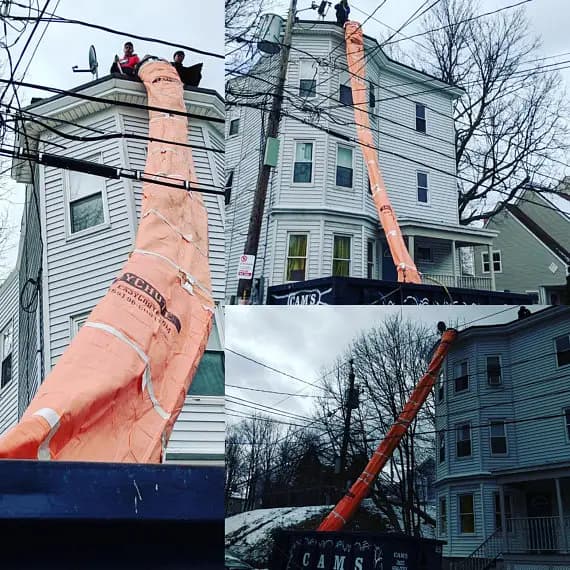
How EasyChute's Fabric Debris Chute Works on a Kitchen Job
EasyChute makes lightweight, reusable fabric trash chutes from woven, coated poly fabric — the same kind of material used for heavy-duty tarps and construction barriers, but engineered into a continuous debris channel. Here's how the system works on a typical kitchen renovation job:
Section Sizing and Configuration
EasyChute sections come in 10-foot, 25-foot, and 50-foot lengths. For a second-floor kitchen job, a single 10-foot section typically reaches from a window opening down to dumpster level — especially for first-floor dumpster placement or a street-level roll-off. For a third or fourth floor, you connect sections with a 1.5-foot overlap, essentially stacking as much length as the job requires.
- 10 ft lite-duty: Light demo debris, drywall scraps, cabinet interiors, light tile.
- 10 ft heavy-duty: Dense materials — countertop sections, thick tile, chunks of concrete backerboard.
- 25 ft and 50 ft sections: Multi-story runs, scaffold-based setups, tall commercial buildings.
Hanging the Chute
The top of each EasyChute section has four woven loops. You attach these loops to any anchor point at the window or scaffold opening using standard carabiners or quick-connect clips — no special tools, no drilling, no hardware installation. A single person can hang the chute in minutes. For a detailed walkthrough of the setup process, see our step-by-step installation guide.
Feeding Debris and Directing the Drop
Once hung, debris goes in the top — either directly tossed in, or fed through a window opening using a shovel or by hand for larger pieces. The chute's diameter and coated interior allow material to move freely down to the dumpster without jamming, provided you're managing piece size (more on that below). The bottom of the chute directs directly into the dumpster opening, so dust and debris land where you want them, not on the sidewalk or neighboring property.
What Kitchen Renovation Debris Can (and Can't) Go Down a Fabric Chute
Not everything from a kitchen demo should go into a debris chute — knowing the limits keeps the system running fast and prevents clogs or damage.
Works Well in a Chute
- Drywall pieces and dust (break large sheets into sections first)
- Cabinet doors, drawer fronts, and face frames (remove hardware that could snag)
- Ceramic and porcelain tile from backsplashes and floors
- Light framing lumber and furring strips
- Insulation batts and blown-in material (bag it first to prevent dust spread)
- Packing material, cardboard, and light packaging
- Countertop laminate and thin materials
Requires Care or Shouldn't Go Down the Chute
- Large granite or quartz slabs: These need to be broken into manageable sections before feeding. A full slab dropped from height can generate extreme impact force.
- Sharp metal: Sheet metal edges, old appliance scraps, or exposed fasteners can tear fabric chute walls — wrap or bundle these before dropping.
- Appliances: Old refrigerators, ranges, and dishwashers don't go down chutes. Appliance removal is a separate operation using dollies, hand trucks, and stair-climbing equipment.
- Hazardous materials: Old popcorn ceilings containing asbestos, lead paint chips, and similar regulated materials have specific disposal requirements. Consult EPA construction and demolition debris guidelines before handling or disposing of suspect materials.
Comparing Hand-Carrying Versus Using a Debris Chute for Kitchen Jobs
The productivity math on debris chutes is straightforward once you run the numbers on a real kitchen job. Here's a realistic comparison for a second-floor kitchen gut demo generating roughly 2,000 pounds of debris:
- Hand-carry method: Two workers, 60 to 80 trips down a flight of stairs with loads of 25 to 35 pounds each. At 4 to 5 minutes per round trip (load, carry down, dump, return), that's 4 to 7 person-hours of stair-carry time alone — before accounting for fatigue, slip risk, and wall damage.
- Chute method: One worker feeds the chute from above, one worker stages and monitors below. Setup takes 15 minutes. The same 2,000 pounds of debris moves in 60 to 90 minutes of active chute operation. Total: under 2 person-hours including setup and strike.
The time savings compound on larger jobs and taller buildings. For a third-floor kitchen in a walk-up apartment building in a dense urban neighborhood, the chute difference is even more dramatic — and the alternative (carrying through a shared stairwell) may not even be acceptable to the building owner. See how contractors handle exactly these scenarios in our construction chute guide.
Choosing the Right EasyChute Section Length for Your Kitchen Job
Selecting the right chute length is simple once you know your floor height and dumpster placement. Here's a practical decision framework:
Measure Your Drop Distance First
Stand at the window or opening where you'll hang the chute. Measure — or estimate — the vertical distance from the bottom of the window frame to the top of the dumpster opening or the ground where debris will land. That measurement, plus a few feet for the entry angle, is your minimum chute length.
- First-floor window to grade: Usually 8 to 12 feet — a single 10-foot section typically works.
- Second-floor window: Usually 14 to 20 feet — a 25-foot section or two 10-foot sections connected.
- Third floor and above: 25 to 35 feet or more — plan 25-foot or 50-foot sections, or connect multiples.
Account for Dumpster Placement
If the dumpster is directly below the window, your chute can run nearly vertical and the measurement is simple. If the dumpster is offset — back from the building, in an alley, or on a slope — you may need additional length to reach it at the angle the chute will hang. Add 20 to 30 percent extra length when in doubt. It's easier to have a little extra reach than to come up short mid-job.
Reusability and Cost Efficiency Over Multiple Kitchen Jobs
One of the most practical advantages of EasyChute's fabric design is reusability. Unlike single-use cardboard or thin plastic chutes, the coated poly fabric is designed to handle job after job. A contractor who does kitchen renovations regularly — even just four or five per year — recovers the cost of the chute quickly compared to renting rigid scaffolding chute systems or paying day laborers for stair carries.
The portability factor matters here too. A 10-foot EasyChute section weighs under 3 pounds and folds into a compact box that fits in a pickup bed, cargo van, or even a job site backpack. That means your crew can carry the chute to any job — urban apartments, suburban split-levels, row houses, commercial spaces — without a truck dedicated to equipment transport. For more on how the economics of fabric chutes compare to alternatives, see our guide to canvas trash chutes.
Job-Site Safety Considerations When Chuting Kitchen Debris
Running a debris chute safely isn't complicated, but there are a handful of non-negotiable practices that protect your crew, the building, and anyone on the ground below.
Ground-Level Exclusion Zone
Never allow foot traffic beneath or near a running debris chute. Mark off the drop zone with cones, tape, or temporary fencing. Assign one crew member to monitor the base of the chute and keep the area clear. This is especially important in urban settings where pedestrians may walk close to the building. OSHA construction safety standards require that falling object hazards be controlled — a marked exclusion zone and covered dumpster are your primary controls.
Secure the Anchor Points
Before feeding any debris, verify that every carabiner or clip is locked and that the anchor points (window frame, scaffold rail, or beam) can handle the dynamic load of debris moving through the chute. For heavy materials — tile, countertop pieces — the impact of large chunks hitting the chute wall generates lateral load. Test the system with a small load before full operation.
Keep the Feed Opening Clear of People Below
The worker feeding the chute should never lean over the opening while debris is being fed from below by a second person. Establish a clear communication protocol — a simple call-and-response system — before starting. This prevents debris from coming back up or the feeder from being struck by material that bounces.
Break Down Large Countertop Sections Before Dropping
Granite and quartz countertops can be scored and broken into manageable sections using a diamond blade grinder. Feed pieces that fit cleanly into the chute mouth rather than forcing oversized sections that could jam, tear the fabric, or generate uncontrolled impact at the bottom. For a detailed look at how demolition chutes handle dense materials, that guide walks through the right sequencing for mixed-material demo jobs.
Urban Kitchen Remodels: Neighborhoods Where Chutes Are Essential
In dense urban markets, the debris chute shifts from a convenience to a near-necessity. Buildings with no freight elevator, narrow staircases, shared common areas, and strict building management rules make hand-carry debris removal nearly impossible without damaging the building or violating management rules.
Contractors doing kitchen renovations in markets like Brooklyn brownstones, Lower Manhattan high-rises, and Greenpoint walk-ups routinely specify debris chutes as standard scope on any multi-floor job. The chute doesn't just save time — it's often the only way to satisfy building management's debris removal requirements while keeping the job moving on schedule.
EasyChute ships free to job sites across the United States, which means a contractor in any of these markets can order the right sections and have them on site within a few days — no local rental source required, no truck trip to a supply house. If you want to see the chute in action before ordering, the EasyChute video library shows real job-site setups across different building types and chute configurations.
Frequently Asked Questions
What is a kitchen counter trash chute and do I need one?
A kitchen counter trash chute typically refers to either a built-in countertop waste drop for food scraps in a residential or commercial kitchen, or a construction debris chute used when renovating or demolishing a kitchen on an upper floor. If you're doing food prep in a high-volume kitchen environment, a countertop drop can add convenience. If you're a contractor removing old cabinets, countertops, or tile from a second floor or higher, a fabric debris chute like EasyChute is the right tool — it moves construction waste down to a dumpster without stair carries.
Can I use a fabric debris chute for heavy countertop materials like granite?
Yes, with proper technique. EasyChute offers heavy-duty 10-foot sections designed for dense materials. The key is to break granite and quartz slabs into manageable pieces before feeding them into the chute — don't attempt to drop full-size slabs. Use a diamond blade grinder to score and section the material first. This protects both the chute fabric and prevents dangerous impact loads at the bottom of the drop. For very heavy concentrated pieces, control the feed rate by lowering material with a rope before it transitions into the chute.
How many chute sections do I need for a typical second-floor kitchen job?
For most second-floor kitchens, one 25-foot section or two connected 10-foot sections is sufficient. Measure the vertical distance from your hanging point — typically the bottom of the window frame — to the top of the dumpster or the ground. Add a few feet for the entry angle. If the dumpster is offset from the building rather than directly below, add 20 to 30 percent extra length to ensure the chute reaches comfortably. When in doubt, go longer — extra reach is always easier to manage than coming up short mid-job.
Is it safe to run a debris chute from a kitchen window opening?
Yes, when proper safety practices are followed. The essential steps are: establish a ground-level exclusion zone beneath the chute, mark it clearly with cones or tape, verify that anchor points can handle the load before full operation, and maintain communication between the worker feeding the chute above and the crew member managing the dumpster below. OSHA construction safety standards require that falling object hazards be controlled — the exclusion zone and a covered dumpster are your primary controls. Never allow pedestrians or bystanders in the drop zone while the chute is in operation.
What materials should not go down a construction debris chute?
Full-size appliances (refrigerators, ranges, dishwashers) should never go down a fabric debris chute — these require dollies and hand trucks. Oversized, unsectioned granite or quartz slabs can overload the chute and should be broken down first. Sharp sheet metal edges should be bundled or wrapped to prevent fabric tears. Regulated hazardous materials — asbestos-containing materials, lead paint, or other EPA-designated construction waste — have specific legal handling and disposal requirements and should never be simply chuted into a general debris dumpster without following proper protocols.
How do I order EasyChute sections for a kitchen renovation job?
EasyChute sells directly online at fixed prices with free shipping to job sites across the United States. You can browse sections by length and duty rating, select the configuration that matches your job's floor height and debris type, and place an order for direct-to-site delivery. There's no rental counter to visit, no truck trip to a supply house, and no negotiating on price — what you see is what you pay. For questions about which configuration is right for your specific job, the EasyChute FAQ covers common setup and sizing questions in detail.
Can one person set up and strike an EasyChute on a kitchen job?
Yes. A 10-foot EasyChute section weighs under 3 pounds and folds into a compact box, making it genuinely one-person portable. Hanging the chute involves attaching four woven loops to anchor points using carabiners or quick-connects — no drilling, no special tools, no additional hardware. A single person can typically hang, operate, and strike a chute in minutes. For multi-section configurations on taller buildings, a second person speeds up the process, but the system is fundamentally designed for small crews working without specialized rigging expertise.
Ready to Move Kitchen Debris the Smart Way?
Whether you're a contractor gutting a second-floor kitchen in a Boston triple-decker, a remodeling crew swapping countertops in a Brooklyn walk-up, or a junk removal operator clearing a full kitchen before a renovation starts — the right debris chute makes the job faster, safer, and cleaner.
EasyChute ships free to job sites across the United States. No rental counters, no daily fees, no truck trips to pick up equipment. Order the sections you need, hang them in minutes, and move on to the next job. Get in touch if you have questions about which configuration fits your job, or visit the debris chute product page to explore section options. Demo it. Bag it. Chute it.