
Residential renovation in Massachusetts comes with a challenge you rarely see covered in equipment manuals: children are frequently on or near active job sites. A gut reno on a lived-in colonial, a roofing tear-off on a suburban two-family, a dumpster drop in a driveway while the homeowner's kids play ten feet away — these are everyday realities for contractors across the state, from the South Shore to the Merrimack Valley.
A debris chute is one of the safest ways to move demolition material from upper floors to a dumpster below. But "safest for the crew" and "safest when children are present" are two different conversations. This guide bridges them. You'll get a practical, OSHA-aligned playbook for setting up, operating, and striking a debris chute on occupied residential sites where kids may be present — including the specific steps that turn a potential hazard into a controlled, professional operation.
Why Debris Chutes and Occupied Homes Are a Common Pairing in Massachusetts
Massachusetts has one of the oldest housing stocks in the country. The median residential structure in cities like Worcester, Springfield, Lowell, and Lynn dates back decades — many are owner-occupied multi-families where renovation work happens while families continue to live in the building or immediately adjacent units.
That means contractors regularly work in environments that look like construction zones from the second floor up and active family homes from the first floor down. Add summer breaks, school holidays, and the flexibility of remote-working parents, and you have a near-constant possibility of children being within the debris drop zone during active work hours.
The Legal Exposure You May Not Have Considered
OSHA's construction standards — specifically 29 CFR 1926 Subpart C — require general contractors to maintain safe job-site conditions for everyone who could foreseeably be present, not just workers. In Massachusetts, the state Building Code and local ordinances in Boston, Cambridge, and other cities add additional requirements around pedestrian protection and debris containment. If a falling object injures a child near your chute zone, the absence of a formal exclusion perimeter is a significant liability problem — regardless of whether the child was supposed to be there.
Understanding the Debris Chute's Actual Risk Profile
Before we talk mitigation, it helps to be precise about what the risks actually are. A well-rigged fabric trash chute channels debris in a predictable direction. The material doesn't fly sideways; it drops down. That's a fundamentally different risk profile from tossing material off a roof — which is why chutes exist in the first place.
But "predictable" is not the same as "zero-risk." The real hazards with children present are:
- Overfill ejection: When a section becomes overloaded, material can burp back out at a connection joint or at the outlet, spraying into the drop zone.
- Chute swing: Wind loading or uneven debris can cause the lower section of a hanging chute to oscillate, extending the hazard radius.
- Outlet splash: Heavy, angular material (old shingles, concrete block, ceramic tile) hitting the dumpster can throw chips and dust outward from the outlet point.
- Rigging failure: An improperly clipped carabiner or a worn loop, under dynamic load, can drop a section of chute unexpectedly.
- Curiosity: Children are drawn to things that are loud, fast-moving, and clearly off-limits. The chute itself can attract rather than deter approach.
Every safety measure in this guide addresses one or more of these specific mechanisms. None of this is theoretical — it's the checklist that separates contractors who've thought through the scenario from those who haven't.
Pre-Job Site Assessment: Do This Before You Unbox Anything
The best time to address child safety on a debris chute job is before the job starts. A ten-minute walkthrough on the morning of setup — or, better, the day before — saves hours of reactive problem-solving.
The Drop Zone Audit
Walk the path from the chute outlet to the dumpster and then extend that circle by 10 feet in every direction. That's your drop zone. Ask yourself:
- Is there a yard, play area, driveway, or sidewalk within that radius?
- Are there ground-floor windows, doors, or gates that children could use to enter from inside the property?
- Is the dumpster positioned where its nearest edge is at least 3 feet from any foot-traffic path?
- Will neighboring properties have sight lines to your drop zone that could attract curious kids from next door?
Talking to the Client Before Work Begins
Have a direct, adult-to-adult conversation with your client about the drop zone. Frame it professionally: "We're going to seal off the area below the chute for the duration of debris removal. That means the back yard / driveway / side entry needs to be off-limits for children from the time we start hanging the chute until we strike it at the end of the day." Most clients appreciate the specificity. If they can't commit to keeping children out of the zone, you need a different dumpster position or a different debris removal method for that job.
Choosing the Right EasyChute Configuration for Occupied Residential Sites
EasyChute sells sections in 10 ft, 25 ft, and 50 ft lengths that connect with a 1.5 ft overlap. For occupied residential jobs, configuration choices have direct safety implications.
Section Length and Outlet Control
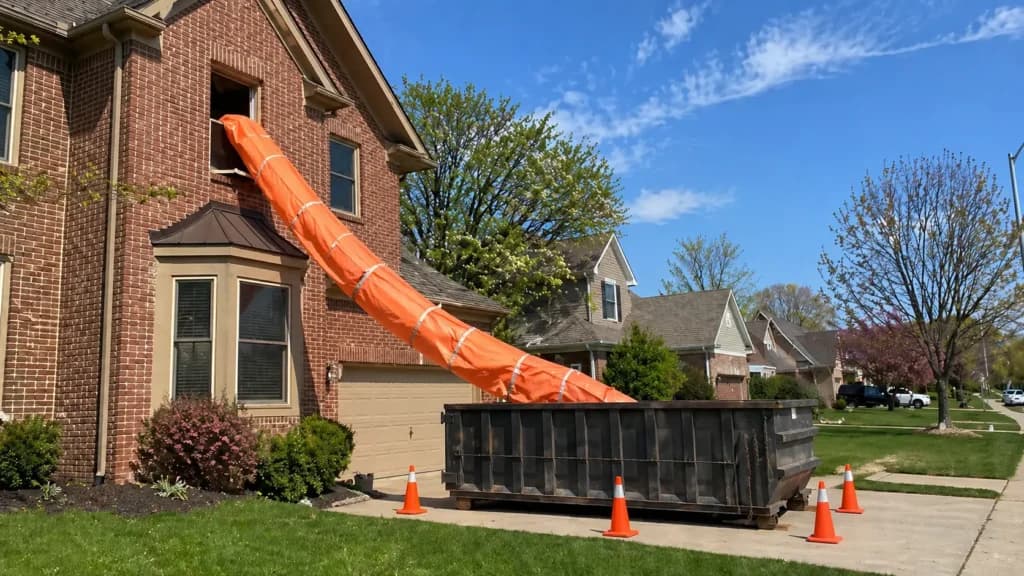
On a two-story home with an 18-to-20-foot drop, two 10 ft sections is the typical configuration. The advantage of shorter sections is that you can position the outlet closer to the dumpster opening — ideally with the outlet mouth sitting 12 to 18 inches above the dumpster rim. This tight outlet-to-container gap minimizes the debris splash radius dramatically. A 25 ft or 50 ft section hung from the same height will have several feet of swing and a longer unsupported tail, which increases the horizontal hazard zone.
Heavy-Duty vs. Lite-Duty for This Scenario
For sites with children present, lean toward the heavy-duty 10 ft section even if your debris load might technically allow lite-duty. The heavier fabric holds its shape better under load, which reduces the accordion-fold pressure that causes material to eject at joints. A section that maintains its circular cross-section is a section you can predict. You can learn more about the full product range on the About EasyChute page.
Setting Up the Exclusion Zone: The Non-Negotiable First Step
Before you hang a single section of chute, your exclusion zone needs to be established and clearly marked. This is not optional on any job site where children might be present — it is the single most important step in this entire guide.
What a Proper Exclusion Zone Looks Like
- Physical barrier: Minimum of orange construction fence, safety tape, or temporary fencing on all sides of the drop zone. Tape alone is insufficient if children are active on the property — it breaks, it sags, and it doesn't stop a curious 6-year-old. If the client has kids under 10, use hard fencing.
- Signage: "Danger — Falling Debris" signs on at least two sides of the perimeter, at child eye-level as well as adult eye-level.
- Gate control: If your exclusion zone has a ground-level entry point (fence gate, door), assign a crew member or physical lock to that point during active chute operation.
- Radius: Extend the perimeter at least 6 feet beyond the dumpster on all sides. For jobs above three stories, extend to 10 feet.
Communicating the Zone to Everyone on Site
Give every adult on the property a verbal briefing at the start of the day. That includes the homeowner, any tenants, and any subcontractors. The message is simple: nobody enters the drop zone while material is moving. If you have crew members who cycle between upper floors and the ground level, establish a hand-signal or radio protocol so the person loading the chute knows when the outlet area is clear before they push material in.
Rigging the Chute Correctly: A Step-by-Step Protocol
Proper rigging is where safety lives. A chute that is hung sloppily will behave unpredictably — and unpredictability is the enemy when children are nearby. The step-by-step installation guide covers the mechanics in detail, but here are the critical checkpoints specifically for occupied residential sites.
Anchor Point Selection
- Choose anchor points — window frames, roof edge brackets, scaffold rails — that are structurally sound and will not deflect more than 1 inch under the combined weight of the chute sections and debris load.
- On older Massachusetts homes (pre-1960 construction), probe window trim and sill framing before loading it. Rot is common. If the wood feels soft, find a different anchor.
- Use carabiners rated for the load. The four woven loops on each EasyChute section are designed to distribute weight evenly — clip all four, every time. Never run a section on two loops because the other two are inconvenient to reach.
Connection Joint Inspection
The 1.5 ft overlap between sections is where material can escape if the connection is loose. Before loading any debris, pull down on the lower section while a crew member holds the upper — you want zero gap at the overlap. If you can see daylight through the joint, the chute will throw material at that point. Tighten the connection and re-inspect.
Outlet Positioning Over the Dumpster
The outlet should be centered over the dumpster opening, not hanging over the rim. In practice, this means the lower section may need to be trimmed with a secondary carabiner run to a stake or wall bracket at ground level to keep it from swinging. Take five minutes to do this on occupied sites — the slight inconvenience is worth the stability.
Operating the Chute Safely Around Children: Rules for Active Debris Movement
Once the chute is hung and the exclusion zone is set, you move into the operational phase. These are the rules that govern behavior while material is actively moving through the chute.
The Two-Person Minimum Rule
On any site where children are present, never operate the chute with just one person. You need at minimum one person loading at the upper end and one person with eyes on the outlet and the exclusion zone perimeter. The ground-level person's job is not to do other work while monitoring — their job is to monitor. On busy residential jobs, this discipline gets eroded quickly. Don't let it.
Load Control and Debris Size
- Feed material steadily, not in large dumps. A single massive push of material — a full sheet of drywall, a pile of old shingles — creates a surge that can pop the joint or cause outlet splash.
- Break large pieces before loading. A sheet of drywall should go in halves or thirds, not full sheets. Old shingles should go in manageable armloads, not full-bundle heaves.
- Never load material that is wider than the chute diameter (22 inches on EasyChute sections). Jamming oversized pieces creates a blockage that can cause sudden ejection when freed.
- See the demolition chutes guide for material-specific loading practices for gut work.
Pausing Operations When Perimeter Is Breached
If a child (or any unauthorized person) enters or approaches the exclusion zone, stop loading immediately. Signal the upper-floor crew. Do not resume until the person is safely out of the zone and the perimeter is re-secured. This sounds obvious, but in the rhythm of a productive demolition day it requires a conscious commitment. Build the pause into your site culture — it's the same muscle as calling out "clear" on a nail gun.
Material-Specific Hazards to Know Before You Load
Not all debris behaves the same in a chute, and some categories carry elevated risk when children are nearby due to their splash or dust characteristics.
Asphalt Shingles
Old shingles can carry granule dust and, on pre-1980 roofs, trace amounts of asbestos-containing materials. On any roof tear-off involving shingles from before 1986, confirm asbestos status before using an open chute to a dumpster in a residential yard. The EPA's construction and demolition debris guidance addresses regulated materials in demolition waste. If testing hasn't been done and you're on a pre-1980 structure, treat shingles as potentially regulated and take appropriate precautions. For confirmed clean roofs, the roofing trash chute guide has the full operational playbook.
Drywall and Plaster
Drywall creates significant dust at the outlet. When children are present, consider wetting the outlet end of the chute lightly before starting a drywall load, which suppresses airborne dust. Plaster debris from older homes can contain lead paint dust — this is a particularly serious concern in Massachusetts, where pre-1978 housing is ubiquitous. Wet suppression, respirators for crew, and an extended exclusion zone are all warranted.
Concrete and Masonry
Heavy, hard materials create the most aggressive outlet splash. For concrete block, brick, and tile, position the dumpster so the outlet drops material toward the far wall of the container (away from the side facing foot traffic). A piece of plywood laid inside the dumpster at the outlet point can absorb impact and reduce chip ejection significantly.
OSHA Compliance Basics for Massachusetts Residential Contractors
OSHA's construction standards apply to commercial work, and enforcement on purely residential single-family jobs varies. But the liability picture is clear: OSHA's guidance on ergonomics and safe material handling establishes the baseline for what a reasonable employer does to protect people in and around a work zone. Massachusetts also has its own Department of Labor Standards (DLS) with jurisdiction over construction safety, and local building departments in cities like Boston, Cambridge, and Somerville can issue stop-work orders for unsafe debris handling practices.
The practical compliance checklist for a chute setup on an occupied residential site:
- Written hazard communication if any regulated materials (lead, asbestos) are present
- Physical exclusion zone established before work begins
- Site-specific safety briefing documented (even a crew text message thread counts as a record)
- Crew members trained on the specific chute being used — not just "debris chutes in general"
- Incident reporting protocol in place if something goes wrong
The EasyChute FAQ answers common setup questions that can help you prepare your crew before they arrive on site.
Striking the Chute at End of Day: Don't Rush This Step
The end of a long demolition day is when accidents happen. The crew is tired, the job is "done," and everyone wants to load up and leave. Striking the chute safely is just as important as setting it up correctly — and with children nearby, it deserves the same deliberate approach.
The Correct Strike Sequence
- Stop all debris loading. Call clear on the upper floor.
- Confirm the exclusion zone is clear of all people before anyone approaches the lower sections.
- Detach the lowest section first — not the top. Working bottom-up keeps the upper sections secured while you handle the lower end.
- Fold each section as it comes down and move it immediately outside the drop zone before detaching the next.
- Once all sections are down, do a visual sweep of the dumpster perimeter for any material that landed outside the container during the day's work.
- Remove exclusion zone fencing and signage only after the chute is fully stowed and the dumpster is covered or secured.
Storage and Reuse
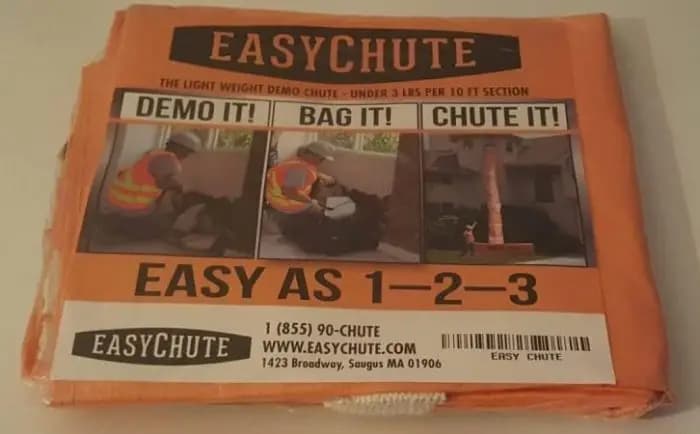
A 10 ft EasyChute section folds into a small box and weighs under 3 lbs. Inspect each section for tears, worn loops, or damaged fabric before folding and storing. A section with a compromised loop should be tagged out until the loop is repaired — don't clip a carabiner to a loop that's fraying, even on your next "easy" job. Consistent inspection is what makes reuse safe across dozens of jobs.
Practical Communication Templates for Client-Facing Conversations
Most safety breakdowns on occupied residential sites start with a communication gap — the contractor assumed the client understood the drop zone, or the client didn't realize the chute would be running during school pickup time. Here are two simple scripts you can use.
Pre-Job Client Briefing (Day Before or Morning Of)
"We'll be running a debris chute from [the second floor / the roof] to the dumpster in your [driveway / yard / parking area]. While the chute is operating, that area needs to be completely off-limits — no kids, no pets, no foot traffic. We'll put up fencing and signs. Can you make sure everyone in the household knows not to go near the dumpster area from [start time] until [estimated wrap time]? If plans change and you need someone to pass through, just flag one of my crew and we'll pause operations."
Neighbor Notification (If Drop Zone Borders a Property Line)
"We're doing work next door starting [date]. We'll have a debris chute dropping material into a dumpster on the [side / back] of the property. The area right next to the fence on your side will have some noise and possibly some dust during debris drops. Please keep children away from that section of your yard while work is active — I'd estimate we'll be running the chute between [9:00 AM] and [4:00 PM]."
These conversations take three minutes and eliminate the scenario where a neighbor's child wanders up to the outlet side of your dumpster at noon.
When to Consider Alternatives to a Chute on an Occupied Site
A debris chute is almost always the right call on multi-story residential work — it's faster, safer, and less physically demanding than bucket-brigade or interior cart methods. But there are specific scenarios where a chute may not be the right fit, and recognizing them early saves you from a compromised setup.
- Extremely tight lots: If the only dumpster position is within 3 feet of an active pedestrian path and you cannot establish a meaningful exclusion zone, a different debris removal approach may be warranted. See the construction debris removal page for alternatives.
- Active daycare or childcare on adjoining property: If your exclusion zone borders a licensed childcare facility, notify the facility operator and your client before beginning work. Consider scheduling the chute operation during outdoor play breaks.
- Regulated material confirmed: If asbestos or lead paint testing confirms regulated materials, specialized disposal protocols take precedence over standard chute operation. Consult a licensed abatement contractor.
In most cases, the chute is absolutely the right tool — the steps above just make it the right tool used correctly. You can also compare setup options in our debris chute rental vs. EasyChute comparison.
Massachusetts-Specific Context: What Makes This State's Residential Sites Unique
Massachusetts contractors work in some of the most constrained residential environments in the United States. Boston's triple-deckers sit 10 feet from the neighboring triple-deckers. Cambridge side streets have no sidewalk. Somerville's zoning produces lots so narrow that a dumpster in the driveway blocks the only pedestrian access to the rear of the property.
These physical constraints are compounded by a dense population of families in multi-unit buildings. A renovation on the second floor of a triple-decker in Dorchester means you have active residents on the first and third floors, their children, and neighbors within earshot and arm's reach of your work zone. The experience in similarly dense New England urban environments consistently reinforces the same lesson: the contractors who plan their exclusion zone as carefully as they plan their tear-off sequence are the ones who finish jobs without incidents.
The lightweight, compact nature of EasyChute sections matters here. A 10 ft section that weighs under 3 lbs can be carried up a narrow triple-decker staircase by one person, hung from a second-floor window without a crew lift, and struck in minutes when the day wraps. That speed and portability means you can run the chute only during controlled windows — school hours, nap times, whatever the client's household schedule requires — and strike it when the children are active again. Flexibility is a safety feature.
For contractors working in the broader region, the construction chute guide covers multi-floor setups in dense urban environments in detail.
Frequently Asked Questions
Is it legal to run a debris chute on an occupied residential property in Massachusetts?
Yes, provided you follow applicable OSHA construction safety standards and any local building department requirements. Massachusetts does not have a statewide prohibition on chute use at occupied properties, but local permits for dumpster placement and debris operations may apply depending on your municipality. Boston, Cambridge, and Somerville all have specific requirements for dumpsters placed in the public right-of-way. Always check with your local building department before the job begins. The exclusion zone, signage, and crew supervision requirements outlined in this guide reflect standard compliance expectations.
How far should the exclusion zone extend around the chute outlet?
At minimum, 6 feet beyond the dumpster on all sides for work up to three stories. For work above three stories, extend the zone to 10 feet. The zone should account for the swing radius of the chute's lower section in wind conditions typical to your job site. On windy days, the swing radius can increase, and your perimeter should expand accordingly. The outlet splash radius from heavy materials like concrete or tile can reach 3 to 4 feet horizontally, which is why the 6-foot minimum is a floor, not a ceiling.
What should I do if a child enters the drop zone while debris is actively moving?
Stop loading immediately and signal the upper-floor crew to halt. Do not wait to see if the child moves away on their own — call stop first. Once the child is safely out of the zone and returned to an adult, re-brief the adult responsible before resuming. Document the incident in your job log, including the time, what happened, and what corrective steps you took. If any debris came close to the child during the incident, you are legally required to report this through your company's incident reporting chain and potentially to OSHA, depending on the severity.
Can I run the chute during school hours when kids are less likely to be home?
Scheduling chute operations during school hours is a practical and smart risk reduction measure, but it is not a substitute for an exclusion zone. Younger children (under school age), school vacations, early dismissals, and work-from-home parents mean the property is rarely 100% clear simply because it is a weekday morning. Use school hours as a scheduling preference, not a safety guarantee. Establish the physical exclusion zone every time the chute is set up, regardless of what time of day it is.
What debris types pose the highest risk when children might be near the outlet?
Concrete, brick, and ceramic tile create the most aggressive outlet splash — hard angular materials hitting a metal dumpster can project chips several feet horizontally. Asphalt shingle granule dust and drywall dust create respiratory hazard at the outlet. On pre-1978 Massachusetts homes, drywall and plaster debris may carry lead paint dust, which is a serious hazard to children even in small quantities. Wet suppression at the outlet, extended exclusion zones, and downward-angled dumpster positioning all reduce these specific risks.
How many people does it take to safely operate a debris chute on an occupied residential site?
A minimum of two crew members: one loading material at the upper end and one stationed at ground level with eyes on the outlet and exclusion zone perimeter. On larger jobs or sites where the perimeter has multiple access points, a third crew member monitoring the perimeter is warranted. The ground-level crew member's role during active operations is exclusively site monitoring — not secondary tasks. This two-person minimum is a site safety standard, not a convenience guideline, when children may be present.
Where can I learn more about EasyChute sections and which configuration fits my job?
The debris chute overview page covers all section sizes and connection options. The installation guide walks through setup step by step, and the EasyChute video library shows real setups in the field. For job-specific questions, you can reach the team directly through the contact page. EasyChute ships free to job sites across Massachusetts and the United States at fixed prices, so there's no cost surprise between the website and the invoice.
Ready to Set Up Safely on Your Next Massachusetts Job?
Running a debris chute on an occupied residential site does not require heroic effort — it requires deliberate planning, a properly established exclusion zone, and crew members who know what to do when the unexpected happens. The steps in this guide are actionable today, on your next job, with the crew you already have.
EasyChute's lightweight fabric sections — designed and built by contractors who have worked exactly these kinds of Massachusetts residential sites — make the setup fast enough that you have time to do it right. Under 3 lbs per 10 ft section. One person to hang it. Reusable across hundreds of jobs. Free shipping to your job site.
Visit the EasyChute About page to learn how the product was built, or head directly to the debris chute product page to choose the sections that fit your next project. If you're comparing purchase to rental, the debris chute rental vs. EasyChute guide breaks down the real cost math. Questions before you order? The contact page gets you to the team directly.
Demo it. Bag it. Chute it — safely.