
New Hampshire renovation work has a complication that most big-city job sites don't face nearly as often: residential proximity. Whether you're tearing off a roof in Nashua, gutting a bathroom in Concord, or demoing a kitchen in Manchester, the job site is frequently someone's home — and that home often has children in it, next door to it, or passing through it every afternoon when school lets out.
Running a debris chute in that environment is not inherently dangerous. Done correctly, it is actually one of the safest ways to move demolition material off upper floors, because it eliminates the wheelbarrow trips and hand-carry loads that cause the most worker injuries. But setup, operation, and tear-down all require deliberate planning when kids are anywhere near the drop zone.
This guide is for New Hampshire contractors who want a clear, step-by-step protocol for safe debris chute operation on occupied or semi-occupied residential job sites. We'll cover exclusion-zone sizing, communication with homeowners, anchor-point inspection, chute-loading technique, and the end-of-day checklist your crew should run every single time.
Why Debris Chutes and Kids Are a High-Stakes Combination
Falling debris is one of the most preventable causes of bystander injury on construction sites, and OSHA's construction industry safety guidelines make clear that struck-by hazards don't discriminate between workers and passersby. Children are especially vulnerable for three reasons.
- Unpredictable movement: Kids dart into areas without reading signage, ducking under tape, or understanding that "stay back" applies to them.
- Lower height profile: A shingle, chunk of drywall, or piece of trim that sails wide of the chute's opening and falls from a second- or third-story window will strike a small child at head height when it would hit an adult at shoulder or chest height.
- Curiosity override: The noise of a debris chute — the whoosh, the thud in the dumpster — is interesting to a child. That curiosity actively draws them toward the hazard zone rather than away from it.
None of this means you can't work efficiently. It means you need a system. The good news is that a well-hung fabric chute with a properly sized exclusion zone is far safer than the alternative — tossing material out a window, carrying loads down interior stairs, or rigging improvised shoots that can detach under load.
Know Your New Hampshire Job-Site Context Before You Rig
Residential density and lot size
New Hampshire's housing stock ranges from dense Manchester triple-deckers to spread-out rural lots in Carroll County. The exclusion zone math is different in each case. On a tight urban lot, a neighbor's driveway may be eight feet from your drop point. On a rural lot, the dumpster can sit fifty feet from any fence line. Survey the specific site on the morning of setup — don't rely on what a similar job looked like last week.
School calendars and afternoon foot traffic
NH school dismissal times cluster between 2:30 PM and 3:15 PM for most districts. That means foot traffic past your job site spikes during exactly the window when afternoon teardown work is ramping up. Build your day's schedule so that high-volume debris runs — the ones where workers are loading the chute fastest — happen in the mid-morning, not the mid-afternoon.
Seasonal considerations
Winter jobs in New Hampshire present a unique wrinkle: snow on the ground makes exclusion-zone fencing harder to anchor, children may be outdoors on school vacation weeks, and debris can bounce farther on frozen ground than on soft summer turf. Factor seasonality into your pre-job safety walk.
Choosing the Right Chute Section Length for Your Drop Height
Getting the section length right is a safety decision, not just a convenience decision. A chute that's too short leaves a gap between the lower mouth and the dumpster opening, which means debris can scatter on impact. A chute that's too long pools material inside the fabric, creating load stress on the anchor loops and increasing the risk of a mid-chute failure.
EasyChute's fabric trash chute sections come in 10 ft, 25 ft, and 50 ft lengths, and they connect with a 1.5 ft overlap — so you can build exactly the drop height you need. A rough rule of thumb:
- 10 ft section: Single-story work, roof edges on cape-style homes, low scaffolding.
- Two 10 ft sections or one 25 ft section: Standard two-story colonial, common throughout NH.
- 25 ft + 10 ft or a 50 ft section: Three-story triple-deckers, steep-pitch roofs where the ridge is significantly higher than the eave.
When kids are on site, err toward slightly more chute length rather than less — a chute mouth that lands 12 to 18 inches inside the dumpster rim controls debris scatter far better than one that terminates at rim height.
Exclusion Zone Setup: The Non-Negotiable First Step
Minimum zone dimensions
Before a single section of chute goes up, the exclusion zone must be established. For residential work in New Hampshire, the following minimums apply as a baseline — your specific site conditions may require expanding them.
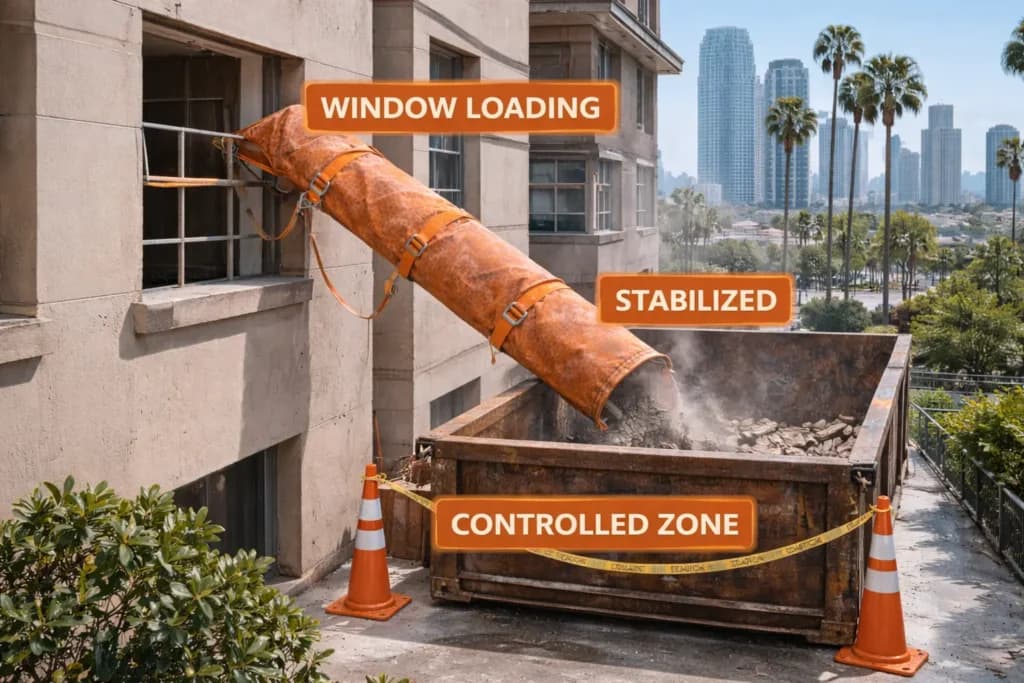
- Extend the zone a minimum of 6 feet outward from every side of the dumpster.
- Extend the zone upward from the wall plane at least 4 feet in all lateral directions from the chute opening — to account for debris that may bounce or slide off the chute's exterior.
- If the drop height exceeds 20 feet, extend the base exclusion radius to 10 feet on all sides of the dumpster.
Fencing and barrier materials
Orange safety fencing alone is not sufficient when children are present. Kids will walk through it, thinking it's a suggestion. Use a combination approach:
- Hard barrier first: Water-filled jersey barriers, interlocking construction fencing panels, or at minimum T-post-and-chain-link on the pedestrian-facing side.
- Warning tape behind that: High-visibility caution tape at both adult and child eye level (roughly 42 inches and 24 inches off the ground).
- Signage: Laminated signs that read "Danger — Falling Debris" at both adult and child reading height. Plain language beats construction jargon when the audience is a seven-year-old.
Designating a spotter
When debris runs are actively happening, one member of your crew should be on the ground inside the exclusion zone — not loading, not on the phone — solely watching for zone breaches. This is especially important during school dismissal hours and on weekends when neighborhood foot traffic is unpredictable. The spotter calls a halt to loading the moment anyone approaches the zone boundary.
Anchor-Point Inspection: Where Most Failures Begin
A construction chute fail is almost always an anchor fail. EasyChute sections hang from four woven loops using carabiners or quick-connects, which distributes the load evenly and prevents the unilateral stress that causes seam tears. But the anchor points those carabiners clip to still need a pre-use inspection every single day.
What to inspect before every hang
- Window frame or sill: Check for rot, loose casings, or previous damage. A rotten sill can pull free under dynamic load — especially when a large piece of sheathing slides through the chute and creates a momentary impact.
- Scaffold rail anchors: If hanging from scaffold, verify the rail is properly pinned at every connection. Do not clip chute loops to free-floating horizontal bars that aren't cross-braced.
- Roof edge blocking: If hanging over a fascia, place a 2x lumber block between the loop and the fascia edge to prevent the carabiner from sawing through the fascia under load.
- Carabiner gates: Confirm all gates are locked, not just closed. Vibration from a busy chute can open an unlocked gate over the course of an afternoon.
See the step-by-step EasyChute installation guide for a full visual walkthrough of anchor setup. When in doubt, watch the EasyChute videos before your first hang on a new structure type.
Communicating with the Homeowner Before Work Begins
This is where NH contractors frequently leave money — and safety — on the table. A five-minute conversation with the homeowner before the first debris run can prevent the most common kid-on-site scenarios: the homeowner's child wandering out to watch, the neighbor's kids cutting through the yard, the teenager who wants to "see what's in the dumpster."
The pre-job homeowner briefing
Cover these points explicitly — not in a written waiver buried in your contract, but in a verbal conversation the morning you set up:
- Identify the exclusion zone clearly. Walk the homeowner to the perimeter and physically show them where the boundary is.
- Confirm that all household children will remain inside or in the backyard while debris runs are happening. Get a yes.
- Ask whether neighbors have children who regularly use the driveway, walkway, or yard adjacent to the drop zone.
- Establish a communication signal — a knock on the door, a text — for when debris runs are paused and it's safe for the family to access the front of the house.
- Tell them what the chute sounds like in operation. The whoosh-and-thud is alarming if you've never heard it before, and an alarmed homeowner may send a child to investigate.
Neighbor notification
For jobs in denser NH neighborhoods — think Concord's South End, the older neighborhoods of Keene, or Nashua's east side — a brief knock on each adjacent neighbor's door the first morning is worth the three minutes it takes. Let them know there will be intermittent loud noise from the chute and that the barrier is there for safety. Neighbors who know what's happening don't panic, don't send kids to look, and don't call the building department with vague noise complaints.
Loading the Chute Safely When Children Are Present
Loading technique matters more than most contractors acknowledge. A piece of debris thrown into the chute at an angle can ride up the chute wall, create enough lateral force to shift the chute's hang point, and in a worst case exit through a section seam or connection overlap. When a spotter is managing bystanders below, the person loading above needs to be disciplined about how material goes in.
Safe loading protocol
- Confirm the spotter is in position before the first piece goes in. Do not start a debris run while the spotter is repositioning or on a break.
- Feed material horizontally, not at an angle. Slide debris into the chute's opening so it enters parallel to the chute's axis, not at a 45-degree toss. This reduces bounce and lateral force inside the fabric.
- No single piece heavier than 50 lbs. Break up large sections of drywall, concrete board, or old decking before loading. Heavy single pieces create impact spikes at the anchor points. OSHA's ergonomics guidance also recommends against single-person lifts over 50 lbs — breaking material down protects both the chute and the worker loading it.
- Pause between loads. Do not continuously feed the chute like a conveyor belt. Allow each load to reach the dumpster before the next piece goes in. This prevents chute-jamming, which causes workers to reach into the opening — a hand-injury risk — and prevents pressure buildup that stresses connection overlaps.
- Call out before each load. A simple verbal "loading" or a hand signal to the spotter below keeps everyone coordinated, especially on a noisy job site.
Chute Connection and Overlap Inspection Mid-Job
Multi-section chutes — the kind you need on a typical New Hampshire colonial with a two-story drop — have connection points that need a mid-day check. The 1.5 ft overlap that joins sections should be inspected after the first hour of heavy use and again at the midday break.
- Look for section creep: if debris is flowing fast and heavy, the upper section can "walk" upward relative to the lower one, reducing overlap length. Re-seat and secure the connection before resuming.
- Check for external debris accumulation on the outside of the chute. Wet insulation or mud that clings to the exterior fabric adds weight the anchor loops weren't sized for.
- Inspect the bottom mouth of the chute. If the dumpster is filling up and the mouth is now pressing against debris rather than hanging free inside the container, shorten the bottom section or empty the dumpster. A chute that's balled up against a pile of debris in a full dumpster can bounce material out of the container.
For a detailed look at how the demolition chute system handles multi-section interior gut work, that guide covers connection integrity in depth. And for roofing-specific scenarios — shingle tear-offs on steep NH pitches — the roofing trash chute guide addresses the unique anchor and loading considerations for pitched surfaces.
End-of-Day Checklist: Secure the Site When Kids Are Around
End of day on a residential New Hampshire job site is not simply "pack up and leave." A partially rigged chute left overnight is a magnet for curious children, and the exclusion zone fencing that felt robust at 7:00 AM can shift, sag, or get partially dismantled by the time 6:00 PM rolls around. Run this checklist before the last crew member leaves.
Daily close-out protocol
- Remove all chute sections from anchor points. Do not leave a hung chute overnight — even a securely anchored chute is an attractive climbing target for children and an unauthorized access point for anyone who wants to reach the window opening.
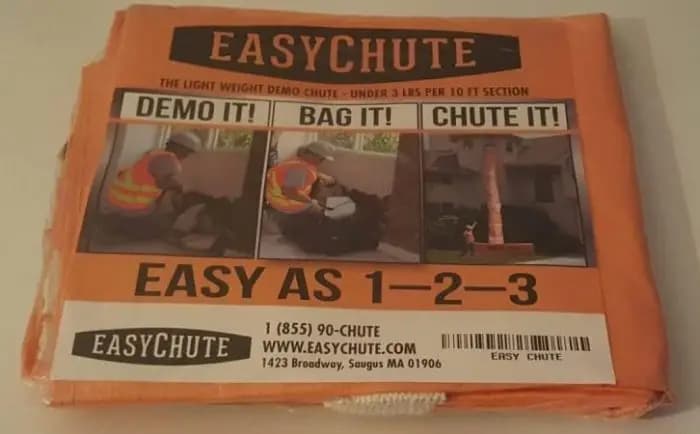
- Fold and bag each section. EasyChute sections fold small enough to fit in a contractor bag — do it on site rather than leaving sections draped over the scaffold rail.
- Confirm the dumpster lid is closed or covered with a tarp if the hauler has provided one. An open dumpster invites dumpster diving and, in a worst case, kids climbing in.
- Walk the exclusion zone perimeter and re-secure any fencing panel that shifted during the day.
- Confirm any window or opening used as a hang point is boarded or otherwise secured from interior access.
- Text or knock to tell the homeowner debris runs are done for the day and the zone is safe for normal use.
The Weight Argument: Why Lightweight Fabric Chutes Reduce Kid-Risk
There's a logical connection between chute weight and bystander safety that doesn't get discussed enough. Heavy steel or rigid plastic chute systems require more workers to hang, take longer to set up, and — critically — are more often left partially rigged at end-of-day because striking them is so labor-intensive. That partially rigged steel system sitting against a New Hampshire colonial overnight is a bigger hazard than any operational chute.
A fabric chute that one worker can carry, hang, and strike in minutes gets struck every day because it's not a burden to do so. That daily strike routine is the single most effective end-of-day safety measure you can implement on a residential job with kids nearby.
The weight numbers bear this out: a 10 ft EasyChute section weighs under 3 lbs, folds into a small box, and can be rehung the following morning by a single crew member in the time it takes to drink a cup of coffee. That frictionless setup-and-strike cycle is not just an efficiency feature — it's a safety feature.
Regulatory Context: What New Hampshire Contractors Need to Know
New Hampshire operates under federal OSHA standards for general industry and construction — the state does not have an OSHA State Plan, so federal rules apply directly. The struck-by hazard provisions under 29 CFR 1926 Subpart Q (demolition) are most directly relevant to debris chute operations, and they require that all areas where debris might fall be barricaded to prevent employee — and by extension bystander — exposure.
The EPA's data on construction and demolition debris underscores why this matters at scale: C&D debris represents hundreds of millions of tons of material annually in the U.S., and residential renovation is a significant contributor. Managing that material safely — not just efficiently — is a legal and ethical obligation.
Local building codes in New Hampshire municipalities vary. Some cities and towns (Concord, Manchester, Portsmouth, Nashua) may require a permit or notification for dumpster placement in a public right-of-way, which in turn may require specific barrier configurations. Check with your local building department before the job, not after a complaint is filed.
Pet-Friendly and Kid-Friendly Job Sites: The Overlap
Many of the same protocols that keep children safe also apply to pets — and in New Hampshire residential work, both are almost always present simultaneously. If you've navigated debris chute setup for pet-friendly renovation neighborhoods in New Hampshire, you already have the foundation for kid-safe operations. The key additions when children are involved (versus pets) are the communication protocols — signage, homeowner briefings, and spotter roles — since children can read and respond to instructions in ways that pets cannot.
Running a combined pet-and-kid protocol checklist at the start of each job is worth the extra two minutes. If you're already checking for pet doors, fenced yard access, and dog-containment configurations, add child-specific items to the same walkthrough.
Common Mistakes NH Contractors Make — and How to Avoid Them
- Skipping the exclusion zone because "it's just a quick tear-off." There is no such thing as a quick tear-off when debris is falling from height. Even a 10-minute shingle run needs a zone and a spotter. The five minutes to set up a barrier is worth it.
- Using the homeowner's children as informal spotters. Never, under any circumstances, ask a child to watch the zone, hold a flag, or alert you if someone enters. The spotter must be a trained member of your crew.
- Assuming the homeowner will manage their kids. Homeowners are distracted. They're watching the work, fielding calls, managing their day. Your safety system cannot depend on the homeowner's vigilance.
- Leaving the chute hung during lunch breaks. If the entire crew leaves the site for lunch, the chute comes down or the exclusion zone must be staffed. A hung chute with no one present is an unmanaged hazard.
- Using an undersized dumpster that fills quickly. A dumpster that fills faster than expected causes rushed decisions — loading a full container, skipping the mid-job check, leaving the lid open. Order slightly more dumpster capacity than you think you need.
- Skipping the overlap check on multi-section hangs. This is the most common mechanical failure point. Build it into your midday break routine, not as an afterthought.
For a broader look at how contractors in various contexts handle debris removal safely, the EasyChute FAQ addresses the most common setup questions from contractors across the Northeast.
Frequently Asked Questions
How far does the exclusion zone need to extend when children might be nearby?
At minimum, extend the exclusion zone 6 feet in every horizontal direction from the dumpster footprint. If your drop height exceeds 20 feet, expand that radius to 10 feet. Add a secondary warning line at child eye level — roughly 24 inches off the ground — in addition to standard adult-height caution tape. The goal is a zone that a child cannot accidentally wander into without crossing multiple visible barriers. When in doubt, make the zone larger, not smaller.
Can one crew member handle both loading and bystander watch when kids are nearby?
No. Loading the chute and watching the exclusion zone are two separate jobs that cannot be performed simultaneously by the same person. The loader's attention is on the material going into the chute — the angle, the weight, the pace. The spotter's attention must be entirely on the zone perimeter below. Combining these roles is how bystander injuries happen. When kids are on or near the site, a dedicated ground spotter is non-negotiable, even if it means pulling someone off production.
What should I do if a child enters the exclusion zone while the chute is in use?
Stop loading immediately. The spotter should physically move to intercept the child — calmly, without alarming them — and escort them back behind the barrier. Do not resume debris runs until the zone is re-secured and the homeowner has been notified. Document the incident in your job log. If the child was a neighbor's and not the homeowner's, revisit your neighbor notification protocol and consider whether additional fencing on that side of the zone is needed before the next debris run.
Is it safe to leave a fabric debris chute hung overnight on a residential job?
No. Fabric chutes should be struck at the end of every working day on residential sites. A hung chute invites children to touch, pull, or climb on it, and it leaves the anchor-point window or opening unsecured from exterior access. The labor cost of removing and rehung a lightweight fabric section is minimal — an EasyChute section can be struck and folded in minutes — so there's no practical reason to leave it up overnight on a site where bystander access is possible.
Do New Hampshire contractors need a specific permit to run a debris chute?
NH does not have a statewide debris-chute-specific permit requirement, but local municipalities may require permits for dumpster placement in a public right-of-way, and some require notification to the building department for demolition work above a certain scope. Contact your local building or public works department before the job. Federal OSHA regulations under 29 CFR 1926 Subpart Q apply to all demolition and debris-removal work in NH regardless of local permitting.
How do I keep the exclusion zone secure during my lunch break if the crew leaves the site?
Either keep at least one crew member on site to monitor the zone, or take the chute down before the break. A hung chute with zero crew present is an unmanaged hazard. If the dumpster is in a driveway or publicly accessible area, ensure it is covered or its lid is closed before you leave. Notify the homeowner that the crew will be off site for the break period and ask them to keep children and neighbors away from the dumpster area until work resumes.
Are canvas or fabric chutes safer than rigid systems when working near children?
Fabric chutes have practical safety advantages in residential settings: they're lighter, faster to strike, and don't leave sharp metal edges or rigid components near ground level. Because they're easy to take down, crews are far more likely to actually remove them at end-of-day, which is the most important bystander-safety behavior. Rigid systems are sometimes left partially rigged because striking them is labor-intensive — that overnight exposure is a greater hazard than any operational difference between the two materials during working hours.
Ready to Run a Safer Job Site in New Hampshire?
Every point in this guide comes down to one principle: a system that is easy to set up and easy to strike gets used correctly, every day. That's exactly why EasyChute was designed by contractors who work residential sites — the lightweight fabric sections, the simple carabiner hang, the small-box fold-down make it realistic to do the right thing even on a short job or at the end of a long day.
If you're ready to spec the right chute length for your next NH job, visit the debris chute product overview, check out our canvas trash chute guide for a material comparison, or head to the contact page to reach the team directly with questions about your specific site setup. Free shipping to New Hampshire job sites, fixed prices, and sections that connect to any drop height — from a one-story cape in Conway to a three-story triple-decker in Manchester.
Demo it. Bag it. Chute it.