
New Hampshire renovation work has a character all its own. Tight colonial neighborhoods in Portsmouth. Dense triple-deckers in Manchester. Narrow side yards in Nashua where a golden retriever is usually napping three feet from your dumpster. If you are running a gut renovation, roofing tear-off, or junk removal job in a New Hampshire neighborhood where pets and families are part of the daily scenery, your debris removal setup matters as much as your demo plan.
A debris chute changes the entire risk profile of a job site. Instead of hauling debris bags down three flights of stairs — past the resident's cat, past the toddler on the second-floor landing, past the neighbor's dog tied to the porch rail — material drops straight from the work zone into the dumpster below. No foot traffic through shared spaces. No scatter. No trip hazards at ground level while debris is in transit.
This guide covers everything a New Hampshire contractor or roofer needs to know about setting up a debris chute in a neighborhood where animals and residents are present — from choosing the right chute length and hanging method, to managing the drop zone so pets and bystanders stay clear.
Why New Hampshire Job Sites Demand Extra Ground-Level Awareness
New Hampshire is not a dense urban market like Manhattan or Boston's core. Most renovation work happens in residential neighborhoods where the job site boundary is informal — a property line, a driveway edge, or just the spot where the sidewalk begins. That informality is exactly what creates hazard.
In a city, pedestrians expect construction. Scaffolding, netting, and barricades are part of the streetscape. In a Portsmouth Hill neighborhood or a Concord side street, residents treat the sidewalk as an extension of their yard. Dogs are walked off-leash in driveways. Cats wander freely. Kids cut across lawns. A debris stream falling from an upper floor with no containment system is genuinely dangerous in this context.
The Scatter Problem Without a Chute
When debris is tossed or carried down manually, loose material — shingle granules, drywall dust, broken tile, nails — spreads. Nails on a driveway are a tire puncture waiting to happen. Shingle grit on a lawn is abrasive to dog paws. Drywall dust that settles on a neighbor's porch is a respiratory irritant to pets and people alike. A contained chute eliminates scatter at the source.
OSHA's Baseline and Why NH Sites Often Exceed It
Federal construction safety rules under OSHA's construction industry standards set minimum requirements for debris handling, overhead hazard protection, and site housekeeping. Those rules apply whether you are on a Boston high-rise or a Derry cape. In residential New Hampshire neighborhoods, the practical exposure is often higher than on a commercial site because there are no barricades, no hard-hat zones, and no security perimeter keeping bystanders back.
Choosing the Right EasyChute Section Length for NH Building Heights
EasyChute sells sections in three lengths — 10 ft, 25 ft, and 50 ft — and they connect with a 1.5 ft overlap, so you can build exactly the drop you need. Matching section length to building height is the first planning step on any New Hampshire job.
Single-Story Additions and Shed Roofs: 10 ft Sections
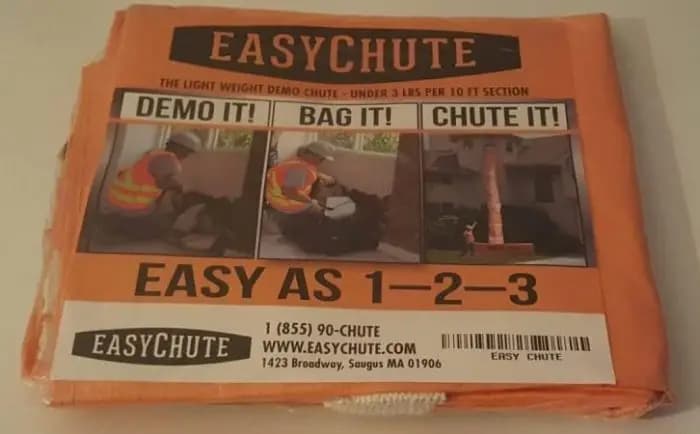
A standard single-story addition in New Hampshire runs 10 to 12 feet from the eave to the ground. One 10 ft section, hung from the fascia or a single anchor point, puts debris safely into a dumpster positioned at the drip line. For jobs this small, the EasyChute lite-duty 10 ft section — weighing under 3 lbs — is a one-person setup. You hang it, do your demo, pull it, fold it into the box it came in, and move on.
Two- and Three-Story New Hampshire Homes: Stack Sections
The classic New Hampshire colonial or triple-decker puts the third-floor work zone 25 to 32 feet up. Stack two 25 ft sections or combine a 25 ft and a 10 ft to reach the dumpster without any manual carry on the stairs. Each section overlaps the next by 1.5 ft and hangs from woven loops with standard carabiners — no tools, no hardware store run.
Steep-Pitch Roofing in the North Country
Northern New Hampshire roofs are built steep to shed snow — 10/12 and 12/12 pitches are common in the Lakes Region and the White Mountain foothills. A steep pitch means the ridge sits high, but the eave is often only 14 to 18 feet off the ground. A single 25 ft section gives you room to angle the drop cleanly over the soffit and reach a dumpster positioned eight to ten feet out from the foundation. See the full playbook in the roofing trash chute guide.
Hanging the Chute: Anchor Points and Hardware for Residential Sites
EasyChute sections hang from four woven loops at the top of each section. Standard carabiners or quick-connect clips go through the loops and around a solid anchor — a window frame, a scaffold tube, a rafter tail, or a temporary beam bridged across a window opening. No drilling, no permanent attachment, nothing that damages the structure.
Window-Frame Anchoring in Tight NH Side Yards
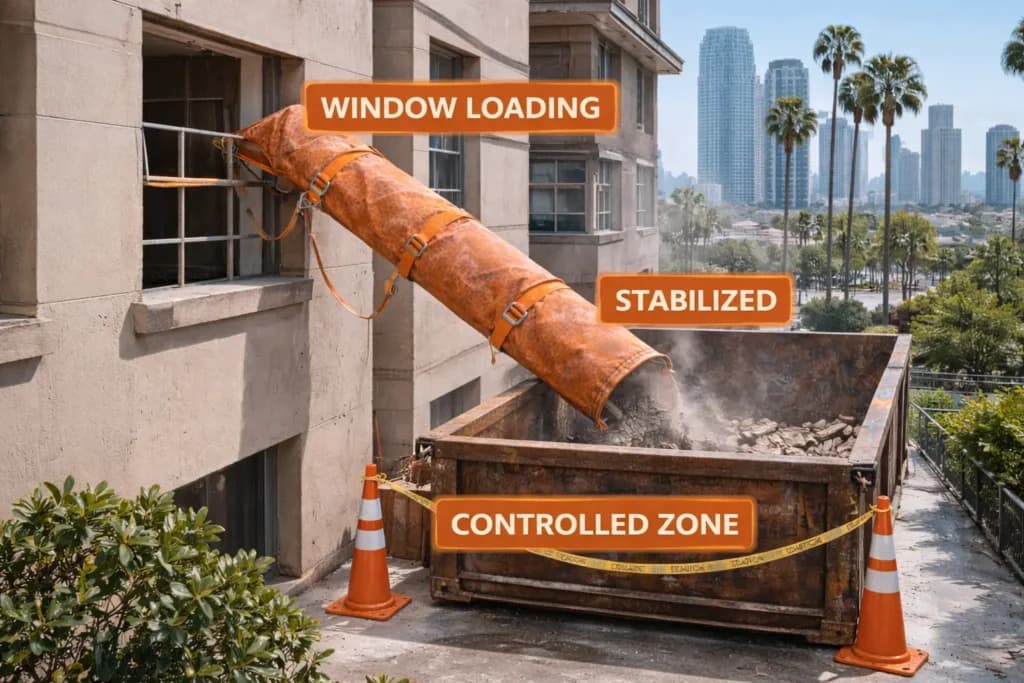
In older Portsmouth and Manchester neighborhoods, side yards are narrow — sometimes only four or five feet. A window opening on the side of the building is often the only practical hang point. Bridge a 2x4 or a scaffold clamp across the window opening, clip the EasyChute loops to the bridge, and the chute drops straight down the exterior wall into the dumpster or bin below. The step-by-step installation guide walks through this exact setup.
Roof-Edge Hangs for Shingle Tear-Offs
For roofing jobs, the top loop clips over a ridge hook or a scaffold leg positioned at the eave. The chute drapes over the fascia and drops to the dumpster. Because EasyChute sections are made from woven, coated poly fabric, they flex with the roof pitch and do not kink. One person can hang a 25 ft section in under five minutes.
Setting Up the Drop Zone: The Most Important Step for Pet-Friendly Neighborhoods
The chute itself is only half the safety equation. The drop zone — the area at the bottom of the chute where debris lands in the dumpster — has to be managed as actively as the work zone above. In a New Hampshire neighborhood where dogs are walked and kids cut through, an unsupervised drop zone is a liability.
Dumpster Positioning and Clearance
Position the dumpster directly under the chute exit, not offset to the side. A direct drop means debris stays inside the container rather than bouncing off the rim and scattering. Leave at least three feet of clearance between the dumpster and any fence, parked vehicle, or structure so debris that does scatter is contained in a predictable zone.
Barrier Options for Ground-Level Control
- Construction fence panels: Temporary chain-link panels set two to three feet out from the dumpster create a visual and physical boundary. Pets and children cannot walk into the drop zone without passing through an obvious barrier.
- Caution tape and stanchions: Lightweight and fast to set up, though less effective for deterring animals than solid panels.
- Dedicated ground spotter: On busy residential streets, assign one crew member as a ground-level monitor during active debris drops. This is especially important on corners or lots with high foot traffic.
- Signage: Post a simple sign — "Active Construction: Keep Pets and Children Clear" — at both ends of the work zone perimeter. Residents respond well to plain-language notices in residential New Hampshire neighborhoods.
Communicating with Neighboring Pet Owners Before the Job Starts
A five-minute conversation with adjacent neighbors the morning before demo begins prevents most conflicts. Let them know what hours debris will be moving, where the dumpster is located, and ask them to keep pets away from the perimeter during active work. Most New Hampshire homeowners appreciate the heads-up and will cooperate. This is not just courtesy — it is risk management.
Noise, Dust, and Debris: Managing the Full Sensory Impact on Animals
Pets on and near renovation sites are exposed to more than falling debris. Noise, vibration, and airborne dust affect animals differently than they affect adults. A dog tied in a yard adjacent to a demo site may experience stress from percussion tools, saw noise, and the vibration of material hitting a metal dumpster from 30 feet up.
How a Debris Chute Reduces Noise at Impact
A fabric chute cushions and slows debris as it travels down each section. Material that would hit a metal dumpster at full free-fall velocity instead arrives at a controlled speed, reducing the sharp impact noise that startles animals. This is a secondary benefit that contractors rarely think about but residents — and their pets — notice immediately.
Dust Containment Inside the Chute
Drywall dust, insulation fibers, and shingle granules that enter the chute at the top travel down inside the fabric channel rather than dispersing in the air. This is not a perfect dust seal — fine particles will escape — but containment is significantly better than an open toss. For heavy dust loads, particularly on interior gut jobs, pair the chute with a poly dust barrier at the window opening. Learn more in the demolition chutes guide.
Pet-Safe Debris Management: What the EPA Says About C&D Waste
Construction and demolition debris is a significant waste stream in the United States. According to the EPA's C&D debris data, hundreds of millions of tons of construction and demolition material are generated annually, much of it containing materials that are harmful to animals if ingested or if they come into prolonged contact with exposed skin or paws.
Specific materials to manage carefully on New Hampshire job sites where pets are present include:
- Lead paint chips: Pre-1978 New Hampshire homes frequently have lead paint. Chips and dust on the ground are acutely toxic to dogs that sniff and lick surfaces. Full containment and prompt cleanup are essential.
- Fiberglass insulation: Fibers cause skin and eye irritation in animals and humans. Keep insulation debris bagged before it enters the chute.
- Roofing nails and staples: Loose fasteners on a lawn or driveway are an emergency-vet visit waiting to happen. Magnetic nail sweepers at the end of each workday are non-negotiable on pet-present sites.
- Treated lumber: Pressure-treated wood contains preservatives that are harmful if chewed or ingested. Treat scraps as hazardous waste, not standard demolition debris.
The EPA's recycling guidance also covers how to properly sort and divert C&D materials — worth reviewing if your New Hampshire municipality has specific diversion requirements.
Ergonomics and Worker Safety: Why Manual Carry Is the Real Risk
The push to protect pets and bystanders on the ground sometimes obscures the risk to the crew doing the work above. Manual debris carry — hauling loaded bags down ladders or stairways — is one of the leading causes of musculoskeletal injury in construction. OSHA's ergonomics guidance identifies repetitive heavy lifting and awkward postures as primary injury drivers in the construction trades.
A debris chute eliminates the descent entirely. Material goes in at the top, drops to the dumpster, and the crew stays on the work level. On a three-story New Hampshire colonial, that means zero stair trips with loaded bags — which translates to fewer back injuries, faster work, and a crew that is not exhausted by mid-afternoon.
Weight Limits and What to Bag Before It Goes Down
EasyChute's fabric sections are built for real construction debris — shingles, drywall, insulation, broken concrete in manageable pieces. The practical rule is simple: if one person can lift it comfortably, it goes in the chute. If it requires two people to lift, break it down first. Oversized chunks of concrete or masonry should be broken into smaller pieces before entering the chute to prevent jamming and to protect the fabric from point-load stress.
What Should Never Go Down a Debris Chute
- Loose liquids or wet concrete (creates buildup and weight spikes)
- Sharp rebar or angle iron longer than 18 inches without padding
- Heavy stones or masonry boulders that exceed the chute's design load
- Hazardous materials — asbestos, lead-painted material scheduled for special disposal
Local Permit and Ordinance Considerations in New Hampshire
New Hampshire does not have a statewide permit requirement specifically for debris chutes, but municipalities often have rules that touch debris removal setup indirectly. Here is what to check before hanging a chute in key New Hampshire markets:
Portsmouth and the Seacoast
Portsmouth's historic district has strict rules about anything that modifies or attaches to a building exterior. If you are working on a historic structure in the South End or Strawbery Banke vicinity, verify with the city's planning department that a temporary chute attachment is permissible under your demo permit. In most cases, a fabric chute that clips to a window frame without drilling is treated as temporary equipment, not an exterior modification.
Manchester and Nashua
Both cities require dumpsters placed on a public street to have a street-use permit. If your dumpster is in the driveway or on private property, no street permit is needed — and your chute drops directly into it. Confirm dumpster placement with the property owner and your dumpster hauler before setting up the chute, since the chute position is determined by where the dumpster lands.
Rural and Lakes Region Towns
Many smaller New Hampshire towns have no specific ordinance governing debris chutes. Standard practice applies: keep the dumpster on private property where possible, maintain a clean perimeter, and comply with your demo permit's housekeeping conditions. Check with the town's building department if you are unsure — most New Hampshire building officials are accessible by phone and will give you a direct answer.
Reusability and Cost Efficiency: Why EasyChute Makes Sense Across Multiple NH Jobs
Renting a rigid steel or aluminum chute for a New Hampshire residential job often costs more per day than a fabric chute costs to own outright. EasyChute sections are reusable job after job. A 10 ft heavy-duty section folds into a compact box, weighs under 3 lbs, and stores in the back of a truck or in a job trailer without taking meaningful space.
For a New Hampshire contractor running four to six roofing or renovation jobs per season, owning your chute setup pays for itself after the first or second use. For junk removal operators running daily, it pays back within a week. The fabric trash chute overview compares material types and durability in detail if you are evaluating alternatives.
Shipping to New Hampshire Job Sites
EasyChute ships free to job sites across the United States, including every New Hampshire address — from Nashua to Berlin, from the Seacoast to the Connecticut River Valley. Order online at fixed prices, ship direct to the job site, and you are set up the same week. No showroom visit, no freight quote negotiation.
Step-by-Step Debris Chute Setup Checklist for Pet-Friendly NH Neighborhoods
Use this checklist on every New Hampshire job where animals and residents are present in the immediate work area:
- Measure the drop: From your work-level exit point (window, roof edge, or scaffold) to the top of the dumpster. Add 10 percent to account for section overlap and angle.
- Select and connect sections: Lay sections on a flat surface, overlap by 1.5 ft, and connect before hanging. It is easier than connecting mid-air.
- Identify and test anchor points: Window frame bridge, scaffold tube, or rafter tail — load-test before full use.
- Position the dumpster: Directly below the chute exit, lid open, with at least three feet of clearance on all sides.
- Set the ground barrier: Fence panels, caution tape, or a dedicated spotter — choose based on foot traffic level.
- Notify neighbors: Quick conversation or a note on the door. Alert pet owners specifically to keep animals away from the dumpster perimeter during active work hours.
- Post signage: At both ends of the work perimeter, clearly stating active construction hours.
- Brief the crew: Everyone knows the chute-only policy for debris. No manual carry down the stairway while the chute is active.
- Magnetic nail sweep at end of day: Run a magnetic sweeper across the driveway, lawn edge, and sidewalk before the workday ends.
- Strike and store: Unhook carabiners, fold sections, store in original box. Ready for the next job.
For a visual walkthrough, the EasyChute video library shows the full setup and strike sequence in real job conditions.
Common Mistakes Contractors Make on Residential NH Sites — and How to Avoid Them
- Underestimating the drop: Ordering a 25 ft section for a 28 ft drop means the chute exit sits above the dumpster rim and debris scatters. Always add a buffer section.
- Skipping the ground barrier: On a quiet New Hampshire street, it is tempting to skip the perimeter because it feels like overkill. It is not. One unleashed dog near the drop zone during an active dump is all it takes for a serious incident.
- Placing the dumpster offset from the chute: Even a two-foot offset means debris exits the chute at an angle, bounces off the rim, and lands outside the container. Align the chute exit with the center of the dumpster opening.
- Not bagging dusty material before it enters the chute: Loose drywall dust and insulation that enters the chute without bagging creates a dust cloud at the bottom that settles on neighboring yards and can irritate animal respiratory systems.
- Forgetting to strike the chute before leaving: A chute left hanging overnight on an unoccupied site is a liability — wind can dislodge it, and an unsupervised chute in a neighborhood attracts curious animals and children.
The EasyChute FAQ covers additional setup questions from contractors in the field — worth bookmarking before your first install.
How EasyChute Compares to Rigid Chute Systems for NH Residential Work
Rigid chute systems — galvanized steel or hard plastic — are designed for permanent installation in multi-story buildings like apartment complexes or high-rises. They are heavy, require mechanical fastening to the structure, and are expensive to rent for a single residential job. For a comparison of permanent versus temporary chute types, the debris chute overview breaks down each category.
For New Hampshire residential renovation and roofing work, rigid systems are almost never the right tool. The jobs are too short, the buildings too varied in height, and the installation time too significant relative to the job duration. A fabric chute that one person can hang in minutes and fold into a truck at the end of the day fits the actual tempo of residential contracting in New Hampshire.
Frequently Asked Questions
Is a debris chute required by law on New Hampshire residential renovation jobs?
There is no New Hampshire statute that specifically mandates a debris chute on residential renovation projects. However, OSHA's construction safety rules require contractors to protect workers and the public from falling debris, and your general liability insurance policy likely has language about maintaining a safe work perimeter. Using a debris chute is the most straightforward way to demonstrate compliance with both. When in doubt, check your demo permit conditions and your insurance policy's site-safety requirements.
Can I use EasyChute on a one-story addition — or is it only for tall buildings?
EasyChute works on any height where you need to move debris from an elevated work zone to a dumpster or bin below. A single 10 ft section is well-suited to one-story work. The benefit is not just about height — it is about keeping debris contained, reducing scatter, and eliminating manual carry that creates trip hazards in shared spaces. Many contractors use EasyChute on jobs as short as 8 to 10 feet off the ground.
How do I keep my neighbor's dog away from the dumpster drop zone?
The most effective combination is a physical barrier — temporary construction fence panels set around the dumpster perimeter — combined with a direct conversation with the neighbor before work begins. Ask them to keep pets inside or leashed during active debris drops. Posting a simple sign at the perimeter also helps. On jobs that run multiple days, a brief reminder each morning is reasonable and neighbors generally appreciate the communication rather than finding out about hazards after the fact.
Will EasyChute ship to a job site address in rural New Hampshire?
Yes. EasyChute ships free to any address in the United States, including rural New Hampshire towns throughout the North Country, the Lakes Region, the Seacoast, and the Upper Valley. Order online and ship directly to the job site address. Lead times are standard ground shipping from Massachusetts, so most New Hampshire deliveries arrive in one to three business days.
What is the best way to handle lead paint debris in an older New Hampshire home?
Lead paint renovation in pre-1978 homes in New Hampshire requires compliance with EPA's Renovation, Repair, and Painting (RRP) Rule if the occupant is a child under six or a pregnant woman, or if the home is being prepared for such occupants. Regardless of RRP applicability, lead-containing debris should be bagged before it enters any chute, and the drop zone should be swept and cleaned daily. Keep pets away from any area where lead paint chips or dust may have settled. Consult your state's environmental agency for current New Hampshire-specific disposal requirements.
How many job sites can I reuse an EasyChute section across before replacing it?
EasyChute sections are built from woven, coated poly fabric designed for repeated commercial use. With proper storage — folded clean and dry in the original box — sections can handle dozens of job cycles before showing meaningful wear. Inspect the loops and seams after each use and retire a section if you see fraying at the loop attachments or significant abrasion on the fabric body. Most contractors report using sections across full seasons of regular work without replacement.
Can a single person set up an EasyChute on a New Hampshire job site without a second crew member?
Yes. A 10 ft section weighs under 3 lbs and a 25 ft section is easily managed solo. Connect your sections on the ground, then carry the assembled chute up and clip the top loops to your anchor point — a window bridge or scaffold tube. The process takes five to ten minutes for a single person who has done it once before. The step-by-step installation guide walks through the solo setup sequence in detail.
Ready to Set Up a Safer Debris Chute on Your Next New Hampshire Job?
EasyChute was built by contractors who know what it means to work in residential neighborhoods where pets, kids, and neighbors are part of the job-site environment. Lightweight fabric sections, free shipping to any New Hampshire address, and a setup that one person can manage in minutes — that is the whole point.
Explore the full product line and place your order at EasyChute, or read more about how the system works in real job conditions at the construction chute guide and the canvas trash chute overview. If you have specific questions about your job setup, reach out through the contact page — the team is ready to help you get the right configuration for your New Hampshire site.