
If you own or manage rental properties, fix-and-flip projects, or multi-unit buildings anywhere in Massachusetts — from Worcester to Worcester County, from the South Shore to the Merrimack Valley — you already know that debris removal is one of the fastest ways a renovation budget bleeds out. Bags carried down stairways, workers making fifteen trips to a dumpster, torn-up hallways, and slow job timelines are expensive problems. A properly set-up debris chute solves all of them at once.
This guide is written specifically for Massachusetts real estate investors: the people managing contractors, scheduling dumpster drops, and trying to get units turned over as fast as possible. Whether you are doing a full gut renovation on a triple-decker in Somerville, replacing a roof on a rental in Brockton, or clearing out a hoarder unit in Springfield, the right chute setup cuts labor hours and reduces injury risk in ways that directly protect your margins.
Why Investor-Owned Properties Have Unique Debris Management Challenges
Owner-occupied renovations move at a different pace than investor-driven projects. When you own a property as an investment, every idle day costs you either carrying costs, lost rent, or both. That math makes debris removal speed a financial issue, not just a logistics one.
Investor properties in Massachusetts also tend to cluster in older housing stock — triple-deckers, converted mills, 1900s-era row houses, and walk-up apartment buildings. These structures were not designed for modern renovation workflows. Staircases are narrow, hallways are long, and there is rarely a convenient ground-floor exit near the work area.
The Triple-Decker Problem
Massachusetts is famous for its triple-deckers, and investors own a disproportionate share of them. Working the second or third floor of a triple-decker means your crew is hauling debris down two to three flights of stairs repeatedly. Each trip burns labor time, creates slip hazards on stairs, and beats up the common areas you will need to refinish anyway.
- A single gut renovation on a 1,200 sq ft unit can generate 4–6 tons of debris.
- Carrying that debris down stairs in bags often takes more crew-hours than the demo itself.
- A fabric trash chute hung from a third-floor window drops that same debris into a dumpster in a fraction of the time.
Turnover Timelines and Carrying Costs
For a buy-and-hold investor, every week a unit is offline is a week of lost rent. For a flipper, it is a week of mortgage, taxes, and insurance eating into your profit. Speed matters. A debris chute setup that lets one worker clear an entire floor in a morning — instead of two workers spending a full day on stair runs — compresses your timeline in ways that have real dollar value.
What a Debris Chute Actually Does (and Why Lightweight Fabric Wins)
A debris chute is a vertical channel hung from an upper floor that lets workers slide demo waste — drywall, insulation, flooring, roofing material, old fixtures — directly into a dumpster below. No stair trips. No hallway damage. No ergonomic strain from repeated heavy lifts down stairs.
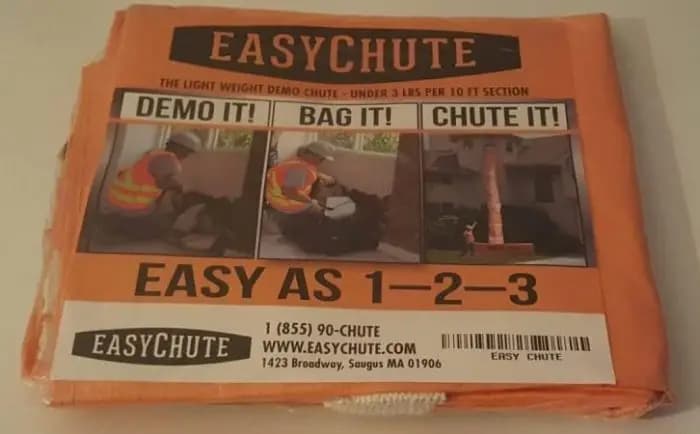
Traditional metal or hard-plastic chutes were the original solution, but they are heavy, expensive to rent, and slow to set up. EasyChute took a different approach: woven, coated poly fabric sections that weigh under 3 lbs per 10-foot section and fold into a small box. One worker can carry the entire chute in a bag, hang it from four carabiner loops at a window or roof edge, and have it operational in minutes.
Section Lengths and When to Use Each
EasyChute sections come in 10 ft, 25 ft, and 50 ft lengths, and they connect with a 1.5 ft overlap so you can build to any height. Here is how investors and their contractors typically choose:
- 10 ft lite-duty or heavy-duty: Second-floor windows, single-story roof edges, quick junk removal jobs. Connect two sections for a third floor.
- 25 ft: Three-story triple-deckers, four-story apartment buildings, standard commercial walk-ups. One section often covers it.
- 50 ft: Taller commercial buildings, mid-rise condos, any job site where you are working above the fourth floor.
Because sections connect to any height, you buy what you need and add on as your portfolio grows — an advantage over rental systems where you pay per use whether you need 20 ft or 60 ft.
OSHA Compliance and Why It Matters for Massachusetts Investors
If you are hiring contractors and something goes wrong on your job site, liability questions can point back to you as the property owner — especially if the site lacked basic fall protection and debris control equipment. This is not a theoretical concern in Massachusetts, where the Division of Occupational Safety enforces state-level construction safety standards that align with and sometimes exceed federal requirements.
OSHA's Construction Industry safety standards specifically address debris handling, fall hazards created by materials on stairs and walking surfaces, and the obligation to keep job sites free of hazards created by accumulated waste. A debris chute directly addresses several of these requirements at once.
Ergonomics and Worker Injury Risk
Repeated heavy lifting and carrying on staircases is one of the most common sources of musculoskeletal injury in construction. OSHA's ergonomics guidance emphasizes eliminating manual material handling wherever possible. A chute that eliminates stair carries is not just faster — it is a genuine injury-reduction tool. Fewer injuries mean fewer workers' comp claims, better crew retention, and fewer project delays caused by hurt workers.
For investors who are running lean crews or working with smaller subcontractors, one back injury on a staircase can derail a project for weeks. Eliminating that risk with a chute that costs less than a day's labor is straightforward risk management.
Step-by-Step: Setting Up a Debris Chute on a Massachusetts Investment Property
The setup process is intentionally simple. EasyChute was designed by a contractor and a junk removal owner — people who wanted something they could deploy fast on real job sites, not a system that required a crew to read a manual. For the full visual walkthrough, see the step-by-step EasyChute installation guide.
Step 1: Choose Your Anchor Point
Identify the window, roof edge, or scaffold level closest to the heaviest debris concentration. On a Massachusetts triple-decker, this is usually a rear bedroom or kitchen window on the second or third floor. Rear windows are preferred because they face the backyard where most investors position their dumpsters, and they minimize street-facing debris risk.
Step 2: Measure Drop Height and Select Sections
Measure from the anchor point to the top of the dumpster. Add a foot or two to account for the dumpster lip and the connection overlap. Select the right combination of sections. For most Massachusetts triple-deckers, a single 25 ft section or two connected 10 ft sections covers the drop from a third-floor window to a standard 10-yard dumpster.
Step 3: Hang the Chute
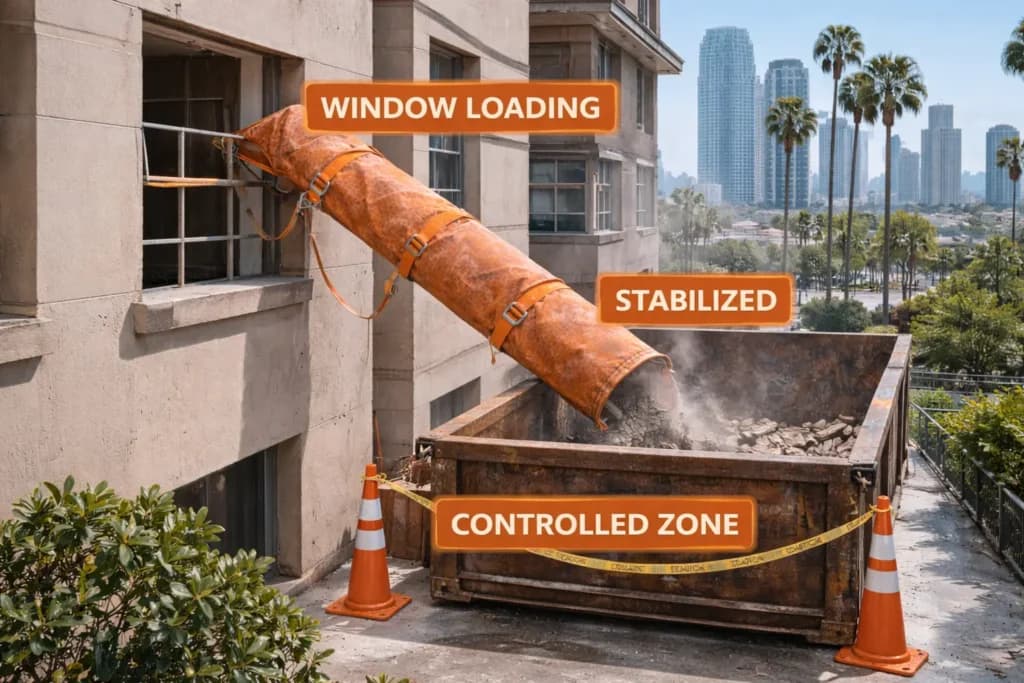
EasyChute sections hang from four woven loops using standard carabiners or quick-connects. Attach to a window frame, structural anchor, or scaffold rail. No drilling, no hardware left behind, no damage to the building. This is especially important on investment properties where you want zero collateral damage from your own setup process.
Step 4: Aim at the Dumpster and Secure the Bottom
Direct the lower end of the chute into or just above the dumpster. If wind is a factor — and on Massachusetts coastal or exposed properties it often is — secure the lower end with a simple rope or bungee to keep it aimed correctly. The chute's fabric is flexible enough to angle slightly, so minor positioning adjustments take seconds.
Step 5: Load from Above, Keep the Top Clear
Workers feed debris in from the top. Keep the top opening clear of anything that could jam (large beams, full bags that exceed the opening). Break down large pieces before loading. For heavy-duty demolition debris, use the heavy-duty 10 ft sections rather than the lite version.
Step 6: Strike and Pack Out
When the job is done, disconnect the carabiners, fold the section, and pack it back into its box. EasyChute sections are reusable job after job, which is the whole economic point for investors managing multiple properties.
Debris Volume Planning for Massachusetts Investment Properties
One mistake investors make is underestimating debris volume and over-ordering dumpster size, or the reverse — ordering a small dumpster and paying for a second pickup. Getting the volume estimate right before you hang the chute helps you plan the dumpster positioning correctly too.
According to the EPA's construction and demolition debris data, C&D waste is one of the largest waste streams in the United States. On a per-square-foot basis, interior gut work typically generates 4–6 lbs of debris per square foot of renovated space — meaning a 1,000 sq ft gut can easily fill a 10-yard dumpster.
Rough Volume Reference for Common MA Investment Scenarios
- Single-room renovation (200–400 sq ft): 1–2 tons of debris; 10-yard dumpster usually sufficient.
- Full floor gut (800–1,200 sq ft): 3–6 tons; 15–20-yard dumpster recommended.
- Full triple-decker gut (all three units): 10–18 tons; 30-yard dumpster or multiple pulls.
- Roofing tear-off (1,500 sq ft roof): 2–4 tons of shingles; a dedicated roofing trash chute keeps shingles from sliding off the edge unpredictably.
When you know the volume, you can position the dumpster exactly where the chute drops, and you can plan dumpster swaps without interrupting the debris flow. A chute that runs continuously — no stair delays — burns through dumpster capacity faster than most investors expect the first time they use one.
Chute Setup for Specific Massachusetts Investment Property Types
Massachusetts has an unusually diverse housing stock, and the right chute configuration depends on the building type. Here is how experienced Massachusetts investors and their contractors adapt the setup for the most common scenarios.
Triple-Deckers (Somerville, Worcester, Springfield, Lowell, New Bedford)
Triple-deckers have rear porches on each level that often serve as natural anchor points — no window frame required. Hang the chute from the third-floor porch rail using carabiners and you have a straight vertical drop to the backyard dumpster. The porch structure is usually sturdy, the sightlines are clear, and the setup takes under ten minutes. See how the chute performs in similar dense urban environments in our guide to commercial versus residential debris chute use.
Roofing Jobs on Suburban Rentals
Roofers doing tear-offs on investor-owned single-family or small multi-family rentals in towns like Braintree, Natick, or Framingham benefit from hanging a chute directly from the roof edge. This keeps shingles from free-falling onto the lawn, the neighbor's property, or any equipment below. It also eliminates the need for workers to carry shingles to the roof edge and manually toss them — a fatigue-intensive and hazardous task. The complete roofing trash chute guide covers the specific setup for pitched roofs.
Mill Conversions and Taller Commercial Buildings
Massachusetts has a significant inventory of old mill buildings converted to condos or apartments, particularly in cities like Lawrence, Lowell, and Fall River. These buildings are often four to six stories and present serious debris logistics challenges. A 50 ft EasyChute section — or a combination of sections reaching 50+ ft — handles these drops without scaffolding and without the cost of a traditional rental chute system. For a detailed look at setup expectations in an urban Massachusetts context, the guide on debris chute setup in Peabody, MA covers many of the same urban-density issues found in mill-town conversions.
Junk Removal and Estate Cleanouts
Investors who acquire occupied or hoarder properties often need to do a full cleanout before renovation can even start. Junk removal crews working a second- or third-floor unit can run the chute for the cleanout phase and leave it in place for the subsequent demo — one setup, two phases of use. EasyChute was co-created by a junk removal owner precisely because this workflow is so common.
Cost Analysis: Chute Ownership vs. Rental for Massachusetts Investors
Investors with ongoing renovation pipelines hit a crossroads quickly: rent a chute per job, or own one and reuse it. The math almost always favors ownership within the first three or four projects, and EasyChute's lightweight fabric design is specifically built for the own-and-reuse model.
What Rental Actually Costs
Traditional metal chute rental in Massachusetts typically runs $200–$400 per week plus delivery and pickup fees. On a two-week renovation, you might spend $600–$900 just on the chute, before the dumpster cost. For a full gut renovation that takes three to four weeks, rental costs can easily exceed the purchase price of an EasyChute system that you will use for the next decade.
For a detailed breakdown specific to Massachusetts markets, the guide on debris chute rental cost for Massachusetts renovations walks through the numbers in detail, including scenarios that apply directly to investor-owned properties.
Ownership Economics for Active Investors
- EasyChute sections are priced at fixed rates with free shipping to Massachusetts job sites.
- A 10 ft heavy-duty section weighs under 3 lbs — easy to store in a truck or van between jobs.
- Sections are reusable across dozens of projects with proper care.
- The break-even against rental typically occurs within three to four projects for active investors.
- After break-even, every project using the chute is pure savings compared to renting.
For investors managing five or more units per year — a modest portfolio by Massachusetts standards — owning a chute system is simply more economical than renting every time. It also eliminates the scheduling dependency on a rental company, which matters when you are trying to start demo on Monday morning and the rental company cannot deliver until Wednesday.
Environmental Considerations for Massachusetts Investors
Massachusetts has some of the most active municipal recycling and waste diversion requirements in the country. The state's Construction and Demolition Debris regulations require contractors and property owners to divert certain materials — wood, metal, concrete, drywall — from landfill disposal. A debris chute system actually supports better waste sorting because debris can be separated at the source (on the floor where it is generated) and directed into separate dumpsters or bins below.
The EPA's recycling guidance encourages source separation as the most effective method for diverting C&D materials. When workers are carrying everything down stairs in mixed bags, sorting is impractical. When a chute is handling the vertical transport, workers on the upper floor can sort as they go — wood in one load, metal in another — and direct each down the chute to the appropriate bin. The chute becomes an enabler of better waste diversion, not just a convenience tool.
Common Mistakes Investors and Contractors Make with Chute Setup
Even with a simple system, there are setup errors that slow things down or create safety issues. Knowing these in advance keeps your project moving.
Mistake 1: Choosing the Wrong Anchor Point
Hanging the chute from a window that does not face the dumpster forces workers to angle debris or manually redirect it at the bottom. Always position the dumpster before you hang the chute, not after. Rear-facing windows or porch rails that look directly down onto the dumpster location are the ideal anchors.
Mistake 2: Under-Sizing the Chute
Connecting two 10 ft sections when you need 25 ft works fine mechanically. But investors sometimes underestimate their drop height and find the chute ends 5 or 6 ft above the dumpster, requiring a manual toss for the last segment of the drop. Measure the drop before ordering. When in doubt, go longer — extra length can be coiled at the bottom temporarily.
Mistake 3: Not Securing the Bottom in Wind
Massachusetts coastal and exposed properties — think South Shore, Cape Cod, or any hillside property in the Pioneer Valley — experience frequent wind. An unsecured lower end will swing and miss the dumpster. A single rope or bungee cord from the lower end to the dumpster handle takes thirty seconds and eliminates this problem entirely.
Mistake 4: Loading Oversized Pieces Without Breaking Them Down
Whole sections of drywall, long lumber pieces, or full bags that exceed the chute opening diameter will jam. Break drywall into sections no wider than the chute opening before loading. The rule of thumb: if you cannot hold it comfortably with both hands, break it down first.
Mistake 5: Leaving the Chute Up Overnight on Unsecured Properties
An investor property between tenants is an attractive target for theft of tools and materials. A chute left hanging overnight advertises that the building is actively under renovation and may be unoccupied. Take it down at the end of each day — it folds and packs in minutes — and store it in a locked vehicle or on-site locked storage.
How Massachusetts Investors Can Coordinate Chute Setup with Their Contractors
Many investors do not set up the chute themselves — they want their GC or demo subcontractor to handle it. That is perfectly reasonable, but the investor who understands the setup process and equipment can brief contractors accurately, hold them accountable for using the chute correctly, and avoid paying for labor hours that the chute should be eliminating.
Include Chute Setup in Your Scope of Work
When writing the scope of work for a demo or renovation subcontractor, specify that a debris chute will be used and that all debris from above the first floor must be chuted, not carried. This sets the expectation before bidding and prevents contractors from pricing the job based on stair-carry labor and then not changing their workflow when you show up with a chute.
Send Contractors to the EasyChute Resources First
EasyChute has a library of videos and documentation that makes contractor onboarding fast. The EasyChute video library shows the chute being hung, loaded, and struck in real job-site conditions. Send your contractors that link before the first job. It eliminates the learning curve and gets them confident in the system before they are on your clock.
You can also point them to the EasyChute FAQ page for quick answers to common setup questions — section weight limits, connection methods, storage, and more.
Scaling Up: Managing Chute Logistics Across a Massachusetts Portfolio
An investor with five to twenty units in various stages of acquisition, renovation, and stabilization needs a systematic approach to chute logistics. Here is a simple framework for managing chutes across a portfolio.
- Assign one chute kit per active project: Each renovation gets its own sections labeled with a job address. Sections travel with the job, not between jobs.
- Keep a base inventory: Own enough sections to cover your typical concurrent renovation count plus one spare kit. If you typically have two units in demo at once, own three kits.
- Log usage per section: Note how many jobs each section has been on. EasyChute's fabric is durable, but tracking usage helps you identify when a section should be retired.
- Store in a central location between jobs: Sections fold small and weigh under 3 lbs each. A single storage shelf in your garage or workshop can hold enough chute sections for a ten-unit portfolio.
- Include chute setup in your contractor onboarding checklist: Every new sub who works on your properties should know how to hang the chute before their first job day.
Investors with properties outside Massachusetts will find that EasyChute ships free to job sites across the United States, so a consistent system works whether you are expanding into Rhode Island, New Hampshire, or further afield. The Rhode Island debris chute setup guide covers the nuances for contractors and investors operating across state lines in New England.
Frequently Asked Questions
How long does it take to set up an EasyChute on a Massachusetts investment property?
One person can typically hang, position, and secure an EasyChute section in five to fifteen minutes, depending on the anchor point and the need to connect multiple sections. Triple-decker rear porches are the fastest setup because the porch rail serves as a ready anchor. Mill conversion windows take slightly longer because the anchor point requires more rigging. Either way, setup time is measured in minutes, not hours, and strike (take-down) is even faster.
Can one worker operate the chute alone, or does it require a two-person crew?
EasyChute is designed for single-operator setup and use. The sections weigh under 3 lbs each, and the four-loop carabiner hanging system does not require a second person to hold anything in place during installation. During debris loading, one worker on the upper floor feeds material in while the dumpster below fills on its own. If you are working faster than one person can feed, a two-person crew speeds up debris clearing — but the chute itself does not require more than one operator.
What types of debris can go through the chute?
EasyChute handles drywall, insulation, flooring, old roofing shingles, light fixtures, cabinet debris, and similar renovation and demo materials. The heavy-duty 10 ft sections are rated for heavier, coarser material. You should not load whole sheets of plywood wider than the chute opening, full sealed bags that do not compress, or extremely heavy single pieces like concrete blocks. Break oversized pieces down before loading. When in doubt, check the EasyChute FAQ for material-specific guidance.
Is a debris chute required by Massachusetts building code or OSHA for investor properties?
Massachusetts does not universally mandate debris chutes for all residential renovation projects, but OSHA construction standards require that job sites be kept clear of debris hazards, and debris on stairways is explicitly a hazard. Using a chute helps satisfy that obligation. In some municipalities, local building departments may have specific requirements for debris control on permitted projects. Always check with your local building department when pulling permits on an investment property renovation.
What is the difference between the lite-duty and heavy-duty 10 ft sections?
The lite-duty 10 ft section is designed for lighter renovation debris — drywall, light demo material, insulation — and is the lightest option in the EasyChute lineup. The heavy-duty 10 ft section uses a more robust woven poly fabric rated for heavier, coarser material including roofing shingles, heavier demo debris, and mixed construction waste. For most interior renovation work on Massachusetts investment properties, either works; for roofing tear-offs or heavy demo, the heavy-duty section is the better choice.
Can the same chute be used for both interior gut work and exterior roofing jobs?
Yes. EasyChute sections connect to any anchor point — a window frame for interior gut work, a roof edge for a shingle tear-off, or a scaffold rail for multi-story commercial work. The same sections that handle your triple-decker gut renovation handle your roofing subcontractor's shingle disposal job on the same property. For roofing-specific setup tips, the roofing trash chute guide covers pitched-roof anchoring in detail.
Do I need to notify neighbors or the city before setting up a chute on a Massachusetts investment property?
For most residential renovations, no special chute-specific notification is required beyond the standard building permit process. However, if the chute extends over a sidewalk, public right-of-way, or onto adjacent property, you may need a temporary use permit from the local municipality. Boston, Cambridge, and other dense cities have specific rules about equipment overhanging public sidewalks. Always confirm with your local building department before hanging a chute that could swing over public space.
Ready to Set Up a Debris Chute on Your Next Massachusetts Investment Property?
Every Massachusetts investor who has used a debris chute for the first time says the same thing: they wish they had started sooner. The labor savings, the reduction in stair-carry injuries, the faster project timelines, and the simple economics of ownership over rental all point in the same direction.
EasyChute sections ship free to Massachusetts job sites. They are designed by people who have run real renovation and junk removal crews, and they set up in minutes without tools, drilling, or any permanent modification to your property. If you have questions about which sections fit your specific property type, the team at EasyChute is reachable through the contact page and happy to help you configure the right setup for your portfolio.
Start with one section, see how it performs on your next project, and scale from there. For investors who are serious about protecting margins, compressing timelines, and running safer job sites across a Massachusetts portfolio, a debris chute is not an optional upgrade — it is standard equipment.