

Index
- Understanding the Risk: Why Kids and Chutes Don’t Mix
- Pre-Setup Site Assessment When Children Are Present
- Perimeter Control and Physical Barriers
- Signage, Communication, and Worker Briefing
- Height and Discharge Zone Management
- Material Velocity and Debris Containment
- Operational Protocols During Active Use
- Monitoring and Incident Response
- Compliance With Local and OSHA Standards
- Rental vs. Purchase: Choosing the Right Chute for Kid-Safe Jobs
- Post-Job Cleanup and Site Restoration
- Frequently Asked Questions
- Ready to Set Up Safely
Understanding the Risk: Why Kids and Chutes Don’t Mix
Debris chutes are purpose-built for high-volume, high-velocity material transfer from upper floors to ground-level dumpsters. When children are on or near a job site—whether as residents in an adjacent property, schoolchildren passing by, or dependents of site personnel—the risks multiply quickly. A trash chute setup with kids on site requires deliberate, layered safety measures that go beyond standard contractor practice.
The primary hazards include falling debris outside the chute, dust and particulate exposure, noise, and the natural curiosity of children toward moving equipment or open access points. Unlike adult workers who have been briefed and equipped with PPE, children lack context for the danger. Your liability exposure increases significantly if a child is injured near an active debris chute.
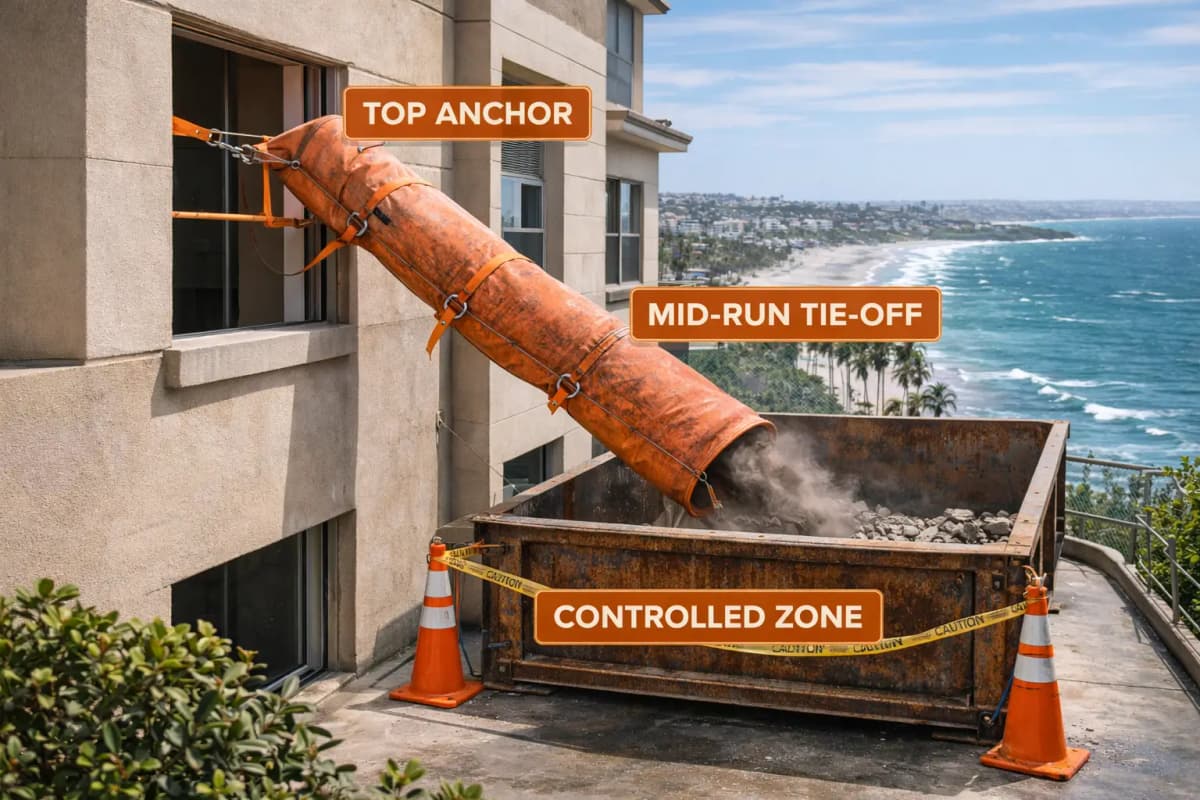
Core risk factors:
- Kinetic energy of falling or ejected material (can exceed 30 mph at discharge)
- Uncontained dust and airborne particles settling on neighboring properties or play areas
- Access to chute openings or loading platforms if barriers are inadequate
- Lack of situational awareness or protective training in minors
- Proximity to active construction zones during peak debris-loading hours
Understanding these risks is the foundation for compliant, ethical setup. Every decision downstream—barrier placement, signage language, operational hours, worker training—flows from this risk assessment.
Pre-Setup Site Assessment When Children Are Present
Before you assemble a single trash chute section, conduct a formal walk-through of the property and adjacent areas to identify where children might be present or accessible. This pre-setup assessment is non-negotiable for residential renovation jobs in neighborhoods, apartment complexes, or properties adjacent to schools or daycare facilities.
Key assessment steps:
- Identify neighboring properties: Schools, daycare centers, parks, playgrounds, or residential units within 150 feet of your job site.
- Map sight lines: Where can children see the chute? Can debris or dust drift onto their property?
- Check access routes: Are there gaps in existing fencing? Can a child wander into the chute zone from a side yard or alley?
- Determine occupancy patterns: When are children most likely to be present? After-school hours? Weekends? Early mornings before school?
- Review property deed and HOA rules: Some covenants restrict or mandate specific chute setups for family-occupied areas.
- Consult the property owner: Ask directly whether children live on-site, visit regularly, or play in adjacent areas. Get their input on preferred setup timing and barriers.
Document your findings in a site photo log with dates and notes. This record protects you if a question arises later about whether you took reasonable precautions.
Perimeter Control and Physical Barriers
A trash chute system with kids on site demands engineered perimeter control. This goes beyond a few orange cones. You need physical barriers that prevent a child from wandering into the chute discharge zone, impact area, or debris staging zone.
Recommended barrier setup:
- Permanent or semi-permanent fencing: Install 6-foot high chain-link or temporary construction fencing around the entire chute footprint and dumpster area. The fence should extend at least 15 feet from the chute discharge point to account for lateral scatter.
- Gates with self-closing hinges: If the barrier must have an access gate for worker use, fit it with a spring-closer and a padlock when the chute is idle or after hours.
- High-visibility tape and netting: Weave bright yellow-and-black or orange-and-white caution tape through the fence mesh. This makes the boundary unmistakable, even in low light.
- No climbing aids: Ensure the fence has no horizontal rails, boxes, or equipment stacked nearby that could allow a child to gain a foothold and climb over.
- Ground-level seal: Bury the fence base 6 inches into the ground or use concrete footings to prevent a child from crawling underneath.
If the site has shared driveways or alleys, reinforce the barrier logic with additional signage at every access point. The goal is to make the chute zone feel off-limits, not just through words, but through the physical environment itself.
Signage, Communication, and Worker Briefing
Clear, multilingual signage is a legal and practical requirement. Contractors in areas with significant Spanish-speaking, Mandarin-speaking, or other language communities must post warnings in those languages as well as English. Signs should use pictograms (universal symbols) to convey the message even if a passerby cannot read the text.
Required signage elements:
- Primary warning sign: “Danger – Falling Debris – No Entry” with a pictogram showing debris and a child in a circle with a slash through it.
- Bilingual or multilingual text: Spanish, and any other local language(s) with 5% or more speaker prevalence in your area.
- Operating hours: Display the hours during which the chute is active. For example, “Active 8 AM–4 PM Weekdays Only.”
- Contact information: Post a supervisor phone number or on-site contact so neighbors can report concerns or emergencies.
- Height and material type: “Heavy Duty Chute – 50ft Coverage – Glass, Metal, Wood Debris” or similar to set expectations about material and reach.
Mount signs at all entry points to the chute zone and at eye level on adjacent properties if your setup is near a shared boundary. Laminate all signage to withstand weather for the duration of the job.
Worker briefing protocol: Before the first day of chute operation, gather all crew members for a 10-minute safety huddle. Specifically address:
- The presence of children on or near the site
- Perimeter barriers and why they exist
- Never allowing a child to enter the chute zone, even if accompanied by a parent or worker
- Reporting any breaches or trespassing attempts immediately to the supervisor
- Proper loading technique to minimize spillage and dust (many workers are unaware that overloading increases ejection velocity and scatter)
Height and Discharge Zone Management
The height from which debris is loaded into a debris chute installation directly influences the velocity and lateral spread of material at the discharge end. When children are on site, you may need to choose a lower chute configuration or staged loading approach, even if it reduces efficiency slightly.
Height-related safety considerations:
- Single-story or two-story drops: If the job allows, use a shorter chute stack (e.g., 25–50 feet rather than the maximum available height). Lower drop = lower discharge velocity = tighter landing zone.
- Discharge angle and direction: Position the chute outlet to discharge material directly into the dumpster, not perpendicular to it. A 90-degree inlet angle can cause material to ricochet.
- Dumpster placement: Position the dumpster directly under or immediately adjacent to the chute outlet. Do not place it 10+ feet away, which increases scatter risk.
- Spillage containment: Deploy plywood or tarps under and around the dumpster to catch any spillage or fine debris before it scatters onto adjacent properties.
If you’re unsure about the optimal trash chute capacity or discharge characteristics for your site geometry, consult the chute manufacturer or a site safety consultant. This is not a place to guess.
Material Velocity and Debris Containment
Debris exiting a tall chute can travel at significant speed. Dust, grout, insulation, and small fragments become projectiles. Containing this particulate—especially where children might inhale it—is critical for both safety and health.
Containment strategies:
- Chute liners or sleeves: Some chutes accept internal mesh or fabric liners that reduce dust escape and catch smaller fragments before they exit the discharge end.
- Discharge covers or deflectors: Install a cover or deflector shroud at the chute outlet to slow material and redirect it downward into the dumpster, not outward.
- Dust suppression spray: Use a fine-mist water spray in and around the chute zone to suppress airborne dust. This is especially effective on dry debris like drywall, tile, or concrete. Schedule this during hours when children are least likely to be nearby (e.g., very early morning).
- High-efficiency particulate air (HEPA) vacuums: Use a HEPA-rated wet/dry vacuum to clean up debris and dust at the base and around the perimeter. Never use a standard shop vac, which re-aerosolizes fine particles.
For heavy-duty trash chute operations involving high-velocity loads (metal scraps, masonry, dense wood), increase the perimeter barrier distance by 25% beyond what you would normally use on an adult-only site.
Operational Protocols During Active Use
How you operate the chute day-to-day is just as important as how you set it up. A well-designed system can fail if the team doesn’t follow protocol.
Daily operational checklist:
- Pre-shift walkthrough: 15 minutes before loading begins, have a crew member inspect the perimeter for breaches, weather damage to barriers, or signs of trespassing.
- Load limiting: Do not overload chute sections. Overstuffed material jams, then suddenly releases with increased velocity. Load until the section is full but not compacted.
- Prohibited items log: Post a list of materials that cannot go in the chute (aerosol cans, hazardous waste, large appliances). Explain why in plain language: “Aerosols can explode” or “Large items jam the chute and create hazards.”
- Staffing the discharge zone: Always have one crew member near the dumpster during active loading to monitor material landing, remove jams, and watch for any unusual behavior or trespassing.
- No loading during peak child-traffic hours: If assessment showed that children are most likely to pass the site between 3–4 PM (school dismissal) or Saturday mornings (play time), schedule debris loading outside those windows when possible.
- Communication protocol: Use two-way radios between the loading platform and dumpster area so crew can signal “clear to load” or “stop – jam” without shouting, which can alarm nearby residents.
Post this checklist on the chute platform or a visible bulletin board so every crew member is reminded each day.
Monitoring and Incident Response
Even with excellent barriers and signage, a child may approach the chute zone out of curiosity or because an adult wasn’t watching closely. Your incident response plan should account for this.
Monitoring practices:
- Designated lookout: On jobs where children are known to be nearby, assign one worker to act as a safety monitor during peak chute-use hours. Their only job during those hours is to watch the perimeter and stop anyone from breaching it.
- Security camera or observation mirror: If budget allows, set up a simple motion-activated camera at the chute discharge zone. Not for surveillance of the neighborhood, but to document any trespassing attempts or debris scatter incidents.
- Neighbor communication: Introduce yourself to the property owner and immediate neighbors before you start. Leave them your cell phone number. Ask them to call if they see children playing near the chute or if debris lands on their property.
Incident response steps:
- If a child is spotted in the chute zone: Stop all loading immediately. Use calm, friendly language (“Hey buddy, this is a construction area – let’s head back that way”). Never physically grab or startle the child. Alert the parent or guardian and the site supervisor. Document the incident with names, times, and photos.
- If debris lands on neighboring property: Stop loading, safely recover the debris, apologize to the neighbor, and document the incident. Check for damage and offer to repair or reimburse. Report to your insurance carrier.
- If a child is injured: Call 911 immediately. Do not move the child. Preserve the scene. Notify your supervisor, the property owner, and your insurance company within 2 hours. Cooperate fully with emergency responders and investigators. Do not admit fault verbally; let your incident documentation speak for itself.
Compliance With Local and OSHA Standards
Trash chute setup in residential areas is subject to multiple layers of regulation. Federal OSHA standards apply to your workers; state and local codes may impose additional requirements, especially where children are involved.
Review OSHA construction industry guidelines for fall prevention, personal protective equipment, and material handling. Focus on sections covering:
- Housekeeping and debris removal (1926.25)
- Fall protection and fall prevention (1926 Subpart R)
- Personal protective equipment (1926 Subpart E)
Additionally, OSHA ergonomics standards address safe lifting and loading practices. Train your crew on proper body mechanics to prevent strain injuries when loading the chute repeatedly.
Check your local building department and health department websites for residential renovation requirements. Many jurisdictions mandate:
- Written waste management plans before permits are issued
- Notification to neighbors 48–72 hours before debris removal begins
- Dust control measures (e.g., water suppression, containment walls)
- Specific signage in local languages
Massachusetts, for example, has specific rules for construction waste handling near schools and residential zones. If you’re unsure, contact your local building inspector or hire a site safety consultant for a pre-job review ($500–$1500 is cheap insurance against a major incident).
Rental vs. Purchase: Choosing the Right Chute for Kid-Safe Jobs
Not all debris chutes are equal when children are on site. A debris chute rental option allows you to select a system specifically designed or configured for lower-risk, lower-velocity operations. Similarly, owning a heavy-duty trash chute gives you flexibility to scale down the configuration for sensitive sites.
Rental advantages for kid-safe sites:
- Access to smaller modular sections (25–50 feet) that reduce velocity
- Rental company may provide site assessment and risk consulting at no extra cost
- Liability often shifts partially to the rental company; confirm coverage in the rental agreement
- No long-term storage or maintenance burden after the job
Purchase advantages:
- Ownership of the asset lets you build a reputation for kid-safe operations if you add safety features (liners, deflectors, dust suppression equipment)
- Long-term cost savings if you run many jobs per year
- Full customization to match your workflow and site safety practices
For contractors new to sites with children present, rental is the safer bet because it spreads liability and ensures you’re using equipment already vetted for that application.
Post-Job Cleanup and Site Restoration
The job isn’t done until the chute is removed and the site is clean. Leftover debris, dust, or scattered material on neighboring properties can cause injury to a child and spark legal complaints.
End-of-job cleanup protocol:
- Final debris sweep: Use a broom, shovel, and HEPA vacuum to clear all loose material from the chute zone and a 20-foot radius around the dumpster.
- Perimeter barrier removal: Once the chute is dismantled and the dumpster is removed, take down all temporary fencing and signage.
- Dust settling and inspection: Leave the site undisturbed for 24 hours so any airborne dust settles. Return the next day for a final walkthrough.
- Neighboring property inspection: Walk adjacent properties to check for debris, dust residue, or damage. Take photos before and after cleanup. If you find debris on a neighbor’s roof or yard, remove it yourself and document the removal.
- Site restoration photos: Take a full set of photos showing the clean site, barriers removed, and all areas restored to pre-chute condition. Keep these for your liability file.
For trash chute cleaning and maintenance, follow manufacturer guidance. If you own the chute, inspect it for damage, wear, or debris lodged inside. Clean the interior and exterior before storing or deploying it on the next job.
Frequently Asked Questions
Can I use a trash chute on a residential job if children live in the adjacent house?
Yes, but only with deliberate safety measures. Install a perimeter barrier at least 15 feet from the discharge point, use multilingual signage, suppress dust, and coordinate with the neighbor on timing and concerns. Consider scheduling high-volume loading during school hours (9 AM–2:30 PM) when children are less likely to be home. Get written permission from both property owners and document your safety plan.
What if a child trespasses into the chute zone despite my barriers?
Stop all loading immediately. Use calm, non-threatening language to guide the child back to their guardian. Do not chase or frighten the child. Alert the site supervisor and the property owner. Document the trespassing with names, times, photos, and witness statements. Review your perimeter barriers for gaps and reinforce them. If trespassing occurs more than once, increase monitoring or request police help in managing repeat incidents.
Do I need separate insurance for jobs with children on site?
Check with your insurance broker. Most general liability policies cover construction debris removal, but some exclude or limit coverage for “premises injury to minors” or “child trespassing.” Disclose to your insurer that you’re working near occupied residential areas with children. They may require additional certificates of insurance, rider coverage, or specific safety documentation before approving the job.
What’s the best time to run a chute when kids are nearby?
Schedule high-volume loading during school hours (approximately 9 AM–3 PM on school days) or very early morning (7–8 AM) before children wake up or leave for school. Avoid after-school hours (3–5 PM), weekends, and early mornings in summer when children are more likely to be at home or playing outdoors. Coordinate with the property owner to confirm the schedule.
Should I use dust suppression on every job with a child nearby?
Yes. Water misting at the chute inlet and discharge point is cheap and effective. It slows dust propagation, reduces velocity of small fragments, and shows the neighbor that you’re taking their concerns seriously. Use a fine mist, not a soaking spray, to avoid clogging the chute or creating mud.
What should I say to a neighbor who complains about dust or debris landing on their property?
Apologize immediately and take full responsibility, even if you’re not sure the debris is yours (it probably is). Offer to clean it up at no charge. Document the cleanup with photos. Invite the neighbor to call you directly if they see any more debris. This turns a complaint into a testimonial of your professionalism.
Is there a checklist I can use before and during the job?
Yes. Combine the pre-setup assessment items, barrier inspection steps, operational checklist, and incident response protocol into a single laminated job card. Review it every morning before loading starts. Share it with the crew so they know what to expect and why. This document also serves as proof of due diligence if you’re ever questioned about safety practices.
Ready to Set Up Safely
Trash chute setup with kids on site is challenging, but it’s absolutely manageable with planning, communication, and the right equipment. The contractors who succeed—and avoid incidents—are the ones who treat child safety as a non-negotiable priority from the moment they accept the job, not an afterthought once the chute is in the air.
Start with a pre-site assessment that identifies neighboring children and traffic patterns. Build your perimeter barriers to engineering standards, not just compliance theater. Post multilingual, pictogram-heavy signage. Train your crew explicitly on the presence of children and the reasons for each safety rule. Monitor the site actively during high-risk hours. And clean up thoroughly before you leave.
If you’re unsure about any aspect of your setup, consult the EPA construction and demolition debris facts for material handling best practices, or hire a site safety consultant to review your plan before you start.
For experienced guidance on selecting the right trash chute sections and configuring them for maximum safety on sensitive sites, reach out to EasyChute. We’ve equipped contractors across the Northeast with systems designed to work safely and efficiently in residential neighborhoods with children present. Let’s build a safer job site together.