
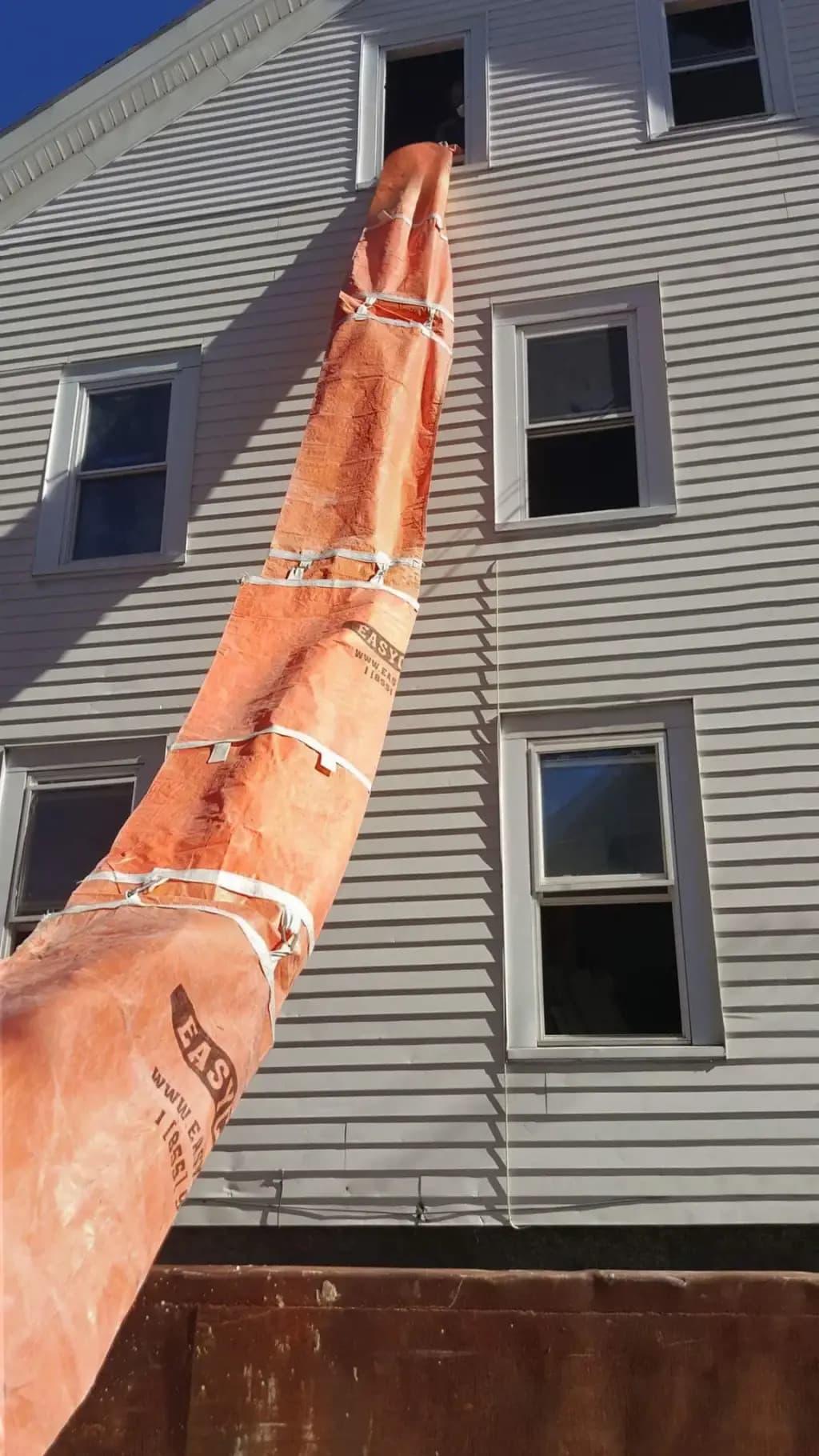
Auburn, MA sits at a crossroads that keeps contractors busy year-round. With dense residential neighborhoods, aging triple-deckers, and a steady pipeline of gut renovations and roofing tear-offs, the town generates a serious volume of construction debris — and moving that debris safely from upper floors to a dumpster below is one of the most underplanned parts of any job. If you're preparing for a project in Auburn and wondering exactly what debris chute setup looks like from start to finish, this guide walks you through every stage.
EasyChute ships its lightweight, reusable fabric debris chutes free to Auburn job sites. A single person can hang, run, and strike a full chute in minutes. Here's what that actually looks like on the ground.
Why Auburn MA Job Sites Need a Debris Chute Strategy
Auburn isn't a dense urban core, but it's not wide-open suburban sprawl either. The town's mix of older two-story colonials, converted multi-families, and commercial strip retrofits means debris drops of 15 to 35 feet are common. Carrying shingles, drywall chunks, or demolition rubble down interior stairs in those conditions isn't just slow — it's a genuine injury risk.
According to OSHA's Construction Industry safety guidelines, struck-by and overexertion injuries are among the leading causes of lost workdays on job sites. A properly rigged debris chute eliminates the manual carry that causes most of those incidents. And in Auburn's tighter neighborhoods, where driveways are narrow and neighbors are close, a chute keeps the work contained and professional-looking.
Typical Auburn Project Types That Benefit from a Chute
- Roofing tear-offs on 1.5- and 2-story homes
- Interior gut renovations in older two-families
- Window and door replacements with associated framing debris
- Attic cleanouts and insulation removal
- Small commercial strip-unit build-outs
- Deck demolitions where the second-floor access is easy to work from
For any of these, a debris chute that runs from the work level straight into a dumpster or trailer below saves hours over the life of a project and keeps your crew working productively instead of hauling up and down stairs.
Choosing the Right EasyChute Section Length for Auburn Drops
EasyChute sections come in three lengths: 10 ft, 25 ft, and 50 ft. They connect with a 1.5 ft overlap, so combining them is easy and the math is straightforward. Before you order, measure your drop — from the window, roof edge, or scaffold level down to the top of your dumpster or debris pile.
Quick Length Reference for Common Auburn Drops
- Single-story roof or second-floor window (10–14 ft drop): One 10 ft section is usually enough
- Two-story roof or third-floor window (18–28 ft drop): Two 10 ft sections joined, or one 25 ft section
- Three-story work or scaffolded commercial building (30–50 ft drop): One 50 ft section, or a combination of 25 ft and 10 ft sections
- Taller custom drops: Multiple 50 ft and 25 ft sections chained together
It's always better to order slightly more than you think you need. An extra 10 ft section weighs under 3 lbs and folds into a small box — it costs nothing to bring it on site and nothing to leave in the truck if you don't need it. Learn more about sizing and configuration in our fabric trash chute guide.
What to Have Ready Before the Chute Arrives on Site
EasyChute ships free to Auburn, MA job sites, but the best setup happens when the site is prepped before the chute even comes out of the box. Take 10 minutes before delivery day to run through this checklist.
Pre-Setup Site Checklist
- Identify your hang point. You need a structural anchor at the top — a window frame, scaffold rail, roof edge joist, or beam. EasyChute hangs from four woven loops using carabiners or quick-connects. If you don't have carabiners on hand, pick up four locking carabiners at any hardware store.
- Position the dumpster or trailer. The chute should drop directly into the dumpster opening. Leave a few feet of lateral wiggle room — you can angle the bottom of the chute if needed.
- Clear the drop zone. Nothing should be in the vertical path below the chute. Brief your crew on the exclusion zone before work starts.
- Check for utility lines. In Auburn neighborhoods, overhead power and cable lines are common. Confirm the chute path doesn't cross any live lines.
- Mark the loading point. Where debris enters the chute at the top should be clearly communicated to everyone on the crew.
Spending 10 minutes on this upfront prevents the two most common setup problems: a chute that won't reach the dumpster and a hang point that shifts under load.
Step-by-Step: How the Setup Process Works
EasyChute is designed for a single person to hang and configure without special tools. Here's the actual sequence, start to finish. For a visual reference, our step-by-step installation guide covers the process in detail.
Step 1: Unbox and Unfold
Each section unfolds from a compact box. Lay the section out on the floor or roof deck and identify the top end — the loops are at the top. If you're connecting multiple sections, lay them all out in order before hanging anything.
Step 2: Connect Sections (If Needed)
Slide the bottom of the upper section 1.5 ft into the top of the lower section. The overlap creates a sealed joint so debris doesn't escape between sections. No tools, no clips — just the overlap. Run your hand around the joint to confirm it's even before hanging.
Step 3: Attach at the Top
Clip your four carabiners through the woven loops at the top of the chute and secure them to your hang point. If you're working from a window opening, the frame jamb or a horizontal board braced across the opening works well. On a roof, the fascia board or a temporary horizontal bar over the edge gives you a solid connection point. Make sure all four loops are under even tension — an uneven hang will cause the chute to twist and slow debris flow.
Step 4: Drop and Aim
Let the chute fall freely into the drop zone. Walk downstairs or down the ladder and check the bottom position. The outlet end should be inside or directly over the dumpster opening. If it's slightly off, you can angle the chute by adjusting which loops you hang from at the top — shifting tension left or right moves the bottom in that direction.
Step 5: Brief the Crew and Start Loading
Before anyone drops debris, make sure all workers on the ground know to stay clear of the chute's footprint. Set a simple rule: no one stands under or directly beside the chute during active use. Then start loading — one person at the top feeds debris in, gravity does the rest.

How Long Does Setup Actually Take in Auburn Conditions?
On a typical Auburn residential job — a two-story home, 20 ft drop, one person doing the hanging — setup runs 10 to 20 minutes from unboxing to first debris drop. That includes unfolding, connecting sections if needed, hanging, and doing a quick safety check.
Teardown at end of day or end of project is even faster. Unclip the carabiners, let the chute drop to ground level, fold it back into sections, and box it. A practiced crew can strike a full chute in 5 to 8 minutes. Because the fabric is woven, coated poly — not paper, not mesh — it shakes clean and goes right back in the box for the next job.
Factors That Affect Setup Speed
- Number of sections being connected: Each joint adds 2–3 minutes of connection time
- Height and access to the hang point: Roof edge hangs from a ladder take slightly longer than window hangs from inside
- Dumpster placement: If the dumpster needs to be repositioned after the chute is hung, that adds time — nail the placement before you hang
- First-time setup vs. repeat: A crew that's used EasyChute before will cut setup time nearly in half by the second or third use
Safety Protocols to Follow During Auburn Job Site Chute Operations
Running a debris chute safely isn't complicated, but it does require consistent discipline — especially on jobs where multiple trades are on site. OSHA's ergonomics and safe loading guidelines are worth reviewing before any crew starts chute work, particularly around proper lifting mechanics at the loading end.
Core Safety Rules for Active Chute Use
- Establish a ground exclusion zone. Mark with cones or caution tape at minimum. No one enters while the chute is active.
- Load one person at a time. Multiple crew members throwing debris simultaneously risks overloading the chute and creating a blockage or sway.
- Don't load oversized pieces. Large sections of drywall or plywood can bridge across the chute opening and cause a jam. Break materials into chute-sized pieces first.
- Inspect the hang points at start of each day. Carabiners and loops take repetitive loading; a 30-second check takes care of this.
- Keep the chute vertical. If the chute is blowing or swaying significantly in wind, pause loading until conditions settle.
Auburn's weather can be unpredictable — late-season wind and rain are real factors on exterior work. The EasyChute's coated fabric sheds moisture well, but windy days do require more attention to chute movement. When in doubt, tie off the mid-section of the chute to the building to stabilize it.
What Auburn Roofers Need to Know About Chute Setup
Roofing tear-offs are probably the most common EasyChute application in Auburn. Shingles are heavy, they slide fast, and the old method of throwing them off the roof into a dumpster (or worse, into a pile on the driveway) is dangerous for everyone below and messy for the homeowner.
Our full roofing trash chute guide goes deep on roofing-specific setup, but here are the key points for Auburn jobs specifically:
Roofing-Specific Setup Tips
- Hang from the fascia board or a temporary horizontal bar set across two rafter tails — both give a stable, structural hang point
- Angle the chute slightly away from the building face so debris doesn't drag against the siding as it falls
- Position the dumpster as close to the building's drip line as possible — minimizing horizontal distance reduces mess outside the dumpster
- For a hip or complex roof, plan your hang point before stripping starts — rerouting a chute mid-job costs time
- Double-check that the chute outlet is fully inside the dumpster before stripping; shingles move fast and don't self-correct
Auburn's older homes often have narrow driveways and close lot lines, which means dumpster placement is tight. If you're working with a small or awkward dumpster position, the chute's flexibility (you can angle it slightly by adjusting loop tension) gives you more options than a rigid metal chute would.
Interior Gut Work and Window-Drop Setups in Auburn Homes
Many Auburn renovation jobs involve interior demo — stripping kitchens, bathrooms, or entire floors in older two-families. The classic approach is to hang the chute from a second- or third-floor window opening, letting it run straight down to the dumpster in the driveway below.
For interior gut work, see our demolition chutes guide for specific techniques around opening prep and debris staging. For Auburn jobs, the practical considerations are:
Window-Drop Setup Considerations
- Remove the window sash before hanging. Trying to work around a window is slower and risks sash damage. Pop the sash out first — it takes 2 minutes.
- Use a horizontal board across the window rough opening as your hang point. A 2x4 braced between the jack studs gives four solid carabiner anchors and doesn't require any attachment to the building exterior.
- Keep the opening clear of foot traffic. Tape off or cone off the window area inside so crew members moving debris don't accidentally walk into the opening.
- Stage debris near the window. Instead of carrying material across the room to the opening one piece at a time, build a small staging pile and feed the chute in batches.
This approach is especially effective in Auburn's older multi-family homes, where stairwells are narrow and carrying heavy demo material down three flights is both slow and physically punishing for the crew.
What Auburn Contractors Say Goes Wrong (And How to Avoid It)
Most setup problems are predictable and preventable. The ones that show up repeatedly on Auburn-area job sites fall into a short list.
Common Setup Mistakes and Fixes
- Ordering short. Measure the full drop from the hang point to the dumpster top, not just the floor height. Add a few feet of buffer. Running 2 feet short means the debris exits above the dumpster and misses — order one extra 10 ft section to cover this.
- Loose hang points. A carabiner clipped to a sagging gutter or rotted fascia will shift under load. Test the hang point before loading — give it a solid tug. If it moves, find a better anchor.
- No ground control. If no one is managing the zone below the chute, tools, materials, or workers can wander into the exclusion zone. Assign one person as the ground spotter, especially at job start.
- Overstuffing the chute. Large or irregular pieces can bridge and block the chute. Break them down first. If a blockage does form, do not reach into the chute from below — approach from the top and clear it from above.
- Skipping the overlap check. On multi-section setups, an uneven overlap joint can open slightly under load. Take 30 seconds to run your hands around each joint before the first debris drop.
Reusing EasyChute Across Multiple Auburn Jobs
One of the biggest financial arguments for owning an EasyChute rather than renting rigid chute sections is the per-job cost over time. The fabric sections are built for reuse — coated poly fabric handles repeated loading, weather exposure, and job-site handling without degrading quickly.
After each Auburn job, the teardown and storage routine is simple:
- Unclip all carabiners and lower the chute to ground level
- Shake out any residual debris from each section
- Fold each section back along its crease lines (they fold predictably because of the woven structure)
- Return each section to its compact box
- Store flat in the truck, trailer, or shop — the boxes stack cleanly
Inspect loops and seams after every 10 to 15 uses. The loops are woven and reinforced, but on high-use sites it's worth confirming there's no fraying at the carabiner contact points. This takes about 2 minutes and extends the working life of the chute significantly.
For a broader look at how the product performs across job types, see our canvas trash chute overview and the construction chute guide for multi-trade environments.
Environmental and Waste Considerations for Auburn MA Projects
Running debris down a chute into a sorted dumpster actually supports better waste diversion than throwing it off a roof into a mixed pile. When material lands in an open pile, it comingles — wood mixes with shingles, metal mixes with drywall — making sorting difficult or impossible at the dump.
A chute-fed dumpster keeps the debris contained and, if you're running multiple containers, makes it easier to separate materials for recycling. The EPA reports that construction and demolition debris accounts for a significant share of total solid waste generated in the United States — and much of it is recyclable if handled correctly on site.
For Auburn contractors working on green-certified or energy-conscious projects, keeping debris handling clean and separated is increasingly part of the job spec. A debris chute makes that easier, not harder. The EPA's recycling guidance provides a solid starting point for understanding which C&D materials have viable recycling streams in Massachusetts.
Ordering and Shipping EasyChute to Auburn, MA
EasyChute ships free to Auburn, MA job sites at fixed prices — no freight surprises, no negotiating. Orders placed online ship quickly, and the compact packaging means sections arrive without the logistics headache of bulky equipment deliveries. You can order from the EasyChute website, and sections ship straight to your site address or home base.
If you have questions about which sections to order for a specific Auburn project, the EasyChute FAQ covers the most common sizing and configuration questions. You can also contact the team directly — the product was built by contractors, and that background shows in how the support conversations go.
To see the chute in real job-site conditions before ordering, the EasyChute video library shows actual installations across different building types and drop heights.
Frequently Asked Questions
How long does it take to set up a debris chute on a typical Auburn residential job?
For a standard Auburn two-story home with a 20 ft drop, one person can complete setup — unboxing, section connection, hanging, and safety check — in about 10 to 20 minutes. If you've run the chute before and have your hang point already identified, it's closer to 10 minutes. Teardown at end of day runs 5 to 8 minutes. The more you use the system, the faster every step gets.
Do I need special tools or hardware to hang an EasyChute in Auburn?
No special tools are required. The chute hangs from four woven loops using standard carabiners or quick-connects — the kind available at any hardware store. No drilling, no mounting hardware, and no modifications to the building are needed. One person can carry, hang, and configure the full setup. If you already have locking carabiners from other site work, those work perfectly.
What size chute do I need for a roofing job on an Auburn two-story home?
Most two-story Auburn homes have an eave height of 18 to 24 feet. Add a few feet for the dumpster height and you're typically looking at a 20 to 28 ft effective drop. Two connected 10 ft sections or one 25 ft section covers this range comfortably. It's worth measuring your specific drop before ordering — always round up to the next section increment so the outlet sits inside the dumpster, not above it.
Can one person set up and strike an EasyChute alone on an Auburn job site?
Yes. A 10 ft EasyChute section weighs under 3 lbs and folds into a compact box, so carrying and unfolding are genuinely one-person tasks. Hanging is also designed for solo work — clip the loops at the top, let the chute drop, and walk down to check placement. For multi-section setups at greater heights, a second person speeds things up slightly, but it's not required. Single-operator setup is a core part of how the product is designed.
Is a debris chute required by code for Auburn construction projects?
Code requirements for debris chutes vary by project type, height, and local authority. Some Massachusetts building permits and OSHA jobsite safety standards do require controlled debris removal for projects above certain heights. Check with the Auburn Building Department and review applicable OSHA construction standards for your specific project. Even where a chute is not strictly required, using one is a recognized best practice for safety and site management.
How do I keep the EasyChute from swaying in wind during an Auburn exterior job?
Wind is a real factor on exterior Auburn jobs, particularly in fall and spring. If the chute is swaying, tie the mid-section loosely to the building face using a bungee cord or soft strap — this damps movement without restricting debris flow. On very windy days, pause loading until conditions settle. The coated poly fabric is weather-resistant, but a chute under heavy lateral movement is harder to control safely at the loading end.
What materials can I drop through an EasyChute on an Auburn demo or roofing job?
EasyChute handles the full range of standard construction debris: asphalt shingles, drywall chunks, wood framing scraps, insulation batts, plaster, tile, and similar materials. Break large or irregular pieces down before loading — oversized pieces can bridge the chute opening and cause a blockage. Avoid loading sharp metal objects like long nails or screws loose, as they can accelerate fabric wear over time. For standard residential demo and roofing work in Auburn, the chute handles the material load without issue.
Ready to Set Up Your Debris Chute on Your Next Auburn Job?
EasyChute ships free to Auburn, MA — order the sections that match your drop height, and you can have a full chute running on your next job in under 20 minutes. No rental logistics, no rigid equipment to manage, no crew of two required for setup.
Start with the debris chute overview to confirm the right configuration, check the FAQ if you have sizing questions, and reach out directly if you want to talk through your specific Auburn project before ordering. The chute was designed by people who've worked the same kinds of jobs you're running — and that makes the conversation a useful one.