
Connecticut job sites come in all shapes — Fairfield County brownstones, New Haven triple-deckers, Hartford gut renovations, and coastal Westport teardowns where the homeowners are still living two doors down. And in many of those settings, children are part of the picture. Kids playing in a driveway. A toddler in the backyard of an attached unit. A school two lots away. A daycare across the alley.
Debris chutes make waste removal dramatically faster and safer for your crew. But if children are present on or near a job site, the way you set up and operate that chute matters more than the chute itself. This guide walks Connecticut contractors through every angle of running a debris chute safely when kids are in the equation — from site layout to anchor points, signage, timing, and crew communication.
Why Connecticut Job Sites Demand Extra Attention to Child Safety
Connecticut is densely developed. Even suburban towns like Westport, Glastonbury, or Ridgefield often have homes so close together that a dumpster placed on your worksite is practically in someone else's side yard. Urban settings — New Haven, Bridgeport, Stamford, Hartford — routinely have pedestrians, cyclists, and children within feet of an active renovation.
The state also has a high proportion of occupied-during-renovation projects. Homeowners remodeling a second-floor bathroom often keep kids home during the work. Multi-family buildings get gut-renovated one unit at a time while families live downstairs. That proximity creates a real hazard when debris is moving from height.
What Makes Falling Debris Especially Dangerous for Children
Children's reaction times are slower than adults. They are shorter, which means their head and torso are at exactly the height where a bouncing piece of shingle, wood scrap, or plaster chunk is most likely to travel after leaving a chute. And children are unpredictable — they will walk under a chute because they are curious about where it goes, not because they are being reckless.
- A 10-lb piece of shingles dropped from 20 feet carries significant kinetic energy by the time it exits the chute
- Lightweight debris like paper, insulation fluff, or dust can scatter well beyond the dumpster footprint
- Children who are playing outdoors are often not watching construction activity until something lands near them
Choosing the Right Chute Section Length for Your Drop Zone
One of the most practical safety decisions a contractor makes before any debris moves is choosing the correct chute length. A chute that terminates too high above the dumpster creates a secondary fall zone — debris exits with velocity and can ricochet. A chute that is too long can drag on the ground, creating a tripping hazard.
EasyChute sections come in 10-ft, 25-ft, and 50-ft lengths, with a 1.5-ft overlap at each connection point. For a typical two-story Connecticut colonial, two 10-ft sections connected end-to-end typically put the chute exit within 2 to 3 feet of the dumpster opening — the sweet spot. For a three-story or higher drop, a 25-ft or 50-ft section gets you there in one run, reducing the number of connections a crew has to manage overhead.
Calculating Your Drop Distance Before Kids Arrive
Do this math during your site walk, before the first work day begins:
- Measure floor-to-ground height at the window or roof edge where the chute will hang
- Subtract the dumpster height (typically 36 to 48 inches for a standard roll-off)
- Add 18 inches for the overlap between sections to get total connected chute length
- Your chute exit should clear the dumpster top by no more than 24 inches to minimize exit velocity scatter
Getting this calculation right means debris travels in a controlled column, not a fan pattern. For more on setup mechanics, the step-by-step EasyChute installation guide walks you through the full process.
Anchor Points and Hang Height: Keeping the Chute Rigid Under Load
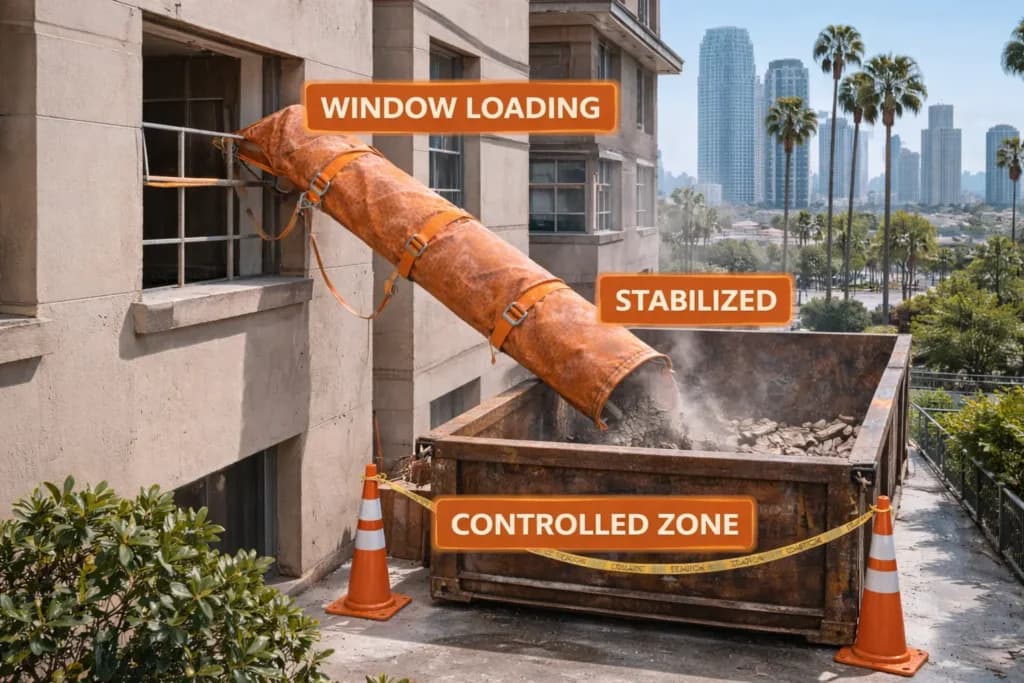
A loose, swinging chute is a hazard even on job sites with no children nearby. When kids are present, a chute that shifts under load can redirect debris unpredictably. The goal is a straight, controlled column from anchor point to dumpster — as a controlled zone every time debris is moving.
Secure Anchor Techniques for Connecticut Building Types
Connecticut's housing stock includes a lot of older wood-frame construction, masonry triple-deckers, and mixed-use buildings. Each anchor situation is a little different:
- Window frame hangs: Run a 2x4 or metal bar across the inside of the window opening and clip the chute's four woven loops to that bar with carabiners — no drilling required, works on virtually any window
- Roof edge hangs: Use a roof anchor bracket rated for the chute weight, or loop over a ridge board with a secondary safety line; never rely on a single point of contact
- Scaffold hangs: Attach to the scaffold frame at two or more height points to prevent pendulum swing; check that the scaffold load rating accounts for dynamic debris impact
EasyChute's four woven loop design distributes load evenly, which matters when a large piece of drywall or a bundle of shingles hits the chute mid-travel. The roofing trash chute guide goes deeper on anchor setups for tear-off work specifically.
Establishing a Child-Free Exclusion Zone Around the Chute
This is the single most important step when children are on or near a Connecticut job site. Before any debris moves, you need a defined, visually obvious exclusion zone around the dumpster and the chute exit. Everyone on your crew — and every adult on the property — needs to know the zone exists and what it means.
How to Define and Mark the Exclusion Zone
The zone should extend at minimum 10 feet in every direction from the dumpster. In practice, that means:
- Orange safety fencing or snow fence staked at the perimeter
- At least two visible warning signs facing the approaches children are most likely to use — typically the driveway and the backyard path
- A rope or caution tape secondary barrier at the base of the chute itself, in case a piece of debris misses the dumpster
- Verbal briefings with the homeowner or property manager every morning before work begins
Communicating the Zone to Homeowners and Parents
Do not assume parents will manage their children without direct instruction. Have a brief conversation — 60 seconds is enough — at the start of each day. Explain that debris will be moving from height at specific times, and that the zone around the dumpster is off-limits for children during those periods. Most parents appreciate the specificity. It tells them you are paying attention.
Many Connecticut contractors working in occupied homes find it effective to give a heads-up 5 minutes before debris drops begin — a knock on the door or a text to the homeowner. This creates a natural checkpoint that also helps your crew work more deliberately.
Timing Debris Drops to Minimize Child Exposure
Even with a perfect exclusion zone, the safest debris drop is one that happens when children are least likely to be in the area. Connecticut schools generally run 8:00 AM to 3:00 PM on weekdays, which gives you a predictable window. For projects where kids are home all day — summer, remote learning days, occupied rentals — you need a different approach.
- Batch debris drops: Instead of continuous chuting, collect debris on the floor and run chute drops in 15 to 20 minute windows at scheduled intervals — this lets you announce and enforce zone clearance each time
- Avoid drop activity during nap windows for homes with toddlers — typically 12:00 PM to 2:00 PM — not because of safety but because it reduces the chance of a child waking up and wandering outside
- Coordinate with daycare pickup and drop-off times if your project is adjacent to a home-based daycare or near a school dropoff route
Using a Spotter During Every Drop Session
On any job site where children may be present, assign one crew member as a ground-level spotter during every debris drop window. Their only job during that window is to watch the exclusion zone and the surrounding area. They do not load debris. They do not answer questions. They watch and they call a stop if any child approaches. This is a simple, low-cost protocol that eliminates most risk. OSHA's construction safety standards emphasize the value of designated safety roles precisely because split attention during debris handling is when most incidents occur.
Debris Chute Load Discipline: What Goes In and What Stays Out
Not everything should go down a chute, and this is especially important when children might be in the vicinity. Lightweight debris that can exit the chute as airborne particles — insulation batts, paper, drywall dust — can travel far beyond the dumpster footprint. Heavy, irregular items — long pieces of baseboard, pipe sections, concrete chunks — can jam the chute and cause a sudden load release.
What to Chute and What to Bag First
- Chute-safe: broken drywall pieces, shingle bundles, roofing felt, broken tile, small lumber scraps, bagged insulation
- Bag before chuting: loose insulation, sawdust and plaster dust, small debris that can aerosolize
- Lower by hand or bucket: long boards or pipes over 6 feet, oversized concrete chunks, anything that could bridge across the chute diameter
Bagging loose material before it goes down the chute is especially important in Connecticut's older housing stock, which often contains legacy materials — older vermiculite insulation, deteriorating plaster with lead paint, asbestos-containing floor tiles. Even if testing has cleared the material, bagging it protects everyone downwind, including children playing nearby. The EPA's construction and demolition debris data underscores how significant the material volume and variety is on typical renovation sites.
Personal Protective Equipment and Crew Accountability
When a job site has children nearby, PPE discipline on your crew sets the tone. A crew working visibly safely — hard hats on, gloves on, spotter in position — also signals to parents and neighbors that the site is being managed professionally. That social signal matters for your reputation in Connecticut's tight-knit communities.
Minimum PPE for Chute Operations Near Children
- Hard hats for all crew members on the floor loading the chute
- Safety glasses or goggles when loading dusty or fragmented material
- Cut-resistant gloves for handling broken tile, metal flashing, and shingle bundles
- High-visibility vest for the ground-level spotter so they are clearly identifiable
- Steel-toed boots for all crew members — debris jams can cause sudden weight releases
OSHA's ergonomics guidelines are worth reviewing for chute-loading tasks specifically — the combination of bending, lifting, and reaching at a window or roof edge creates cumulative strain that also affects crew attention. A tired crew member loading a chute is less likely to notice a child entering the zone below.
Neighboring Properties in Residential Neighborhoods
In many Connecticut towns — particularly in older neighborhoods in New Haven, Bridgeport, Stamford, and Hartford — houses are set close together. A debris chute exiting from the second floor of one property can be visually and physically within range of a neighbor's yard. Children from neighboring homes are not always visible until they are very close.
Pre-Project Neighbor Notification
Before work begins on a job where a chute will be in use, consider a brief door-knock to immediately adjacent neighbors:
- Introduce yourself and your company
- Explain that a debris chute will be in operation and identify approximately where the dumpster will sit
- Ask if they have children who play in the yard or area near your dumpster location
- Share the general window of work hours so they can plan accordingly
This takes under 10 minutes and virtually eliminates the scenario where a neighbor's child wanders into your work zone without anyone knowing they were nearby. It is also the kind of professional courtesy that generates referral business in Connecticut's residential markets. See the debris chute installation guide for Massachusetts for comparable considerations in similar dense-suburb environments.
Debris Chute Stability in Connecticut Weather Conditions
Connecticut weather adds an environmental layer to job site safety. Wind from Long Island Sound can be significant in coastal towns like Westport, Guilford, and Old Saybrook. A chute that is hanging stably in still air can begin to swing and redirect debris in a 20 mph onshore breeze. Fall and spring renovations in Connecticut also bring sudden rain squalls that can make footing on upper floors treacherous just as a crew member is loading the chute.
Wind and Weather Protocols for Chute Operations
- At sustained winds above 20 mph, pause chute operations and secure the bottom of the chute to the dumpster with a bungee or rope to prevent swing
- In rain or wet conditions, increase the exclusion zone by an additional 5 feet — wet debris exits faster and may carry further from the dumpster
- Confirm the chute hang is secure after any significant gust — wind can loosen carabiner gates if they are not locking-style
- Use locking carabiners rather than basic snap-gate for all four hang loops when working in coastal or exposed sites
The fabric trash chute guide covers how woven poly construction handles dynamic loading and weather exposure compared to rigid alternatives — relevant reading for contractors choosing between chute types.
Lightweight Chute Design as a Safety Advantage When Kids Are Near
It is worth noting that chute weight itself is a safety variable. Heavy, rigid chutes — steel or fiberglass tube sections — are harder to strike quickly when an unexpected situation develops below. If a child runs into the exclusion zone during a drop, you need to be able to stop operations fast and, if necessary, remove the chute quickly to prevent further risk.
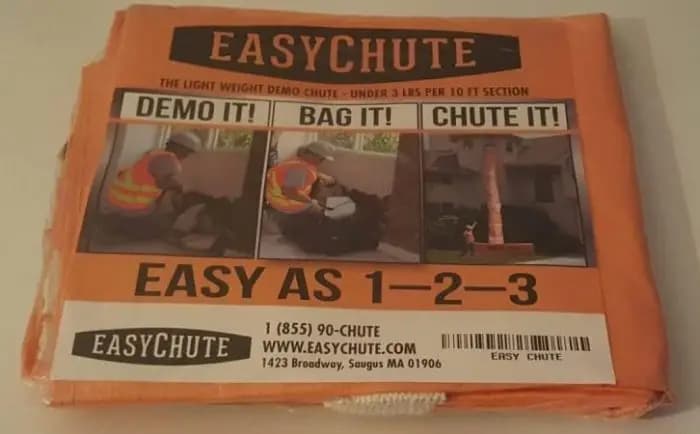
EasyChute's fabric sections weigh under 3 lbs per 10-ft section. One person can hang or strike a section in minutes without scaffolding or a second crew member. That speed and simplicity means your safety response time — the time between recognizing a hazard and neutralizing it — is much shorter than with heavier equipment. The canvas trash chute comparison guide explains the tradeoffs between fabric types and weights in more detail.
Documentation: Creating a Job-Site Safety Record
Connecticut contractors working in occupied residences or near schools are wise to keep a brief written safety record for every job where a debris chute is in operation. This is not bureaucratic overhead — it is protection in the event of a complaint or incident inquiry, and it also formalizes your safety culture for crew members who may be working a job solo or with a small team.
What to Document on Each Debris Chute Job
- Date and time of chute installation and strike
- Sections used and anchor point method
- Exclusion zone dimensions and marking method used
- Name of designated spotter for each drop session
- Any incidents or near-misses, however minor
- Homeowner or property manager briefing confirmation
A simple one-page form per job is sufficient. Many Connecticut contractors use a photo of the exclusion zone setup as part of their documentation — a time-stamped photo showing fencing, signage, and chute position serves as contemporaneous evidence of a safe setup. For a full look at how EasyChute is used across different project types, the EasyChute video library shows real-world installs.
Reusability and Repeatability: Building a Safety System That Scales
The practical advantage of a reusable chute system like EasyChute is that it rewards investment in safety process. If you buy a chute, build a setup protocol around it, and train your crew once, that system repeats across every job for years. The alternative — improvising debris removal job by job — means safety depends on whoever happens to be on site that day, which is exactly the kind of inconsistency that creates incidents.
Connecticut contractors who use a consistent chute setup on every job also find that homeowners respond well to the visible professionalism of the system. A properly hung chute with clear exclusion zone markings looks like a company that knows what it is doing. That matters in a market like Fairfield County or the greater Hartford area where word-of-mouth reputation is a primary driver of new business. The demolition chute guide covers how to systematize chute operations for interior gut work, which often involves the most complex occupied-building scenarios.
Frequently Asked Questions
How far from a debris chute exit should children be kept?
The minimum recommended exclusion zone is 10 feet in every direction from the dumpster. In practice, this means fencing or barrier tape at that radius, with signage at the most likely approach paths. If wind is present or you are chuting lightweight material that may scatter, expand the zone to 15 feet. The key is making the boundary visible and enforcing it actively with a spotter during every drop session, not just posting a sign and moving on.
Do Connecticut contractors need a permit to use a debris chute?
Permit requirements vary by municipality. Most Connecticut towns do not require a separate permit for a debris chute, but the dumpster placement itself often requires a right-of-way or street placement permit from the town public works department if it sits on a public road or sidewalk. Check with your local building department before the job starts. Some towns — particularly in Fairfield County — have specific requirements about dumpster signage and lighting that apply to your overall site setup.
Can one person safely hang and operate a fabric debris chute alone?
Yes, for a single-section hang from a window opening, one person can typically hang, adjust, and strike an EasyChute section in under 10 minutes. However, when children are on or near the site, solo operation of the chute is not advisable. You need at minimum one person at the loading point and one person as a ground-level spotter. Safety protocol should not be compromised because of crew size — if you are running a one-person job in a setting with children nearby, batch debris and wait for a clear zone window before each drop.
What should I do if a child enters the exclusion zone during a debris drop?
Stop the drop immediately. Call out clearly to alert everyone on the loading floor to pause. The ground spotter should calmly direct the child out of the zone and back to a parent or guardian. Do not resume operations until the child is well clear of the zone and the exclusion boundary has been re-established. After the incident, document it briefly and have a conversation with the parent or homeowner to reinforce the protocol. Never resume a drop while anyone — adult or child — is inside the zone without full situational awareness.
Are fabric debris chutes safe for roofing tear-offs near residential yards?
Fabric chutes are well-suited for roofing tear-offs because they are flexible enough to conform to the roof edge angle without creating a rigid protrusion. For roofing work near residential yards, the same exclusion zone rules apply. Shingle debris in particular can include sharp granule particles that scatter, so ensure the chute exit is positioned directly over the dumpster opening and that the zone below is clear before each load. The roofing trash chute guide covers specific setup considerations for tear-off work.
How do I explain the debris chute safety protocol to a homeowner with young children?
Keep it simple and direct. Explain that you use a chute to move debris safely from upper floors into the dumpster, that there is a zone around the dumpster that is off-limits while debris is moving, and that you will give them a heads-up before each drop window so they can keep children inside or away from the area. Most parents respond well to being treated as partners in the safety plan rather than obstacles to the work schedule. A brief daily check-in at the start of each work day takes two minutes and prevents most issues before they happen.
What is the best way to prevent debris from missing the dumpster and landing in the yard?
The most effective method is proper chute length calculation so the exit sits within 24 inches of the dumpster opening, combined with batching debris so you are loading the chute in controlled amounts rather than continuous streams. Use a chute funnel or bag top adapter if your chute system supports one. Keep large, irregular pieces out of the chute and lower them separately. If your dumpster has open ends, orient it so the chute exit aligns with the closed long side — this gives debris the best chance of landing inside rather than bouncing out.
Ready to Set Up Your Connecticut Job Site Safely
Running a debris chute safely when children are present is not complicated — but it does require a consistent system. Clear exclusion zones. A dedicated spotter. Scheduled drop windows. The right chute length for your drop distance. And a brief daily conversation with the homeowner or property manager so everyone on the property knows when debris is moving.
EasyChute's lightweight fabric sections make it easy to build that system and repeat it job after job across Connecticut. Sections weigh under 3 lbs, hang in minutes from any window or roof edge with standard carabiners, and fold down small enough to carry in a truck cab. Free shipping to job sites across Connecticut and the rest of the United States.
Visit the EasyChute FAQ for more answered questions, browse the full debris chute guide, or contact EasyChute directly to talk through the right section configuration for your next Connecticut project.