

If you've ever priced out a debris removal setup for a multi-story renovation, roofing tear-off, or gut-demo job, you already know how fast the numbers can spiral. A modular trash chute kit is one of the smartest investments a contractor or junk removal crew can make — but only when you understand exactly what you're paying for, what drives the cost up or down, and how to spec the right system for your job before you click "buy."
This guide breaks down the full cost of a modular trash chute kit from first purchase through years of reuse. No vague price ranges. No surprises. Just a clear-eyed look at what every line item means so you can make an informed decision and get debris moving safely on your next job.
What Is a Modular Trash Chute Kit and Why Does Modularity Matter?
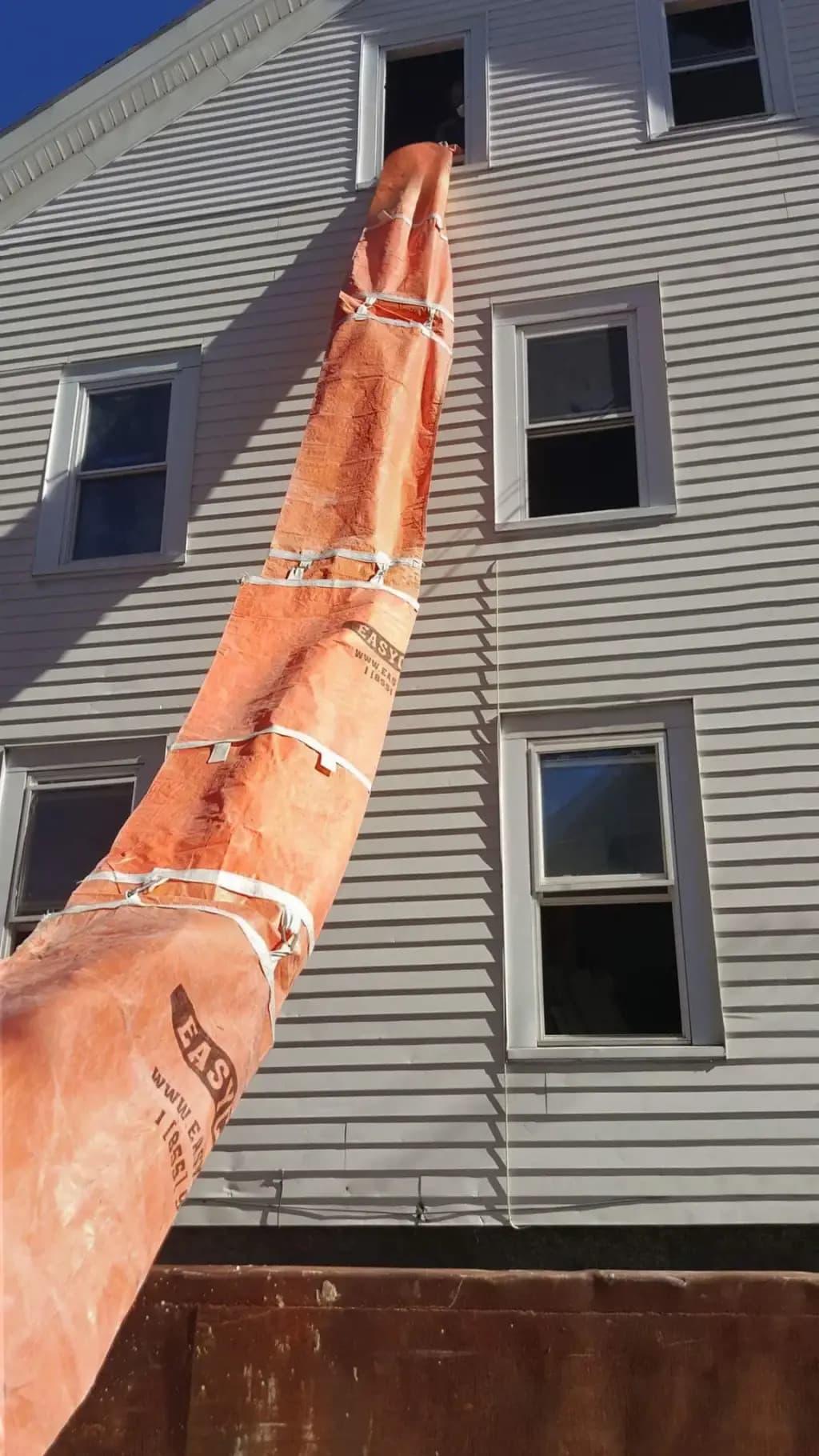
A modular trash chute is a debris drop system made from individual sections — typically 10, 25, or 50 feet long — that connect together to reach whatever drop distance your job demands. Each section overlaps the one below it, creating a sealed channel that guides debris from an upper-floor window, roof edge, or scaffold platform straight into a dumpster or collection bag at ground level.
The modularity is the entire value proposition. Instead of buying one fixed-length rigid chute and hoping it fits every job, you buy sections and configure the system on-site. Working a two-story house? Use two 10-foot sections. Taking on a five-story gut job in a dense urban corridor? Stack sections until you reach the dumpster. The system scales with the work.
EasyChute's woven, coated poly fabric sections are the clearest example of how this works in practice. A single 10-foot section weighs under 3 lbs and folds into a compact box, so a solo worker can carry, hang, and connect multiple sections in minutes. That portability directly reduces labor cost — which is a cost the section price alone will never tell you.
To get a full picture of how debris chutes work and how to choose the right one, it helps to understand the mechanics before you start pricing sections.
The Core Components That Drive Modular Trash Chute Kit Pricing
A modular trash chute kit isn't a single SKU. It's a system. Here's every component that either comes in the box or needs to be sourced separately — and how each one affects what you pay overall.
Chute Sections: The Primary Cost Driver
The fabric or material sections themselves account for the majority of any modular trash chute kit cost. Section length and material grade are the two biggest levers. A 10-foot lite-duty section runs significantly cheaper than a 50-foot heavy-duty section — the material, manufacturing complexity, and shipping weight all scale accordingly.
- 10 ft Lite-Duty Section: Designed for light debris — drywall scraps, insulation, packaging waste. Lowest per-section cost; ideal for interior renovation top-ups.
- 10 ft Heavy-Duty Section: Built for high-impact debris like asphalt shingles, concrete chunks, and dense demo material. Slightly higher cost per section due to reinforced fabric weight.
- 25 ft Section: Mid-range length at a mid-range price point. Good for three- to four-story drops without purchasing multiple shorter sections.
- 50 ft Section: The highest unit cost but lowest cost-per-foot for tall buildings. One 50 ft section covers what would otherwise take five 10-foot sections to achieve.
Connection Hardware: Carabiners, Hooks, and Quick-Connects
EasyChute sections hang from four woven loops using standard carabiners or quick-connect hardware. Many crews already have these on the truck. If you don't, factor in a small hardware cost — typically a few dollars per carabiner at any hardware store. This is one line item where you genuinely have no excuse to overpay.
Mounting Anchors and Attachment Points
Where you anchor the top section determines how you mount it. Common anchor options include:
- Window frame brackets bolted temporarily to the sill
- Scaffold pipe clamps with hook attachment
- Roof-edge anchor boards screwed to the fascia
- Jib arm setups for high-rise or complex geometry
For most residential and light commercial jobs, the mounting solution costs little to nothing beyond what the crew already owns. Complex commercial installs may require purpose-built brackets, which can add to your setup cost.
Dumpster or Collection Bag
The receiving end of the system isn't technically part of the chute kit, but it's part of the total job cost. A roll-off dumpster rental, a debris bag like a Junkster Bag, or a truck bed lined with a tarp all serve as viable landing zones. EasyChute's 22-inch diameter outlet fits neatly into most standard roll-off openings without guides.
Section Count vs. Drop Distance: How to Spec Your Kit Without Overspending
One of the most common mistakes contractors make when pricing a modular trash chute kit is buying too many short sections when one long section would do the job cheaper. The table below shows how section choices affect cost efficiency at common building heights.
Drop Distance Planning Guide
- One-story drop (8-12 ft): One 10 ft section is usually sufficient. No stacking needed.
- Two-story drop (18-24 ft): Two 10 ft sections with 1.5 ft overlap gives you roughly 17 usable feet of drop — enough for most two-story residential jobs.
- Three-story drop (28-36 ft): One 25 ft section, or three 10 ft sections. The 25 ft section is almost always cheaper and faster to rig.
- Four-story drop (38-48 ft): One 25 ft plus one 10 ft section, or one 50 ft section cut to effective length with the overlap. Run the math before you buy.
- Five-story and above: One 50 ft section or a combination of 25 ft and 10 ft sections. At this height, a single 50 ft section almost always wins on both cost and rigging speed.
Remember that the 1.5-foot overlap where sections connect means your effective drop distance is slightly less than the sum of section lengths. Account for this when planning, especially on tighter drops. You can find more on this in the step-by-step EasyChute installation guide.
Shipping Costs: What Free Shipping Really Means for Your Budget
Shipping is the silent line item that inflates the apparent cost of many construction supply purchases. Heavy steel or rigid plastic chute systems can add substantial freight charges — especially for multi-section orders or job sites outside major metro areas.
EasyChute ships free to job sites across the United States. Because a 10-foot poly fabric section weighs under 3 lbs and folds into a small package, the shipping economics are completely different from steel or fiberglass systems. You're not paying freight for 40 pounds of rigid pipe.
When you're doing your own modular trash chute kit cost breakdown, always add the real shipping cost to competitor prices. A section that appears $30 cheaper may arrive with $45 in freight charges — putting EasyChute's free-ship pricing well ahead of the headline number suggests.
Material Quality and Its Effect on Long-Term Cost Per Use
The sticker price on a modular trash chute section is almost irrelevant without knowing how many jobs you'll get out of it. A cheap single-use chute isn't cheap if you're buying a new one every two jobs. A durable reusable chute that lasts 50 jobs is exceptional value even at a higher unit price.
What to Look for in Chute Fabric
- Woven poly construction: Resists tearing and puncture from sharp debris edges — asphalt shingle granules, broken tile, framing nails, concrete chunks.
- Coated surface: The coating prevents debris absorption, makes cleanup faster, and extends lifespan by protecting the weave from moisture and UV degradation.
- Reinforced loop attachments: The four hanging loops are the stress point of any fabric chute. Reinforced stitching at each loop junction is non-negotiable for heavy-duty use.
- Overlap design: A consistent 1.5-foot overlap (as specified in EasyChute's system) ensures sections seat properly without debris leaking at joints.
Canvas vs. Poly: A Cost and Durability Comparison
Canvas chutes have been used in construction for decades, but woven poly fabric has largely replaced them for good reason. Canvas is heavier, absorbs moisture, and degrades faster under repeated wet/dry cycling. Poly fabric is lighter, easier to clean, and maintains integrity across more job cycles. For a deeper look at how the materials compare, see the guide on canvas vs. poly trash chutes for roofing and demolition.
Hidden Costs of NOT Using a Modular Trash Chute System
The cost of a modular trash chute kit looks very different when you put it next to the real cost of skipping it. This is where contractors who've been doing things the hard way start paying close attention.
Manual Carry Labor Cost
Two workers carrying debris bags down stairs on a three-story gut job can eat through 2-4 hours of combined labor per day just in trips. At $35-$55 per worker hour, that's $140 to $440 in daily labor that a chute system eliminates almost entirely. At that rate, a complete modular chute kit pays for itself in a single day on a mid-size job.
Worker Injury Risk and OSHA Compliance
Manual debris handling is one of the leading sources of musculoskeletal injuries in construction. OSHA's ergonomics guidance explicitly identifies repeated lifting and carrying as high-risk activities — and an injury claim or OSHA citation costs far more than any chute system ever will. Using a chute reduces the number of trips, the total load per worker, and the awkward stair-carry postures that cause back and shoulder injuries.
OSHA's construction industry safety standards are worth reviewing for any crew that regularly works above the first floor. A documented debris management system using a chute is also a visible demonstration of safety compliance during site inspections.
Dumpster Overflow and Extra Haul Fees
When debris drops are uncontrolled — tossed out windows, pitched off roofs — material scatters. Scattered material misses the dumpster, gets compacted unevenly, and leads to costly overfill hauls. A chute that drops debris directly into the container reduces scatter waste and lets the dumpster fill evenly, which directly reduces haul frequency on longer jobs.
Modular Trash Chute Kit Cost Breakdown: The Full Accounting
Here's how a typical modular trash chute kit cost breaks down for common job types. These are illustrative frameworks — not quotes — but they reflect the real structure of what you're buying.
Residential Roofing Tear-Off (Two-Story House)
- Two 10 ft heavy-duty sections
- Carabiners (if not already owned): minimal hardware cost
- Shipping: free
- Roof-edge mounting: existing lumber or fascia board at zero material cost
- Total kit cost: Cost of two sections. Setup time: under 15 minutes for a two-person crew.
For everything a roofing crew needs to know about chute setup, the complete guide to roofing trash chutes for shingle tear-offs covers hanging angles, outlet positioning, and shingle flow management.
Interior Gut Renovation (Three-Story Urban Rowhouse)
- One 25 ft section (or three 10 ft sections — run the cost comparison)
- Window frame mounting bracket or scaffold pipe clamp
- Carabiners: four, standard hardware store grade
- Shipping: free
- Total kit cost: One to three sections plus a few dollars in hardware. Reusable for every subsequent job.
Multi-Floor Commercial Demolition (Five Stories)
- One 50 ft section, or a combination of 25 ft and 10 ft sections depending on drop geometry
- Scaffold pipe mounting hardware
- Carabiners or quick-connects at each connection point
- Shipping: free
- Total kit cost: Higher than single-job residential, but amortized across multiple commercial jobs at this scale, cost-per-job becomes very low.
For a broader look at commercial applications, the guide to construction chutes for upper-floor debris removal goes deep on multi-story setups and contractor workflows.
Reusability: The Metric That Changes Every Cost Calculation
Most debris removal products are single-use or near-single-use. A plastic debris chute section from a box store might survive one or two jobs before the fabric tears or the seams fail. EasyChute sections are designed to be reused job after job — by the same crew, across different projects, for years.
When you divide the total cost of your modular kit by the number of jobs it serves, the cost-per-job drops sharply with each successive use. After ten jobs, a kit that seemed pricey at purchase is already delivering exceptional return. After twenty or thirty jobs, the economics are undeniable.
This is why the case for a fabric trash chute over disposable alternatives comes down to reuse cycles above everything else. The fabric construction, the coated surface, and the reinforced attachment loops all exist to maximize that reuse count.
Comparing Modular Poly Fabric Chutes to Other System Types
Not all modular trash chute systems are created equal. Here's how poly fabric modular chutes stack up against the alternatives on the metrics that actually matter for job site budgeting.
Rigid Steel or Plastic Chutes
Rigid chute sections are durable in high-volume permanent installations — permanent trash chutes in apartment buildings, for example. But for job-site use, they're expensive, heavy, difficult to transport, and require dedicated storage. A set of steel sections that covers five stories can weigh hundreds of pounds and require a truck just to move them between sites. The upfront cost is also significantly higher than fabric alternatives.
Improvised Tarps and Bags
Some crews improvise by dropping debris in large bags thrown from upper floors or sliding it down tarps laid against the building exterior. These approaches are slow, dangerous, and create scatter waste. They also carry real OSHA compliance risk — uncontrolled debris drops are a documented hazard under construction fall protection and debris management rules.
Single-Use Paper or Thin Plastic Chutes
Inexpensive single-use chutes look cheap on the invoice but are expensive at the job-year level. If you're running 30 jobs per year, buying a new cheap chute each time costs more annually than a durable modular kit that serves all 30 jobs and keeps going. The construction chute buying guide for contractors lays out exactly how to evaluate this math before purchasing.
Where Location Affects Your Modular Trash Chute Kit Cost
Geography can affect chute costs in a few indirect ways, even when the product price and shipping are fixed.
Urban Dense Markets
In dense urban settings — Manhattan, Chicago, Boston, Philadelphia — debris removal logistics are compressed. Space is tight, dumpsters are expensive and sometimes require permits, and manual carry is genuinely impractical across multiple floors. A modular chute pays for itself faster in these markets because the alternative (labor-intensive manual removal) costs more per hour in dense urban labor markets.
The guide to cost-effective reusable trash chutes for NYC renovation projects makes this case specifically for contractors working in Manhattan and the boroughs.
Suburban and Rural Markets
In suburban and rural markets, manual debris carrying may be slightly more feasible due to lower density, easier dumpster access, and wider staging areas. But labor cost is still labor cost, and the efficiency argument for a modular chute holds in any market where crews are billing time by the hour. Free shipping to every US job site means rural contractors pay exactly the same as urban ones.
How to Calculate Your Own ROI Before You Buy
You don't need a finance background to run this math. Here's a simple framework any contractor can use to evaluate whether a modular trash chute kit makes financial sense for their business.
- Estimate your annual job count where a chute would be used. (Three-story and above, or any job where manual carry exceeds 30 minutes per day.)
- Estimate daily labor hours saved per job by eliminating manual carry trips. (Conservative estimate: 1.5-3 hours combined for a two-person crew.)
- Multiply by your labor rate. At $40/hour combined, 2 hours saved = $80/day in labor cost avoided.
- Multiply by job duration. A 5-day job = $400 in labor savings. A 10-day job = $800.
- Divide kit cost by savings. If your kit costs $300 and saves $400 on the first job, the ROI is immediate and ongoing.
You can also consult the EasyChute FAQ for answers to common questions about capacity, compatibility, and reuse cycles that affect this calculation.
Spec Checklist Before You Order Your Modular Chute Kit
Use this pre-purchase checklist to make sure you're ordering the right configuration and avoiding the most common sizing mistakes.
- Measure your drop distance from the planned hanging point to the top of the dumpster or collection bag.
- Account for the 1.5 ft overlap at each section connection when calculating effective drop length.
- Identify your mounting point (window sill, scaffold pipe, roof edge) and confirm you have or can fabricate the right anchor.
- Assess debris type. Heavy shingles or concrete? Heavy-duty section. Light drywall and packaging? Lite-duty works fine and costs less.
- Consider future jobs. If you regularly work on buildings of different heights, ordering a combination of section lengths gives you the most flexibility at the lowest total cost.
- Check your carabiner inventory. You need four per connection point. Most crews have these already.
- Confirm your dumpster or collection bag location allows the chute to drop debris straight down without obstruction or contact with the building exterior mid-drop.
The EasyChute installation videos are worth watching before your first setup — seeing the overlap connection and hanging loop system in action answers questions that no written spec sheet fully captures.
Environmental and Compliance Considerations That Affect Your Total Cost Picture
Construction and demolition debris is one of the largest material waste streams in the United States. According to the EPA's construction and demolition debris data, C&D materials account for a significant share of all solid waste generated nationally. Controlled debris management — including proper chute use — directly supports better sorting, recycling, and waste tracking on job sites.
Some municipalities and project owners require documented debris management plans for permitted renovation work. A modular chute system is a straightforward way to demonstrate controlled debris handling. This can also reduce site cleanup costs if debris is directed precisely into a container rather than scattered across a sidewalk or yard.
For crews working on projects with green building requirements or recycling mandates, the EPA's recycling guidance provides a useful framework for what debris categories can and should be diverted from landfill — and a chute that delivers debris into a sorted container at the ground level makes that diversion significantly easier to manage.
Frequently Asked Questions
How much does a modular trash chute kit typically cost?
The cost depends on the number of sections and their lengths. A single 10-foot section is the lowest entry point and is appropriate for one- or two-story drops. Longer sections (25 ft or 50 ft) cost more per unit but less per foot of drop. Because EasyChute ships free across the US, the price you see is the price you pay — no freight surprises. Most contractors recoup the cost of a complete kit on a single multi-day job through labor savings alone.
Can I buy just one section to start and add more later?
Yes — that's the entire point of a modular system. You can purchase a single 10-foot section to cover your immediate job and add 25-foot or 50-foot sections as your jobs scale up. All EasyChute sections connect with the same 1.5-foot overlap system and the same four-loop hanging configuration, so any combination of section lengths works together seamlessly. There's no proprietary coupling hardware required.
Is the heavy-duty section worth the extra cost over the lite-duty version?
For asphalt shingles, concrete, tile, brick, or dense demo material, yes — the heavy-duty section is worth the difference. The reinforced fabric and heavier weave handle impact loading and abrasion far better than the lite-duty version under those conditions. For lighter work like drywall scraps, insulation, light wood waste, or packaging, the lite-duty section performs well and costs less. Matching the section grade to your debris type is the best way to optimize cost without sacrificing durability.
How many jobs should I expect from an EasyChute section before it needs replacing?
With proper handling — no sharp impalement through the fabric, clean storage after each job, no dragging across abrasive surfaces — EasyChute sections are built to handle many dozens of uses. The woven, coated poly fabric resists the wear patterns that shorten the life of uncoated or canvas alternatives. Many crews use the same sections across an entire season of roofing or demo work. Exact lifespan depends on debris type, job frequency, and storage conditions.
Do I need special tools or mounting hardware to hang an EasyChute section?
No special tools are required. The four woven hanging loops accept standard carabiners or quick-connect hardware available at any hardware store for a few dollars each. Mounting to a window sill, scaffold pipe, or roof edge is accomplished with whatever anchor method suits the structure. Most crews rig the top section in under 10 minutes using materials they already carry on the truck. The step-by-step installation guide walks through the exact process.
Does EasyChute ship to rural job sites or states outside the Northeast?
EasyChute ships free to job sites across the entire United States — including rural addresses, remote sites, and every state from Maine to Alaska. Because sections are lightweight and fold into compact packages, shipping is practical regardless of location. Contractors in Kansas, Arkansas, Alaska, Alabama, and every other state order the same way as crews in Boston or New York City, with no freight surcharge.
How do I choose between buying a 25 ft section versus three 10 ft sections for a three-story drop?
Run a simple cost comparison between the two configurations. In most cases, a single 25-foot section is cheaper than three 10-foot sections and faster to rig — one section to hang versus three to connect and overlap. However, if you already own two 10-foot sections and need slightly more reach for one job, adding a third 10-footer may be the more economical choice than purchasing an entirely new 25-foot section. The right answer depends on your existing inventory and future job needs.
Ready to Build Your Modular Trash Chute Kit?
You now have the full picture: what drives modular trash chute kit cost, how to spec the right section combination for your drop distance, where the hidden savings are, and how to calculate ROI before you buy. The math is straightforward, the system is simple, and the first job you run with an EasyChute in place will confirm why crews who've made the switch don't go back to manual carry.
Browse the full EasyChute lineup — 10 ft lite-duty, 10 ft heavy-duty, 25 ft, and 50 ft sections — all with free shipping to your US job site. Contact EasyChute if you need help specifying the right configuration for your next project, or learn more about how EasyChute was built by contractors, for contractors. Demo it. Bag it. Chute it.