
Every New Jersey contractor working above the ground floor eventually faces the same decision: how do you get debris down safely, efficiently, and without blowing the budget? Two approaches dominate job-site conversations — the debris chute and rented scaffolding used as a debris-carry platform. Both can work. But they are not interchangeable, and picking the wrong one will cost you in time, money, or OSHA citations.
This guide breaks down the full comparison — cost, setup, labor, safety compliance, site constraints, and use-case fit — so you can make a confident call before the dumpster hits the curb.
Why New Jersey Job Sites Make This Decision Harder Than Usual
New Jersey is not a wide-open suburban market. You are working in dense Bergen County neighborhoods where parking a crane or large scaffold truck is a permit fight. You are on Hoboken brownstones where the sidewalk clearance is measured in inches. You are on South Jersey roofing jobs where a HOA is watching every move from across the street.
That density creates real constraints that influence which debris-removal method is even viable on a given site. A scaffold rental that works fine on a commercial Newark build can be a logistical nightmare on a Cape May Victorian gut-reno.
The Four Factors That Drive the Decision
- Vertical distance: How far does debris need to travel from source to dumpster?
- Site footprint: Is there room for scaffold frames, base plates, and cross braces on a tight NJ lot?
- Project duration: Are you there for two days or two months?
- Crew size and load type: Are you moving shingles, drywall chunks, lumber, or mixed demo debris?
What a Debris Chute Actually Is (and Is Not)
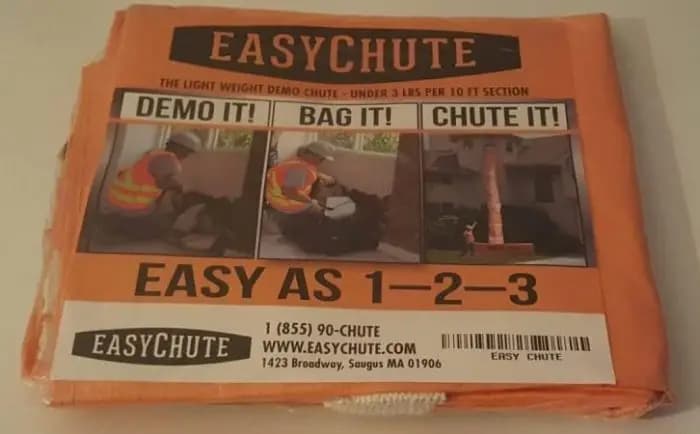
A fabric trash chute — like the EasyChute system — is a series of coated poly-fabric sections that hang vertically from a window opening, roof edge, or scaffold anchor point. Each section overlaps the next by about 1.5 feet. Debris goes in the top, gravity does the rest, and material lands in the dumpster or on a tarp directly below.
A 10-foot section weighs under 3 lbs. A 50-foot section ships in a box you can carry with one arm. The chute itself is not scaffolding, not a work platform, and not a fall-protection system. It is a material-transport tool — the fastest and simplest way to move bulk debris from elevation to grade without carrying it by hand through the building.
What Debris Chutes Handle Well
- Roofing tear-offs (shingles, felt paper, drip edge)
- Interior gut work (drywall, insulation, lath, plaster)
- Window and door replacement debris
- Flooring removal (hardwood strips, tile, underlayment)
- Any loose, breakable, or dusty material that you do not want carried through corridors
What Debris Chutes Do Not Replace
- A work platform for crews to stand on
- Fall protection for workers at elevation
- Structural support for heavy equipment or pallet loads
- A means of moving intact, oversized items (a tub, a boiler, a window unit)
Understanding this boundary is the first step in making a smart comparison. You are not choosing between a chute and scaffolding for working at height — you are choosing between them for moving material to grade. Those are different problems, and sometimes you need both.
What Rental Scaffolding Actually Provides on a Debris Job
When contractors talk about using scaffolding for debris removal, they typically mean one of two setups: a full tube-and-coupler or modular frame system with platform boards, used to stage debris loads before sending them to grade by hand or forklift; or a material hoist or debris chute mounted to the scaffold itself.
Scaffolding gives you a standing work surface at multiple heights, which is genuinely useful for facade work, masonry, and window replacement. Workers can stage materials, rest loads, and work hands-free at elevation in ways a chute alone cannot support.
The Hidden Costs of Scaffold Rental in NJ
The rack rate for scaffold rental is only the beginning. Here is what New Jersey contractors actually pay when the invoice arrives:
- Delivery and pickup fee: Typically $150–$400 per trip depending on distance from the rental yard, often billed separately
- Erection and strike labor: If the rental company erects it, add $400–$1,200+ per day of labor; if your crew erects it, that is 2–6 worker-hours gone on day one
- Daily or weekly rental rate: Frame scaffolding runs roughly $15–$35 per frame per week; a two-story residential setup with six frames, planks, and guardrails can easily hit $400–$700/week before extras
- Permit fees: Many NJ municipalities require sidewalk-use permits for scaffolding that extends over public property; these range from $50 in rural townships to $300+ in denser cities
- Damage deposit or insurance endorsement: Some rental houses require proof that your GL policy covers rented equipment
Add it up and a two-week scaffold rental for a standard NJ residential job can cost $1,200–$2,500 before a single pound of debris moves. That matters when your debris-removal window is 48–72 hours of a longer project.
Cost Comparison: Debris Chute vs. Scaffold Rental for NJ Projects
Let's run a realistic side-by-side for a common New Jersey scenario: a two-story, 1,800-square-foot roofing tear-off and re-roof in a Bergen County neighborhood. The crew is four roofers, the dumpster is in the driveway, and the work takes three days.
- Debris chute (EasyChute 25 ft section): One-time purchase, ships free, reusable across dozens of future jobs. Per-job cost amortized over ten jobs = a few dollars per use. Setup time: 15–20 minutes for one person.
- Scaffold rental for debris staging: Delivery + two-frame setup + weekly rate + strike + permit = $900–$1,500 for three days. Setup time: 1.5–3 hours for two workers.
For a job where workers are not standing on the scaffold to perform work — they just want to move shingles to the dumpster — the cost differential is stark. The scaffold does not add worker safety value if no one is working off it. It is just an expensive debris-staging ledge.
When Scaffold Rental Wins on Total Cost
Scaffolding justifies its cost when:
- Workers will be performing facade, masonry, or window work at elevation over multiple weeks
- The rental cost is shared across both the work-platform function and the debris-staging function
- Local code or the architect's spec sheet explicitly requires a scaffold-mounted debris chute or containment system
- You are on a large commercial NJ project where the daily labor savings of an efficient platform outweigh the rental fee
OSHA Compliance: What New Jersey Contractors Must Know
New Jersey operates under federal OSHA standards for construction, with the state running its own NJ Public Employee Safety and Health (PEOSH) program for public-sector workers. For private construction, federal OSHA Construction Industry standards apply directly.
Both debris chutes and scaffolding carry compliance obligations. Neither is inherently "safer" in a regulatory sense — they just carry different requirements.
OSHA Requirements for Scaffolding on NJ Job Sites
- Scaffolding must be erected, moved, dismantled, or altered only under supervision of a competent person (29 CFR 1926.451)
- Guardrails, mid-rails, and toeboards are required on platforms more than 10 feet above a lower level
- Scaffold capacity must be rated for at least four times the maximum intended load
- Workers erecting or dismantling scaffold must be trained by a qualified person
- Scaffold inspections must occur before each work shift
OSHA Considerations for Debris Chutes
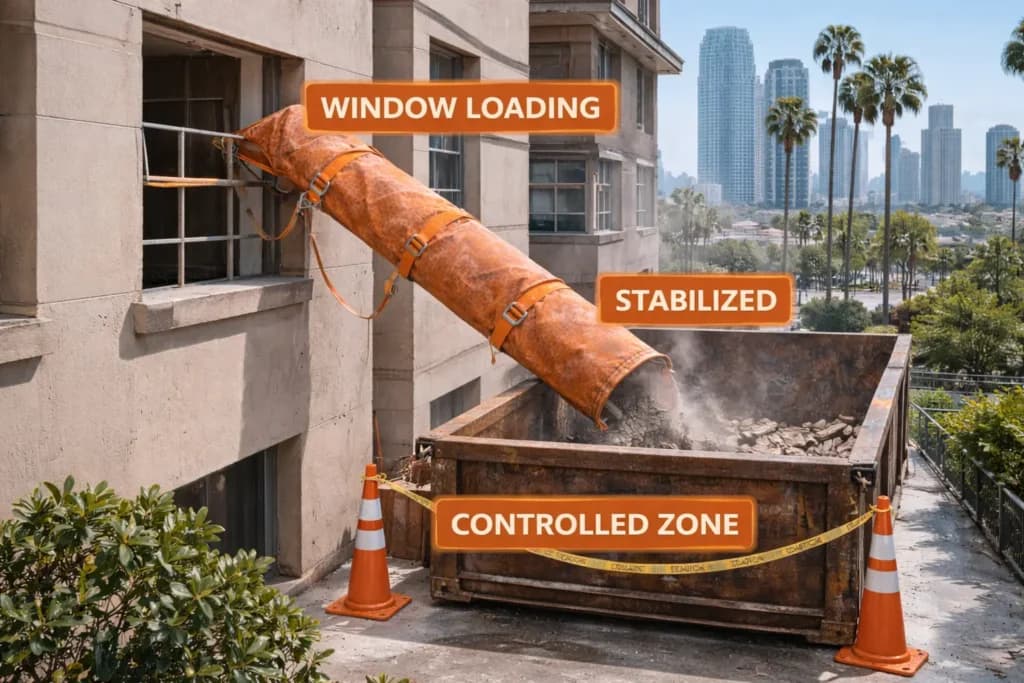
- Debris chutes must be enclosed (or the area below must be barricaded) to prevent materials from falling on workers below (29 CFR 1926.252)
- The drop zone beneath the chute must be clearly marked and kept clear of workers not directly involved in debris loading
- Chute anchor points must be capable of supporting the dynamic load of falling material — four carabiner loops on a structural member satisfy this in most residential applications
- Workers loading the chute from elevation are still subject to standard fall-protection rules — the chute does not substitute for guardrails or personal fall arrest at the loading point
One of the most common compliance mistakes NJ contractors make is treating a debris chute as a fall-protection measure. It is not. It is a material-handling tool. OSHA ergonomics guidance also supports using chutes to reduce the manual-carrying load that contributes to overexertion injuries — but worker fall protection must still be addressed separately at the loading point.
Setup Time and Labor: Where the Real Difference Appears
Time is money on every NJ construction site, and setup time for debris-handling equipment comes directly out of billable or productive hours. Here is how the two approaches compare in real-world conditions.
Debris Chute Setup: What It Actually Takes
- Carry the folded chute section (under 3 lbs for a 10-footer) to the upper floor or roof edge — one person, one trip
- Clip four carabiner loops to a structural anchor: window header, scaffold rail, roof bracket, or similar
- Let the chute hang and confirm the bottom mouth is over the dumpster opening
- Tape or sandbag the bottom if wind is a factor
- Start loading debris — total elapsed time: 15–25 minutes
Strike is equally fast: unclip the loops, fold the chute back into its carry bag, done. One worker. No truck required. No rental yard call. The chute goes to the next job in the same bag.
Scaffold Setup: The Realistic Timeline
- Schedule and confirm delivery (1–3 days lead time typical in NJ rental markets)
- Receive delivery truck — coordinate site access and driveway clearance
- Erect frames, cross braces, base plates, and guardrails: 1.5–3 hours for two workers on a standard two-story setup
- Inspect before first use (required, not optional)
- At project end: schedule pickup, disassemble to component level, reload truck
That erection and strike labor is real overhead. On a 72-hour roofing job, spending five to six combined worker-hours on scaffold handling is a significant percentage of total labor cost — especially when the scaffold's only function was to stage shingles on the way to the dumpster.
Site Constraints Unique to New Jersey Residential and Commercial Work
New Jersey's built environment creates site constraints that tip the scales for many contractors. Knowing these ahead of bid day saves headaches during execution.
Tight Lots and Zero-Lot-Line Properties
Much of North and Central NJ's residential stock was built on narrow lots where the distance between structures is 4–8 feet. Scaffold frames need base plates, bracing, and clear working room. On a lot where the driveway is the only clear ground, a scaffold footprint may not fit without blocking the neighbor's property or the public sidewalk — triggering permit requirements in every municipality from Hackensack to Trenton.
A roofing trash chute hangs vertically from the roof edge. Its footprint at grade is the size of the dumpster opening. That matters enormously on constrained NJ sites.
HOA and Municipal Appearance Rules
Many NJ townships and HOAs have rules about how long scaffold can sit on a property's exterior. Some require removal within a set number of days after work completion. A fabric chute goes up the morning debris moves and comes down the same afternoon — no extended street presence, no HOA complaint, no code enforcement visit.
Weather and Wind Exposure
NJ coastal and waterfront properties — think the Jersey Shore towns, Bayonne, Red Bank, or Cape May — experience sustained winds that complicate both methods. Scaffold requires wind-load engineering on exposed sites above a certain height. Debris chutes should be secured at the base in high-wind conditions, but their light weight means they are not a structural liability in a storm.
Environmental Responsibility: A Factor NJ Contractors Increasingly Track
New Jersey has some of the most aggressive construction waste diversion goals on the East Coast, and contractors working on larger projects increasingly need to document their C&D waste streams. According to the EPA's construction and demolition debris data, C&D materials account for a substantial portion of total US waste generation — and proper handling starts with how debris moves from the floor to the disposal container.
A fabric debris chute is a reusable tool. It produces no waste itself. A scaffold rental involves manufacturing, transportation, and eventual end-of-life disposal of metal components. For NJ contractors tracking green-build credits or working on projects requiring waste management plans, the lifecycle footprint of your debris-handling method is a legitimate consideration.
Sorted vs. Commingled Debris
Some NJ recycling facilities require source-sorted material. If you are running separate dumpsters for wood, metal, drywall, and mixed waste, a debris chute helps you route material to the correct container by simply repositioning the bottom mouth between loads. Scaffold-based carry does not provide this advantage — workers are still hand-carrying material to whichever container they reach first.
Scenario-by-Scenario Recommendation for NJ Contractors
Rather than a blanket recommendation, here is how to map the right tool to the job type most common across New Jersey.
Roofing Tear-Off: Debris Chute Wins
Speed, weight, and footprint all favor the chute. Roofers are already working at the roof edge. Hanging a roofing chute from a roof bracket or chimney anchor takes minutes, and shingles slide down cleanly without manual trips through the attic. No scaffold needed, no permit, no additional rental cost.
Multi-Week Facade Restoration: Scaffold Wins (Add a Chute)
When workers need to stand at elevation for weeks on a masonry or stucco facade job, scaffold earns its rental fee as a work platform. But smart NJ contractors add a fabric chute to the scaffold itself, running it from the top platform to the dumpster at grade. The scaffold does the work-platform job; the chute does the debris-removal job. You get both benefits.
Interior Gut Renovation on 2nd or 3rd Floor: Debris Chute Wins
For interior demolition — drywall, plaster, lath, insulation — scaffold has no role. Workers are inside the building. A chute hung from a window opening routes debris straight to the dumpster without anyone carrying dusty loads through the living space or down the stairs. This is a pure chute application.
Commercial Low-Rise (3–6 Stories) in an NJ Urban Core: Assess Both
At three or more stories in a city like Newark, Jersey City, or Paterson, you likely need both. Scaffold or a material hoist may be required by the building spec or general contractor's site safety plan. A fabric chute can still be deployed off the scaffold rail to move debris from each level without hand-carrying it down through the structure.
Common Mistakes NJ Contractors Make with Both Methods
Experience across job sites across the Northeast reveals a consistent set of avoidable errors. Here are the most expensive ones:
- Renting scaffold for a job that only needs it for debris — not for work: If nobody is performing work from the platform, the scaffold is a very expensive debris shelf. Use a chute instead.
- Underestimating scaffold permit lead time in dense NJ towns: Some municipalities take 5–7 business days to approve sidewalk-encumbrance permits. If you did not plan for this, your project start slips.
- Using a debris chute without barricading the drop zone: OSHA 1926.252 is clear — the area below an open-top debris chute must be controlled. A roll of caution tape and a few cones is all it takes; skipping this step is an unnecessary citation risk.
- Ordering the wrong chute length: Measure the vertical distance from your loading point to the dumpster lid before ordering. EasyChute sections connect in 10, 25, and 50-foot increments — there is a configuration for every height, but you need to know your number. The installation guide walks through how to measure and configure correctly.
- Treating the bottom of the chute as a fixed target: Wind, dumpster placement, and site geometry mean the chute mouth may need repositioning mid-job. Plan for it; it takes 30 seconds to adjust.
How to Choose: A Decision Checklist for NJ Contractors
Use this checklist before you commit to either method on your next project:
- Will workers be standing on the structure to perform work at elevation? If yes, scaffold may be needed as a work platform regardless of debris method.
- Is the job duration 72 hours or less? Debris chute is almost always faster and cheaper to deploy in a short window.
- Does the site have room for scaffold base plates, cross-bracing, and a delivery truck? If not, chute is the practical choice.
- Does the debris consist of loose, gravity-friendly material (shingles, drywall, insulation)? Chute handles this perfectly.
- Does local code, the GC, or the building owner's insurance spec require a scaffold-mounted debris enclosure? If yes, combine both: scaffold structure plus chute for material movement.
- Is reusability across multiple jobs a priority? A fabric chute pays for itself after two or three uses compared to repeated rental costs. See the full canvas trash chute guide for a material comparison.
Frequently Asked Questions
Can I hang a debris chute off scaffold I already have on site?
Yes — this is one of the most efficient combinations on larger NJ jobs. EasyChute sections clip to scaffold rails using standard carabiners or quick-connect links through the woven loop anchors. You run the chute vertically from the top working platform to the dumpster at grade, turning the scaffold into both a work surface and a debris-removal system. Many contractors doing multi-story facade or masonry work use this hybrid approach as a matter of course.
Do NJ municipalities require a permit for a debris chute?
Requirements vary by municipality. A debris chute hung entirely within private property — from a window or roof edge over a dumpster in the driveway — typically does not require a sidewalk-encumbrance permit. If the dumpster or the chute's footprint extends over a public sidewalk or right-of-way, you should check with the local building department. This is the same trigger that applies to scaffold. When in doubt, a quick call to the township saves a potential stop-work order.
What is the maximum height a fabric debris chute can handle?
EasyChute sections connect end-to-end with a 1.5-foot overlap and can be configured to reach virtually any residential or low-rise commercial height. A 50-foot section handles a standard five-story building; multiple sections can be linked for greater heights. The key variable is anchor point integrity at the top — the hanging loops must attach to a structural member capable of supporting the dynamic load of falling debris. The EasyChute FAQ covers load and configuration questions in detail.
Is scaffold rental always more expensive than a debris chute for NJ roofing jobs?
For jobs where the scaffold's only function is debris staging — not worker access — yes, scaffold rental is almost always more expensive when you factor in delivery, erection labor, weekly rental rate, and strike. A fabric debris chute purchased outright costs a fraction of a single scaffold rental cycle, ships free, and can be reused on every subsequent job. If your crew is already working at the roof edge without a scaffold (standard on most residential NJ re-roofing), there is no cost-benefit case for renting scaffold just to move shingles.
Can a one-person crew set up and use a debris chute safely?
Yes. A single worker can carry, hang, load, and strike an EasyChute section without assistance on most residential applications. The 10-foot lite-duty section weighs under 3 lbs. The setup process — hang four loops, confirm bottom placement, start loading — takes under 25 minutes solo. The one task that benefits from a second person is confirming dumpster alignment from grade while the other worker adjusts the anchor height, but this is a 2-minute coordination step, not a sustained two-person operation.
What debris types should not go into a fabric chute?
Avoid putting intact, rigid items longer than the chute diameter into the chute — a full sheet of drywall, a door slab, or long lumber lengths will jam or puncture. Break material down to manageable chunks before loading. Avoid heavy, concentrated point loads like individual cinder blocks dropped from full height; distribute heavy material in smaller pieces. Liquid waste, hazardous materials, and asbestos-containing debris are never appropriate for any gravity chute system and must be handled according to EPA and state DEP regulations. See the debris chute guide for a full material compatibility overview.
Does using a debris chute eliminate the need for OSHA fall protection at the loading point?
No. A debris chute is a material-handling tool, not a fall-protection system. Workers loading debris at a window opening, roof edge, or upper scaffold platform must still comply with OSHA construction fall-protection standards — guardrails, personal fall arrest systems, or safety nets as appropriate for the exposure. The chute reduces the ergonomic risk of carrying heavy loads and the trip hazard of moving material through the building interior, but it does not change the fall-protection obligation at the loading elevation.
Ready to Choose the Right Debris Solution for Your NJ Job?
If you have worked through this comparison and your job is a roofing tear-off, interior gut reno, or any project where you need to move debris quickly from elevation without paying for a scaffold crew — a fabric debris chute is the straightforward answer.
EasyChute ships free to job sites across New Jersey and the entire United States. Sections are available in 10, 25, and 50-foot configurations. One person can hang it, one person can load it, and when the job is done it folds back into a small carry bag ready for the next site.
Browse the full product lineup, watch the system in action on the EasyChute video page, or reach out through the contact page with any project-specific questions. If you are comparing options for a specific NJ site type — dense urban lot, Shore-town roofline, multi-story commercial build — the team can help you configure the right section lengths before you order.
Demo it. Bag it. Chute it.