

If you're a contractor, roofer, or junk removal operator working a job in Hartford, CT — whether it's a gut renovation on a triple-decker in Frog Hollow, a shingle tear-off in West End, or a demo job near Asylum Hill — you've probably asked the same question at least once: What is a debris chute rental actually going to cost me?
The honest answer is: more than the quote suggests, and far more than most crews realize when they're pricing out a job. This guide breaks down what rentals cost in the Hartford market, the hidden fees that inflate invoices, and why a growing number of Connecticut contractors are skipping the rental model entirely in 2026.
Why Hartford Contractors Keep Asking About Debris Chute Rental Costs
Hartford is a dense urban market. You're working around narrow streets, aging multi-family housing stock, and neighbors who do not want debris cascading down a stairwell or through a building lobby. A debris chute isn't optional on most upper-floor jobs — it's the only way to move material safely from an elevated work area into a dumpster below.
Rental companies know this. And because demand is consistent in a city with Hartford's renovation activity, pricing hasn't gotten more competitive. If anything, rental fees in the Greater Hartford area have trended upward over the past two years as equipment costs, fuel, and labor have all risen.
- Standard chute sections in Connecticut range from $40 to $90 per section per week in most markets.
- Setup and delivery minimums are common — often $150 to $300 regardless of job size.
- Pickup fees and extended-use penalties can add another $75 to $200 to the final invoice.
That math adds up fast when you're running a two-week job on a three-story house in Hartford's South End.
What a Typical Debris Chute Rental Invoice Looks Like in Hartford
The Base Rate
Most rental companies price chute sections per unit, per week. In the Hartford, CT market, you're typically looking at $50 to $80 per 10-foot section for the first week. A job that needs 30 feet of chute — common for a two-story residential demo — means $150 to $240 per week before any extras.
Delivery and Pickup Charges
Rental yards in the Hartford area — serving Wethersfield, Newington, West Hartford, and the city itself — typically charge delivery and pickup as separate line items. Expect $75 to $175 each way. That's $150 to $350 added to your total before a single piece of debris moves through the chute.
Damage Deposits and Insurance Add-Ons
Many rental companies require a refundable damage deposit — commonly $100 to $300 — that ties up cash flow during the job. Some also require proof of additional insurance naming the rental company, which can require a certificate from your broker and cost real time to coordinate.
Extended Rental Penalties
Jobs run long. Weather delays, permit holds, and subcontractor scheduling issues are a fact of life in construction. If your rental period runs over by even a day or two, penalty rates often kick in at a higher daily rate than the standard weekly price. It's one of the most common billing surprises Hartford contractors report.
Sample Cost Scenarios: Hartford CT Debris Chute Rental by Job Type
To make this concrete, here are three common Hartford job scenarios with realistic rental cost estimates based on current market conditions.
Scenario 1: Single-Story Roof Tear-Off (10 ft Chute Needed)
- Base rental: $55/week × 1 section = $55
- Delivery: $100
- Pickup: $100
- Deposit (refundable): $150
- Total out-of-pocket during job: ~$405 for a one-week job
Scenario 2: Second-Floor Gut Renovation (30 ft Chute Needed)
- Base rental: $65/week × 3 sections × 2 weeks = $390
- Delivery: $125
- Pickup: $125
- Deposit (refundable): $200
- Total out-of-pocket during job: ~$840 for a two-week job
Scenario 3: Multi-Story Commercial Demo (50 ft Chute Needed)
- Base rental: $70/week × 5 sections × 3 weeks = $1,050
- Delivery: $175
- Pickup: $175
- Deposit (refundable): $300
- Total out-of-pocket during job: ~$1,700 for a three-week job
These numbers don't include any late fees, damage charges, or the administrative time your office spends coordinating pickup and delivery windows with the rental yard. That overhead is real — and it compounds across multiple jobs per year.
The Hidden Costs Rental Companies Don't Put in the Quote
The base quote is never the full story. Here's what Hartford contractors routinely discover only after the invoice arrives.
Coordination Time
Someone on your team has to call the rental company, confirm availability, schedule delivery, track the pickup window, and follow up when the driver is late. On a busy week, that's an hour or more of billable time spent managing equipment logistics instead of running the job.
Waiting for Delivery
If a rental chute shows up on Day 2 instead of Day 1, your crew either waits or begins demolition without it — which usually means hauling debris by hand down stairs until the chute arrives. OSHA ergonomics guidelines are clear about the injury risks associated with repeated manual load-carrying, especially on stairways. That's real exposure for your crew and your workers' comp premiums.
Inflexible Rental Windows
Rental companies set their windows based on their schedules, not yours. If you need to move a chute from one side of a building to another mid-job, you're often stuck either paying for a second delivery or improvising without it.
Condition of Rental Equipment
Rental chutes cycle through dozens of job sites before reaching yours. By the time a metal or hard-plastic rental chute reaches a Hartford job, it may have bent sections, cracked fittings, or mismatched connectors. You don't know what you're getting until it shows up on the truck.
Why More Hartford Contractors Are Buying Instead of Renting
The rental math becomes hard to defend the moment you run more than a few chute jobs per year. That's the inflection point where owning your own fabric trash chute starts paying for itself — often within the first two or three jobs.
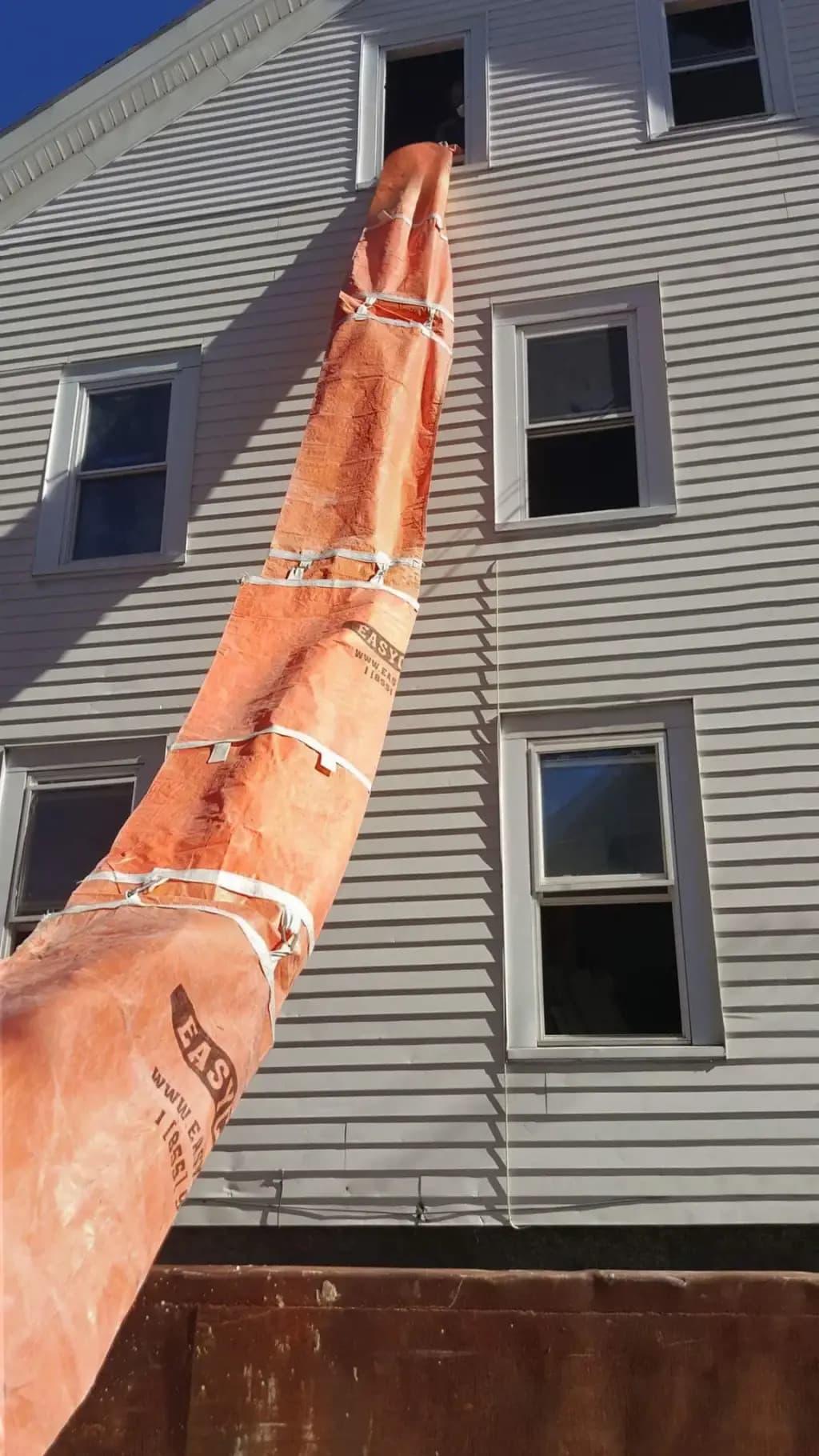
EasyChute sections are priced transparently with free shipping to job sites across Connecticut. A 10-foot heavy-duty section weighs under 3 pounds and folds into a small box. You can carry a full 30-foot chute setup in one hand. That changes the logistics equation entirely.
Break-Even Analysis: Rental vs. Ownership
Consider the scenario above — a 30-foot chute job costing roughly $840 in rental fees. If a comparable owned setup costs $400 to $600, you've broken even in a single job and every subsequent use is free. Over a full season of work in Hartford, Bloomfield, Windsor, or East Hartford, that difference compounds to thousands of dollars in recovered margin.
- No delivery scheduling
- No pickup windows to coordinate
- No damage deposits tying up cash
- No rental company calling asking when you're done
- Equipment in your own van, ready when you are
That's not an abstract benefit — it's operational simplicity that reduces friction on every single job.
How EasyChute Sections Work on Hartford Job Sites
EasyChute was built by contractors who ran into exactly the problems described above. Tim Hogan and Leo Guarente — a Massachusetts contractor and junk removal owner — designed the system to solve real job-site problems, not theoretical ones.
Sections connect with a 1.5-foot overlap and hang from four woven loops using standard carabiners or quick-connects. You can hang a chute from a window frame, roof edge, or scaffold in minutes without specialized tools or hardware. The installation process is straightforward enough that one person can set up and strike a full chute solo.
Section Sizes Available
- 10 ft Lite-Duty: Ideal for light residential demo, single-story roofing
- 10 ft Heavy-Duty: For shingle tear-offs, drywall, heavier construction debris
- 25 ft: Mid-range for two- to three-story residential work
- 50 ft: Commercial jobs, tall multi-family buildings, extended drops
Sections connect to reach any height. A Hartford triple-decker? Three 10-foot sections or one 25-foot section. A four-story commercial building in downtown Hartford? A 50-foot section handles it in one piece.
OSHA Compliance and Debris Chute Safety in Connecticut
Debris chute safety isn't just a best practice — it has regulatory dimensions that Hartford contractors need to understand. OSHA's construction industry standards address the controlled disposal of construction waste and the hazards of uncontrolled debris discharge from elevated work areas.
Dropping debris from an upper floor without a chute creates projectile hazards for workers and passersby below. On Hartford job sites near sidewalks, neighboring properties, or active streets — which describes most of the city's residential neighborhoods — this isn't a theoretical risk. It's the kind of incident that generates citations, lawsuits, and insurance claims.
What OSHA Looks For on Chute Jobs
- Adequate containment of debris during drop (no uncontrolled scatter)
- Warning systems or exclusion zones at the base of the chute
- Secure attachment at all hang points so the chute cannot fall
- Proper capacity for the type of material being moved
EasyChute's woven, coated poly fabric is designed to contain debris during the drop, and the four-loop hanging system distributes load securely across attachment points. It's the kind of setup that holds up under OSHA scrutiny — not because of a marketing claim, but because of how it's engineered.
Environmental Considerations: Construction Debris in Hartford
Hartford contractors generating construction and demolition debris are subject to Connecticut DEP regulations and federal EPA guidelines on C&D waste management. How you move debris matters, not just where it ends up.
A debris chute that directs material cleanly into a dumpster — rather than scattering it across a yard, sidewalk, or neighboring property — makes sorting and proper disposal easier. If you're separating recyclable materials like clean wood, metal, or drywall, a chute that deposits material in a controlled stream into a segmented dumpster or staging area is a practical tool for on-site recycling compliance.
Reusable equipment like EasyChute also reduces the disposable consumable footprint of your operation — something more GC specs and sustainability requirements are starting to reference in 2026.
Comparing Debris Chute Options in the Hartford Market
Traditional Metal or Hard-Plastic Rental Chutes
- Heavy — often 15 to 30 lbs per section
- Requires delivery truck and multiple people to set up
- Rigid — difficult to fit through irregular window openings
- Weekly rental fees plus delivery/pickup charges
- Condition varies; no quality guarantee at delivery
Lightweight Fabric Chutes (EasyChute)
- Under 3 lbs per 10-foot section
- Ships free — arrives in a box at your job site or shop
- One person setup in minutes using standard carabiners
- Folds flat for transport and storage in a work van
- Reusable job after job — no recurring rental fees
- Fixed pricing, transparent — no surprise invoices
For a detailed side-by-side look at the broader category, the canvas trash chute guide covers how fabric-based chute systems compare to rigid alternatives across the most common job types.
Roofing Crews in Hartford: A Specific Use Case
Roofing is one of the most common use cases for debris chutes in Hartford and surrounding towns like Glastonbury, Simsbury, and Avon. A single-family re-roof generates hundreds of pounds of shingles, felt, and fasteners — none of which you want carried down a ladder or tossed off the edge of a roof.
The roofing trash chute guide goes deep on this use case, but the Hartford-specific reality is worth noting: many Hartford homes have setback limitations and neighboring structures close enough that uncontrolled debris scatter is an immediate liability issue.
What Hartford Roofers Should Look For
- Heavy-duty fabric rated for asphalt shingle weight and abrasion
- Attachment system that works with standard roof edge or gutter fascia without damage
- Length that reaches from ridge to dumpster without requiring extension ladders mid-job
- Easy single-person setup so the crew isn't standing around waiting
EasyChute's heavy-duty 10-foot sections are specifically designed for shingle tear-off work. The coated poly fabric handles the abrasive edge of asphalt shingles, and the overlap connection system means you can stack sections to reach from a second-story roof to a dumpster on the street without calculating exact measurements in advance.
How to Choose the Right Chute Length for a Hartford Job
Getting the length right saves time and prevents the most common field problem: a chute that falls short of the dumpster and dumps debris at an angle, creating scatter and cleanup work.
Simple Field Calculation
- Measure the vertical drop from the work area (window, roof edge, scaffold) to the top of the dumpster opening.
- Add 3 to 4 feet for the attachment overhang above the hang point.
- Add 2 to 3 feet to ensure the chute bottom clears into the dumpster without binding.
- Round up to the nearest available section length — it's always better to have a foot of extra drop than to come up short.
For most Hartford residential jobs — two- to three-story triple-deckers — a 25-foot chute or three connected 10-foot sections covers the typical drop range. For four-story or taller commercial work, a 50-foot section or combined setup is appropriate. The construction chute guide has a more detailed breakdown by building type if you want to get precise before ordering.
Ordering and Getting Started in Hartford
EasyChute ships free to job sites and business addresses across Connecticut — Hartford, East Hartford, Wethersfield, Newington, West Hartford, Manchester, and beyond. Orders placed online arrive without freight charges or delivery scheduling headaches.
The EasyChute FAQ covers common pre-purchase questions on section sizing, weight capacity, and attachment hardware. If you're not sure where to start, the debris chute overview walks through how the system works from a first-principles standpoint — useful if you're evaluating it for the first time or explaining it to a customer who's never seen one before.
You can also watch the system in action before ordering. The EasyChute video library shows real job-site setups, including how sections connect and how a single person can hang and strike a full chute without help.
Frequently Asked Questions
How much does it typically cost to rent a debris chute in Hartford, CT?
Rental costs in the Hartford market generally run $50 to $80 per 10-foot section per week, plus delivery fees of $75 to $175 each way and a refundable damage deposit of $100 to $300. A simple two-week gut-renovation job requiring 30 feet of chute can easily total $700 to $1,000 all-in once all fees are included. These figures reflect current 2026 market conditions and vary by rental company and job location within Greater Hartford.
Is it cheaper to buy a debris chute or rent one for Connecticut jobs?
For contractors running more than two or three chute jobs per season, buying is almost always cheaper than renting. A purchased fabric chute setup that covers a 30-foot drop can pay for itself on the first or second use compared to typical rental totals. After that, every subsequent job is at zero equipment cost. The break-even point is low, and the operational simplicity of owning — no scheduling, no deposits, no pickups — adds value beyond the dollar savings.
What size debris chute do I need for a Hartford triple-decker renovation?
Hartford triple-deckers typically have a vertical drop of 20 to 30 feet from the top floor to street level. A 25-foot chute section or three connected 10-foot sections is sufficient for most of these jobs. If the dumpster sits lower than street grade or the work area is on the third floor with high ceilings, adding one additional 10-foot section gives you the extra reach to clear cleanly into the dumpster without debris scatter at the base.
Are debris chutes required by OSHA on construction sites in Connecticut?
OSHA construction standards do not mandate chutes specifically in every situation, but they require that debris not be dropped uncontrolled from elevation and that work areas below are protected from falling material. In practice, using a debris chute is the most reliable way to satisfy these requirements on Hartford job sites near public sidewalks, neighboring properties, or active work zones. Failure to control debris from elevation can result in OSHA citations and significant liability exposure.
How long does it take to set up a fabric debris chute on a job site?
An EasyChute fabric section can be set up by one person in under ten minutes using standard carabiners or quick-connects attached to window frames, roof edges, or scaffold rails. Sections connect with a 1.5-foot overlap — no tools, no hardware kits, no waiting for a delivery crew. Strike time is similarly fast: unhook, fold, box. The entire setup process is covered in the EasyChute step-by-step installation guide if you want a preview before your first job.
Can I use a debris chute for roofing jobs in Hartford?
Yes — roofing is one of the most common uses. Asphalt shingles, roofing felt, and nails are heavy and abrasive, so you need a heavy-duty fabric section rated for that material, not a lite-duty version. EasyChute's heavy-duty 10-foot sections are built specifically for shingle tear-off work. They handle abrasive material, attach securely to roof edges without damaging fascia, and fold flat for transport between roofing jobs across Hartford and surrounding towns.
Does EasyChute ship to Hartford, CT and surrounding areas?
Yes. EasyChute ships free to job sites and business addresses across Connecticut, including Hartford, East Hartford, West Hartford, Wethersfield, Newington, Manchester, Glastonbury, and beyond. Orders are placed online at fixed prices — no freight surcharges, no delivery scheduling required. The chute arrives boxed and ready to deploy, which means no rental yard coordination and no waiting on a delivery truck to show up at your job site.
Ready to Stop Renting and Start Owning Your Debris Chute?
If you're a Hartford contractor who has been absorbing rental fees, delivery charges, and scheduling headaches job after job, the math on owning is worth running. One or two jobs is often all it takes to recover the full purchase cost — and after that, you have a lightweight, reusable chute system that fits in your van, deploys in minutes, and costs nothing per job to use.
EasyChute ships free to Hartford and all of Connecticut. Contact EasyChute with questions about which section sizes are right for your work, or browse the full product lineup to find the configuration that fits your most common job types. For first-time buyers, the debris chute overview page is the best place to start — it explains the system from scratch and helps you match section sizes to the jobs you're running in Hartford right now.
Demo it. Bag it. Chute it.