

If you are pricing out a roofing tear-off, gut renovation, or junk removal job in Burlington, VT, one line item that catches contractors off guard is the debris chute. You assume it will be a quick rental — a few phone calls, a truck drops it off, done. The reality is messier. Rental companies in Vermont can be hard to pin down on price, availability windows are tight, and by the time you add delivery, pickup, and damage deposits, the number climbs fast.
This guide breaks down exactly what a debris chute rental costs in and around Burlington, what drives those costs up or down, and why a growing number of Vermont contractors are skipping the rental counter entirely in favor of owning a lightweight fabric chute outright. Read through, run the math for your own job, and you will have a clear picture before you book anything.
What "Debris Chute Rental" Actually Means in Vermont
When contractors search for debris chute rentals, they typically mean one of two things: a traditional hard-shell plastic or steel construction chute system, or a full scaffold-and-chute package rented from a scaffold supplier. Both exist in the Burlington market, but they serve different job types and carry very different price tags.
Hard-Shell Plastic Section Chutes
These are the classic interlocking plastic tubes you see on urban high-rise jobs. Each section is roughly 3 ft long and locks onto the next. They are durable for multi-month commercial projects but awkward to transport, slow to assemble, and priced accordingly. A rental house will charge per section per week, and a typical residential or small commercial job needs 8–20 sections depending on building height.
Scaffold-Integrated Chute Packages
Some scaffold rental companies in Chittenden County offer a chute as an add-on when you rent the whole scaffold system. This can look affordable on paper — but the base scaffold rental, delivery, and setup fees are what dominate the invoice. The chute is almost incidental to the total cost.
Fabric and Poly Chutes — Owned vs. Rented
A newer category that many Vermont contractors are discovering is the lightweight woven-fabric chute, like those made by EasyChute. These are not traditionally rented through equipment houses — they are purchased outright, stored flat in a job bag, and reused across dozens of jobs. Understanding this distinction is key to doing an honest cost comparison.
Typical Debris Chute Rental Cost Ranges in Burlington, VT
Prices vary by supplier, season, and job complexity, but here is a realistic benchmark for the Burlington metro and surrounding Chittenden County area as of late 2026:
- Per-section weekly rental (hard-shell plastic): $8–$18 per section per week. A two-story house needing 20 ft of chute might need 6–8 sections, putting you at $50–$145 per week before extras.
- Delivery and pickup fee: $75–$175 each way, depending on distance from the supplier's yard. Burlington is well served, but outlying towns like Williston, Essex, or Shelburne may carry a surcharge.
- Damage deposit: Many rental houses require a $150–$400 deposit, returned when every section comes back clean and undamaged.
- Minimum rental period: Most suppliers have a 1-week minimum. Even if your roofing crew tears off shingles in a single day, you are paying for a full week.
- Total for a typical 2-week roofing job: Expect $350–$700 all-in, including delivery, pickup, and deposit return lag.
These numbers are consistent with what contractors report across Vermont and neighboring New Hampshire. For a deeper look at how chute systems work before you rent anything, the debris chute overview guide is a good starting point.
Hidden Fees That Inflate Your Final Bill
The base rental rate is never the real number. Here are the line items that surprise Burlington-area contractors most often:
Fuel Surcharges
Equipment rental companies in Vermont frequently add fuel surcharges, especially for delivery runs outside downtown Burlington. This is separate from the delivery fee and can add $20–$50 per round trip.
Cleaning Fees
Return a chute section with roofing adhesive, concrete dust, or stucco residue and you will likely forfeit part or all of your deposit. Some suppliers charge a flat cleaning fee — $25–$60 per dirty section — regardless of how clean you thought it was. See what professional chute cleaning actually involves to understand why suppliers take this seriously.
Late Return Penalties
If rain delays your project by three days and you return the chute in week three instead of week two, you owe another full weekly charge. Vermont weather in spring and fall makes this a real risk — late-season jobs in particular can drag due to freeze-thaw and wet conditions.
Missing Hardware
Hard-shell chute systems rely on proprietary connectors, pins, and brackets. Lose one on a job site and expect to pay a replacement fee that is often well above what the part is worth.
Overage on Section Count
If the building turns out to be taller than you estimated when you placed the order, you need extra sections fast. Expedited delivery of additional sections mid-job is expensive and not always possible from Vermont suppliers with limited inventory.
Factors That Change Your Cost Estimate in Burlington
No two jobs are identical. Here is what moves the rental needle most on Vermont job sites:
- Building height: A Cape Cod needs 15–20 ft of chute; a three-story colonial needs 25–35 ft; a four-story commercial building in Burlington's Old North End could need 40–50 ft or more.
- Job duration: A weekend blitz roofing crew pays the same minimum weekly rate as a two-week gut-reno crew — but the reno crew gets more value per rental dollar.
- Access constraints: Tight alleyways, narrow lots, or parking restrictions near Burlington's Church Street corridor or along North Winooski Ave can make delivery trucks unwieldy and add to your coordination time.
- Debris type: Heavier debris — tile, slate, or concrete — can damage cheaper rental chutes, raising your liability for the deposit.
- Seasonality: Vermont's construction season peaks in summer. Equipment is tighter and suppliers have less flexibility on delivery scheduling between June and September.
How Burlington Compares to Other Vermont Markets
Burlington is Vermont's largest city and has the most equipment rental infrastructure. That actually works in your favor on price — competition between suppliers in Chittenden County keeps per-section rates closer to the low end of the range. Smaller Vermont cities and towns — Montpelier, St. Johnsbury, Newport — often have only one or two suppliers, and rental rates and minimum fees reflect that.
If you are a contractor who moves across the state — Burlington one week, Stowe or Barre the next — you will find rental availability inconsistent. That unpredictability is one of the strongest arguments for owning your own chute rather than relying on whatever local inventory exists near each job.
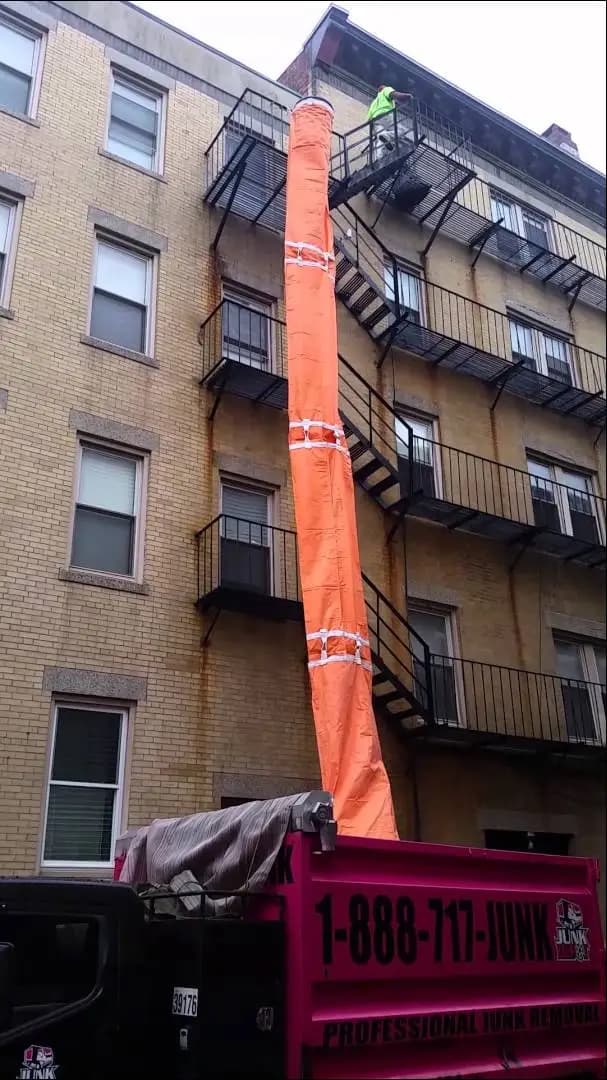
The Real Cost Comparison: Renting vs. Owning a Fabric Trash Chute
This is where the math gets interesting. Let's run a straightforward comparison for a Burlington-based roofing contractor who does 20 jobs per year that require a chute:
Annual Rental Scenario
- Average rental cost per job: $450 (delivery, weekly rate, pickup, deposit loss on average)
- Jobs per year requiring a chute: 20
- Annual rental spend: $9,000
- Time spent coordinating delivery and pickup: 30–45 minutes per job
- Risk of unavailability during peak season: High
Ownership Scenario — EasyChute Fabric System
- One-time purchase: 50 ft heavy-duty fabric chute sections (covering most Vermont residential jobs)
- Weight: Under 3 lbs per 10 ft section — one person carries the entire system
- Setup time: Minutes, not hours
- Reuse life: Dozens of jobs with proper care
- Delivery fees: $0 — ships free directly to your job site or shop
- No deposits, no returns, no cleaning fees, no damage liability to a rental company
Even if you conservatively estimate 30 jobs before replacing a section, the per-job cost of ownership drops well below $50. Compare that to $450 in rental fees per job and the break-even point arrives within the first two or three jobs. For a detailed look at how the fabric system works, the fabric trash chute guide covers materials, setup, and use cases.
OSHA Compliance and Debris Chute Safety in Vermont
Vermont contractors working on any structure above one story are subject to OSHA construction safety standards, which include requirements for debris handling and fall hazard control. A properly installed debris chute — whether rented or owned — directly supports OSHA compliance by eliminating the need to carry heavy debris loads down ladders or stairwells.
Ergonomic Load Reduction
OSHA's guidance on ergonomics and safe lifting is relevant here: repeatedly carrying bundles of shingles, drywall panels, or demo debris down a ladder puts workers at serious risk of musculoskeletal injury. A chute eliminates that trip entirely. Workers load debris at the top, gravity does the rest.
Directed Drop Zone
Both rental chutes and owned fabric chutes improve site safety by directing debris into the dumpster rather than scattering it across the ground. This protects people below and keeps the work zone cleaner — an important consideration on Burlington's dense residential streets where pedestrians and neighboring properties are close.
Documentation for General Contractors
If you are a subcontractor on a larger Burlington project, your GC may require documentation of your debris handling method. Owning a chute with a known spec sheet (weight rating, material, attachment method) makes that documentation simple. With a rental, you are dependent on the supplier's paperwork.
Environmental Considerations: Debris Separation and Recycling
Vermont has some of the country's more stringent waste management regulations, and Burlington enforces them seriously. The EPA estimates that construction and demolition debris accounts for more than twice the volume of municipal solid waste generated annually in the US. Vermont's universal recycling law adds further requirements for contractors to divert certain materials from landfill.
A debris chute system — owned or rented — is only part of the waste management picture. At the base, what matters is how debris is sorted and deposited. Lightweight fabric chutes are flexible enough to aim debris precisely into a divided dumpster or separate bins, making material separation easier on job sites where you need to keep clean wood, metal, and mixed debris in different containers.
For more on how EasyChute fits into responsible demolition workflows, see the demolition chutes guide.
Choosing the Right Chute Length for Burlington-Area Jobs
One of the most common estimating mistakes contractors make is under-ordering length. Here is a practical reference for Burlington's typical housing stock:
- Single-story ranch (8–10 ft eave height): A 10 ft chute section with appropriate overhang is usually sufficient.
- Standard two-story colonial (18–22 ft eave): A 25 ft section or two connected 10 ft sections provides adequate reach with room to angle into a dumpster.
- Three-story Victorian or multi-family (28–35 ft): Common in Burlington's Hill Section and Old North End — plan for 35–40 ft of chute minimum.
- Four-story commercial or mixed-use (40+ ft): You will need a 50 ft section or combined sections. Burlington's downtown corridor and waterfront development projects regularly hit this height range.
The EasyChute system's sections — available in 10 ft, 25 ft, and 50 ft — connect with a 1.5 ft overlap, so you can build exactly the length you need without over-renting. For installation specifics, the step-by-step EasyChute setup guide walks through hanging, connecting, and securing sections on any building type.
Renting vs. Owning: A Quick Decision Framework for Vermont Contractors
Not every contractor should immediately ditch the rental model. Here is a quick framework to guide your decision:
Rental Makes Sense If:
- You have a single one-off job with no expectation of needing a chute again
- The job requires a very long, heavy-duty hard-shell chute for a high-rise commercial project beyond the scope of a fabric system
- Your crew has no storage space for equipment between jobs
Ownership Makes More Sense If:
- You run more than 3–4 chute-requiring jobs per year
- You value showing up ready to work without coordinating a rental delivery
- Your jobs vary in location across Vermont (or New England) and you cannot rely on consistent rental availability
- You want to eliminate the deposit, cleaning fee, and damage liability risk entirely
- You are a junk removal operator who needs a chute fast and regularly
Junk removal crews in particular benefit enormously from ownership. Leo Guarente, one of EasyChute's co-founders, ran a junk removal operation before helping design the system — the product was built from that exact use case. See how it works for roofing crews specifically in the roofing trash chute guide.
What to Ask Before You Rent from Any Burlington Supplier
If you decide a rental is the right call for your specific job, go in prepared. Here are the questions that protect your budget and your schedule:
- What is the total delivered cost — sections, delivery, pickup, and deposit? Get it in writing before you commit.
- What is the minimum rental period and what triggers an additional week charge?
- Are the sections rated for my debris type? Slate and tile are heavier per square foot than asphalt shingles.
- What is the cleaning standard for deposit return? Ask to see it in the rental agreement, not just verbally.
- What is the turnaround if I need extra sections mid-job?
- Can you confirm delivery availability for my specific start date? Do not assume peak-season availability.
These questions will reveal quickly whether you are dealing with a supplier who has transparent, fair pricing — or one who is building margin into vague line items you will only see on the final invoice.
Planning Your Chute Setup in Burlington: Practical Site Notes
Burlington has some specific site constraints worth flagging for out-of-town contractors or those new to working in Chittenden County:
- Parking and dumpster placement: On-street dumpster permits are required in Burlington. Tight curb cuts on many Hill Section streets can limit where the dumpster sits relative to the building, which affects your chute angle. Plan this before delivery day.
- Historic district considerations: Parts of Burlington's South End and Hill Section have historic overlay zoning. While chute systems themselves are not regulated by historic preservation, the visual appearance of scaffolding and equipment anchored to historic facades can require GC coordination.
- Winter and mud season: Vermont's freeze-thaw cycle from March through mid-May creates ground instability. Dumpster placement on soft ground near a building foundation can shift the chute's landing zone. Account for this in your setup.
- Wind off Lake Champlain: Burlington's waterfront and west-facing properties get consistent westerly winds, especially in fall and spring. Lightweight fabric chutes need to be properly tensioned and secured at the base — the EasyChute FAQ addresses wind conditions and anchoring directly.
Frequently Asked Questions
How much does it cost to rent a debris chute in Burlington, VT?
A typical debris chute rental for a residential job in Burlington, VT runs $350–$700 all-in for a one to two-week rental, including delivery, weekly section fees, pickup, and any deposit. Costs vary by building height, number of sections needed, and distance from the supplier's yard. Fuel surcharges, cleaning fees, and late return penalties can push the total higher. Getting an itemized written quote before committing is the best way to avoid invoice surprises.
Is it cheaper to buy a debris chute than rent one in Vermont?
For contractors running more than three to four chute jobs per year, purchasing a lightweight fabric chute outright is almost always cheaper than renting. A fabric chute system can be reused across dozens of jobs with no delivery fees, no deposits, and no damage liability to a rental company. The break-even versus rental typically arrives within the first two or three uses, making ownership the more economical choice for any contractor with regular project volume in Vermont.
What size debris chute do I need for a typical Burlington home?
Most standard two-story colonial and Cape Cod homes in the Burlington area have eave heights of 18–24 feet. A 25 ft chute section, or two connected 10 ft sections, is usually sufficient for these jobs. Three-story Victorians and multi-family buildings common in the Hill Section and Old North End may need 35–40 ft of chute. Always measure the vertical drop from your planned hang point to the dumpster opening and add a few feet of margin for the angle into the container.
Are debris chutes required by OSHA on Vermont job sites?
OSHA does not mandate debris chutes specifically, but its construction safety standards require employers to control fall and struck-by hazards from debris. Using a debris chute is one of the most effective ways to satisfy those requirements when working above one story. Vermont OSHA, which operates under federal OSHA standards, holds contractors to the same rules. Beyond compliance, a chute reduces manual carrying of heavy loads down ladders, directly lowering ergonomic injury risk for your crew.
How long does it take to set up a debris chute?
Setup time varies by chute type. Traditional hard-shell rental chutes can take 30–60 minutes to assemble and anchor depending on height and crew size. Lightweight fabric chutes like the EasyChute system are significantly faster — a single worker can hang, connect, and secure a chute in just a few minutes using standard carabiners or quick-connects. Striking (taking down) the system is equally fast, making it practical even for single-day jobs where a rental minimum-week charge would not make financial sense.
Can I use a fabric debris chute for heavy roofing debris like slate or tile?
Yes, with the right product spec. EasyChute offers both lite-duty and heavy-duty 10 ft sections — the heavy-duty version is designed for denser debris including slate, ceramic tile, and heavier demolition material. For these loads, it is important to use the heavy-duty sections and ensure sections are properly overlapped and anchored at each hang point. If you are regularly moving unusually heavy debris, reviewing the product specifications and the step-by-step installation guide before your first use is a good practice.
Does EasyChute ship to Burlington, VT job sites?
Yes. EasyChute ships free to job sites across the United States, including Burlington and anywhere else in Vermont. Orders are placed online at fixed prices, and sections ship directly to your job site address or shop. There is no minimum order and no need to coordinate with a local rental house. This is especially useful for contractors working across multiple Vermont locations who cannot rely on consistent rental availability in every town.
Ready to Stop Renting and Start Owning Your Debris Chute?
Rental fees, delivery windows, damage deposits, and cleaning charges add up fast — and on a Vermont job site dealing with tight lots, busy streets, and unpredictable weather, the last thing you need is a chute supplier who cannot make a delivery fit your schedule.
EasyChute was built by contractors who ran into exactly these frustrations. The system ships free to any Burlington, VT job site, sets up in minutes with no special tools, and pays for itself within your first few uses. Sections weigh under 3 lbs per 10 ft, fold into a small box, and connect to any height with standard carabiners.
Explore the full EasyChute system, see it in use on real job sites at EasyChute Videos, or reach out directly with any questions about which section length fits your upcoming Burlington project. Demo it. Bag it. Chute it.