

Table of Contents
- Bridgeport, CT Debris Chute Rental Market: 2026 Overview
- Cost Breakdown: Sections, Duration & Material
- Bridgeport-Specific Cost Factors
- Monthly vs. Project-Based Pricing Models
- How to Estimate Your Rental Cost
- Hidden Fees & Surcharges to Avoid
- ROI Calculator & Payback Analysis
- Comparing Poly vs. Canvas Chute Materials
- Permits & Compliance Requirements for Bridgeport
- Insurance & Liability Coverage
- Step-by-Step Budgeting Worksheet
- Frequently Asked Questions
- Ready to Rent Your Debris Chute
Bridgeport, CT Debris Chute Rental Market: 2026 Overview
Bridgeport, Connecticut’s construction and demolition market is active year-round. Contractors tackling residential renovations, commercial retrofits, and mid-rise demolitions consistently need reliable debris chute solutions. The Bridgeport market in 2026 reflects regional cost pressures: labor, transportation, and material availability all factor into rental pricing.
Rental costs for debris chutes in Bridgeport typically range from $300–$600 per week for a basic 25-foot section system, with multi-section projects and extended timelines scaling linearly. Unlike one-time purchase decisions, rental budgeting requires understanding both fixed (delivery, setup) and variable (duration, capacity) components.
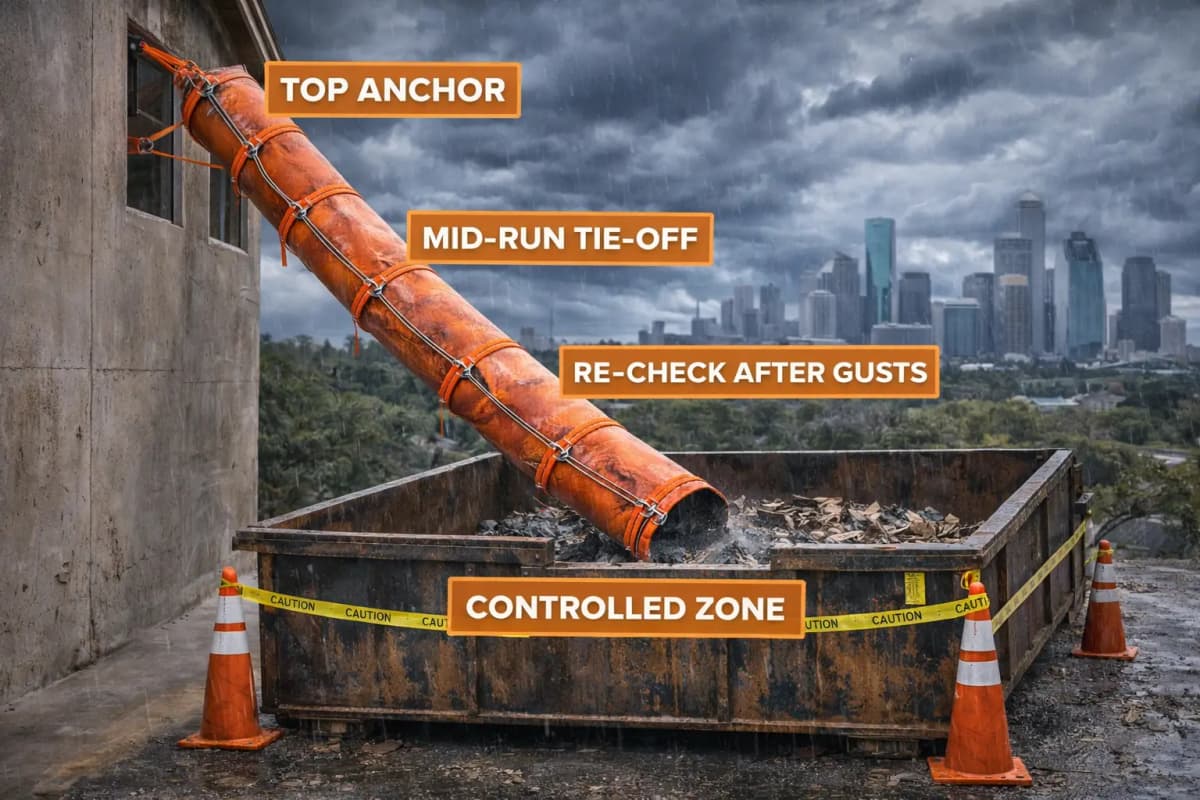
Understanding the cost drivers now saves thousands in overruns. This guide breaks down Bridgeport rental pricing, local compliance factors, and proven budgeting tactics contractors use to forecast accurately.
Cost Breakdown: Sections, Duration & Material
Standard Section Pricing
A single 25-foot chute section is the baseline rental unit. In Bridgeport, expect to pay $300–$400 per week for a basic poly (polyethylene) section. Additional sections stack at roughly 60–70% of the first section’s cost, reflecting shared delivery and setup labor.
For example:
- 1 section (25 ft): $350/week
- 2 sections (50 ft): $560/week (~$210 per additional section)
- 3 sections (75 ft): $770/week (~$210 per additional section)
Canvas chute materials typically rent at a 10–20% premium over poly due to durability and weather resistance, especially relevant in Bridgeport’s humid coastal climate.
Duration: Weekly vs. Monthly Discounts
Weekly rentals are more expensive per day than monthly contracts. A project lasting 4–6 weeks often benefits from a monthly rate of $1,200–$1,500 for a single section, versus $1,400–$1,600 paid weekly. Negotiate monthly rates early if your timeline is locked in.
Long-term rentals (8+ weeks) may unlock 15–25% discounts. Always ask your rental partner for tiered pricing based on your confirmed project duration.
Material Type Impact
Trash Chute Cost Comparison: Canvas vs. Poly Materials in 2026 breaks down durability differences. For Bridgeport’s weather—salt spray, humidity, seasonal temperature swings—canvas holds up better but costs more. Most contractors in the area choose poly for short-term (4–8 week) projects and canvas for longer, exposed installations.
Bridgeport-Specific Cost Factors
Urban Delivery & Access Fees
Bridgeport’s dense urban corridors add delivery complexity. Narrow streets, limited parking, and multi-story building layouts near downtown command a $150–$300 delivery surcharge compared to suburban sites. Confirm delivery logistics with your rental partner; some fees are negotiable if access is straightforward.
Site Setup & Rigging Costs
High-rise buildings (above 6 stories) require professional rigging and tie-off installation. Bridgeport has several mid-rise commercial and residential buildings; expect $400–$800 in rigging labor for secure, code-compliant mounting. This is separate from the rental fee and often billed hourly or as a flat setup charge.
Local Permits & Inspections
Bridgeport’s Department of Building Services requires debris chute permits for any installation lasting more than 2 weeks or visible from public right-of-way. Permit costs are typically $100–$250, plus potential re-inspection fees if modifications are needed mid-project. Plan 5–7 business days for permit approval.
Waste Disposal & Dumpster Coordination
The chute rental does not include dumpster pickup. You must arrange separate waste removal or coordinate with a local disposal vendor. Bridgeport waste removal costs vary: residential demolition debris runs $400–$800 per dumpster load, while commercial C&D debris may be $600–$1,200. Factor this into your total project cost.
Monthly vs. Project-Based Pricing Models
Weekly Rate Model (High Flexibility)
Pay only for the weeks you need. Ideal for unpredictable timelines, weather delays, or small contractors managing multiple concurrent projects. Weekly rates are the rental company’s standard; there’s less negotiating room but maximum flexibility.
Monthly Rate Model (15–25% Savings)
Commit to 4+ weeks and lock in a monthly price. A 5-week project at weekly rates costs $1,750 (5 × $350); the same project on a monthly rate might be $1,200–$1,350, saving $400–$550. Most contractors prefer monthly if timeline is confirmed.
Project-Flat-Rate Model (Best for Long-Term)
Some rental partners offer fixed pricing for the entire project scope (e.g., $2,500 for 8 weeks, 2 sections). This eliminates surprise invoices and simplifies budgeting. Negotiate this if you have locked-in timelines and scope.
How to Estimate Your Rental Cost
Five-Step Estimation Process
Follow this worksheet to forecast your Bridgeport debris chute rental cost:
- Determine Project Duration. Count working days, then convert to full weeks (round up). A 10-day project = 2 weeks rental.
- Estimate Debris Volume & Height. For a 3-story, 5,000 sq ft renovation, expect 75–100 cubic yards of debris. Use the Trash Chute Capacity Calculator Guide to size sections.
- Select Material & Section Count. Most Bridgeport projects use 1–2 poly sections. High-rise demolition may need 3+. Assume $350/week per section as baseline.
- Add Fixed Costs. Delivery ($150–$300) + setup/rigging ($0–$800) + permits ($100–$250) = $250–$1,350 one-time.
- Calculate Total Rental. (Section count × weekly rate × duration in weeks) + fixed costs. Multiply by 1.1 to buffer for contingency.
Example: 6-week renovation, 2 sections, poly, downtown Bridgeport location.
- Weekly chute cost: 2 sections × $350 = $700
- Duration: 6 weeks = $4,200
- Delivery: $200
- Setup/rigging: $600
- Permits: $150
- Subtotal: $5,150
- Contingency (+10%): $515
- Estimated Total Budget: $5,665
Hidden Fees & Surcharges to Avoid
Common Surprise Charges
Request a full, itemized quote before signing. Watch for:
- Delivery surcharges for sites beyond 15 miles of the rental depot
- Weekend/holiday upcharges (typically 25–50% premium)
- Damage fees if the chute is returned with dents, tears, or stains exceeding normal wear
- Disposal fees if debris is left in or on the chute after return
- Late-return penalties (often $50–$100/day if kept past end date)
- Rigging/tie-off modifications requested mid-project (billed hourly at $75–$125/hr)
- Site inspection fees if the rental company needs to assess access before quoting
Ask upfront: “What’s included in the weekly rate, and what are separate line items?” Most reputable Bridgeport rental partners will provide a transparent breakdown.
ROI Calculator & Payback Analysis
For contractors deciding whether to Debris Chute Rental vs. Purchase ROI Calculator for Contractors 2026, the math is straightforward. A new debris chute system costs $2,500–$4,500 to purchase. Rentals cost $300–$600/week.
Breakeven Analysis:
- If you rent fewer than 6–8 weeks per year, renting is cheaper.
- If you run 40+ weeks annually (multiple concurrent projects), purchasing typically yields positive ROI in year 2.
- Bridgeport contractors averaging 3–4 projects per year (12–20 weeks of rental) usually stay in rental territory unless they specialize in high-volume demolition.
Use the rental calculator linked above to model your specific scenario. Factor in purchase financing, storage, maintenance, and insurance if you’re evaluating ownership.
Comparing Poly vs. Canvas Chute Materials
Poly (Polyethylene) Chutes
Lighter, cheaper, easier to handle. Standard rental material. Lifespan: 2–5 years under normal use. Cost in Bridgeport: $350–$400/week for a 25-ft section.
Best for: Short-term (under 8 weeks), interior/protected setups, startups with tight budgets.
Canvas Chutes
Heavier, more durable, better weather resistance. Ideal for exposed, high-traffic demolition sites. Lifespan: 5–10 years. Rental cost: $420–$500/week, roughly 15–25% premium.
Best for: Long-term projects (8+ weeks), outdoor demolition, coastal areas (salt spray, humidity).
Bridgeport’s proximity to the Atlantic and seasonal humidity favor canvas for projects exceeding 8 weeks. For typical 4–6 week renovations, poly is sufficient and more budget-friendly. See Trash Chute Cost Comparison: Canvas vs. Poly Materials in 2026 for a detailed material breakdown.
Permits & Compliance Requirements for Bridgeport
Permit Requirements
Bridgeport requires debris chute permits if:
- Installation duration exceeds 2 consecutive weeks
- The chute is visible from public right-of-way
- The installation is on a building taller than 4 stories
Connecticut’s building code aligns with national standards for debris chute rigging and safety. OSHA Construction Industry safety standards mandate secure tie-offs, warning signage, and inspection intervals.
Local Coordination
Contact Bridgeport’s Department of Building Services at least 5–7 days before installation. You’ll need:
- Completed permit application (available online)
- Site photos showing proposed chute location
- Proof of tie-off and rigging plan (your rental partner typically provides this)
- Insurance certificate naming the city as additional insured
Permit approval is usually swift (3–5 days) if paperwork is complete. Delays occur when inspectors need clarification on rigging or building height. Schedule permits early.
Insurance & Liability Coverage
Most debris chute rental companies require you (the contractor) to carry general liability insurance naming them as additional insured. Typical requirement: $1 million minimum coverage for bodily injury and property damage.
Your insurance policy should explicitly cover debris chute operations and third-party liability (e.g., debris landing on an adjacent property). Many contractors already have this under their standard GL policy, but confirm with your insurance broker.
Read Debris Chute Insurance Requirements for Contractors 2026 for a complete compliance checklist. Undisclosed liability gaps can result in claim denial and project shutdowns.
Step-by-Step Budgeting Worksheet
Print or download this worksheet to lock in your budget:
| Line Item | Unit Cost | Quantity | Total |
| Chute sections (poly or canvas) | $____ / week | ___ sections × ___ weeks | $____ |
| Delivery & pickup | $____ flat | 1 | $____ |
| Setup & rigging labor | $____ flat or hourly | 1 | $____ |
| Permit & inspections | $____ flat | 1 | $____ |
| Waste disposal / dumpster | $____ per load | ___ loads | $____ |
| Insurance (if purchased separately) | $____ per week | ___ weeks | $____ |
| Subtotal | $____ | ||
| Contingency (10–15%) | $____ | ||
| TOTAL PROJECT BUDGET | $____ |
Frequently Asked Questions
What is the average debris chute rental cost in Bridgeport, CT?
A single 25-foot poly section averages $350/week in Bridgeport. Typical projects (2 sections, 6 weeks) range $4,500–$6,500 including delivery, setup, and permits. Costs scale with height, material type (poly vs. canvas), and site complexity (urban vs. suburban access).
Can I negotiate lower rental rates for multi-week projects?
Yes. Confirm your project timeline upfront and ask for monthly or project-flat-rate discounts. Rentals 6+ weeks often qualify for 15–20% reductions. Get the discount in writing before committing.
Are permits required for all debris chute installations in Bridgeport?
Permits are required if installation exceeds 2 weeks, is visible from public right-of-way, or the building is taller than 4 stories. For shorter, enclosed projects, permits may not be needed, but always check with Bridgeport’s Department of Building Services to confirm.
What happens if my project runs longer than the rental period?
Notify your rental partner immediately. Most companies add daily overage charges (typically $50–$75/day) after the rental period expires. It’s cheaper to negotiate a longer rental upfront than pay daily overages; renegotiate if timelines slip.
Can I rent a debris chute for less than a week?
Most rental companies enforce a one-week minimum. If you need the chute for 2–3 days, you’ll typically pay the full weekly rate. Plan small, short projects into longer rental windows to avoid waste, or ask if your rental partner offers daily rates for emergency/rapid-turnaround jobs.
Is delivery included in the rental rate?
No. Delivery is almost always a separate line item ($150–$300 depending on distance and site access). Confirm delivery costs and dates in writing. Some rental companies charge separate fees for delivery and pickup; others bundle them.
How do I know if my site qualifies for a debris chute rental?
If your project involves renovation, demolition, roofing work, or interior tear-out, a debris chute helps. Check with your rental partner on site feasibility: they’ll assess building height, access, and rigging requirements. Most Bridgeport commercial and multi-family sites accommodate debris chutes.
Ready to Rent Your Debris Chute
Bridgeport contractors have clear cost drivers for debris chute rentals: duration, section count, material type, and local logistics. Use this guide to build an accurate budget, avoid hidden fees, and plan permits and insurance ahead of time.
Next steps:
- Fill out the budgeting worksheet above with your project specifics.
- Contact your rental partner with locked-in timeline and site details (address, building height, access notes).
- Request a full, itemized quote and confirm all line items match this guide.
- File your permit application 7–10 days before installation.
- Verify your general liability insurance covers debris chute operations.
For more detailed ROI comparisons, see Debris Chute Rental vs. Purchase ROI Calculator for Contractors 2026. If you’re managing multiple concurrent projects, also review Debris Chute for Contractor Startups vs. Established Firms for scaling strategies.
Questions about material selection? Trash Chute Cost Comparison: Canvas vs. Poly Materials in 2026 breaks down durability and cost trade-offs. And for a detailed budgeting walkthrough, use the Renovation Debris Chute Cost Estimate Checklist.
On the compliance side, review EPA construction & demolition debris facts to understand waste stream requirements and recycling mandates in Connecticut. Bridgeport contractors disposing of C&D debris should coordinate with local waste processors to ensure proper sorting and diversion.
Finally, keep OSHA ergonomics guidelines in mind when loading the chute — safe lifting posture protects your crew and reduces injury claims. Debris chute rental saves time, but operational safety remains the responsibility of your team on-site.
Get a custom quote today. Call or email us with your Bridgeport project details — we’ll provide a transparent, itemized estimate and help you avoid budget overruns.