

Index
- Why Debris Chute Strategy Matters for Your Firm
- Startup Contractors: Constraints and Opportunities
- Established Firms: Efficiency and Scale
- Rental vs. Purchase: A Decision Framework
- Capital Planning and Cash Flow Realities
- Operational Complexity by Firm Stage
- Crew Training and Site Coordination
- Scaling Your Debris Chute Workflow from Startup to Established
- Insurance, Compliance, and Liability Differences
- Common Mistakes by Firm Stage (And How to Avoid Them)
- Technology Tools for Tracking and Costing
- Frequently Asked Questions
- Ready to Build Your Debris Chute Strategy
Why Debris Chute Strategy Matters for Your Firm
Whether you’re a one-person startup or a 50-person established firm, debris removal eats time, costs, and safety margins. The difference is stark: a startup’s margin per job is thin, so every rental decision compounds. An established firm’s challenge is fleet optimization—do we own, rent, or hybrid?
Debris chute strategy isn’t just about the equipment. It shapes your crew’s rhythm, your job timeline, your insurance posture, and your client experience. Get it right, and you move from cleanup bottleneck to competitive advantage. Get it wrong, and you’re either bleeding cash on unused equipment or losing days to unavailable rentals.
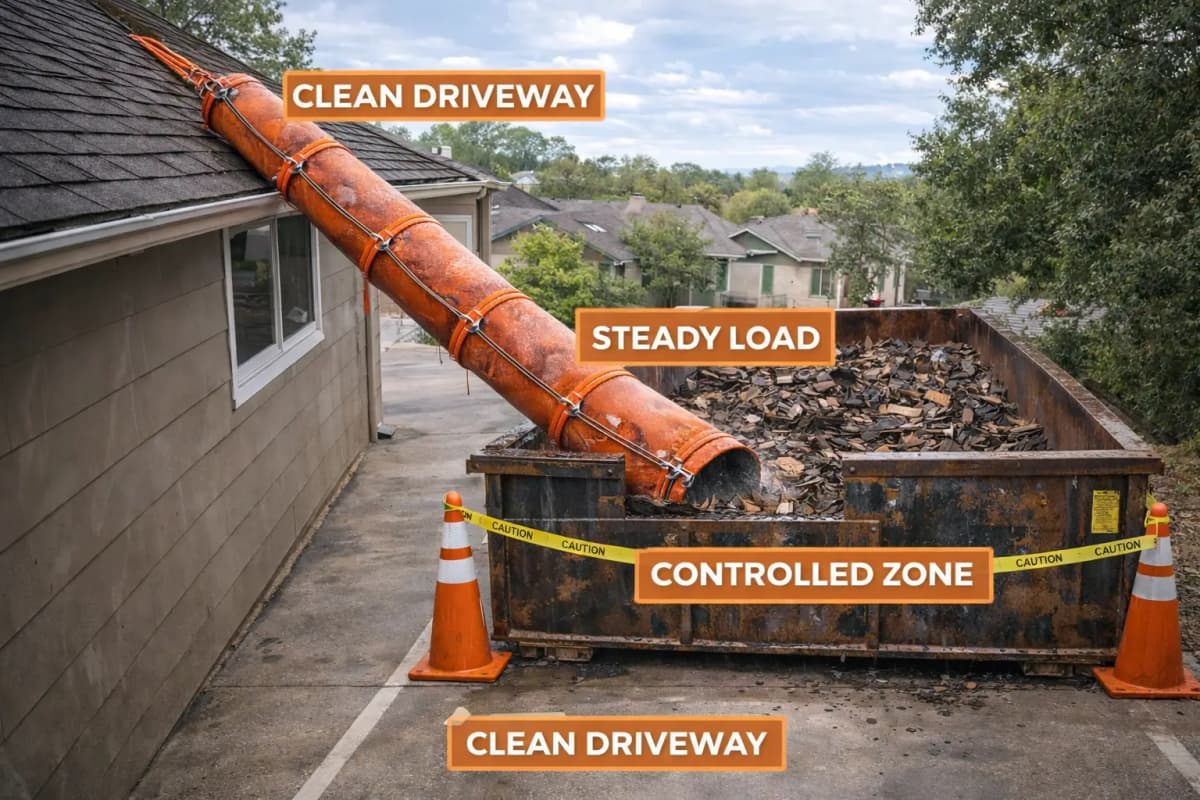
This guide walks you through the financial, operational, and strategic differences. By the end, you’ll know which path fits your firm’s growth stage.
Startup Contractors: Constraints and Opportunities
A startup contractor (1–5 crew) faces real constraints: every dollar is working capital, space is limited, and projects come in unpredictably. Your strength is agility—you can say yes to diverse job types without overcommitting to equipment.
Cash Flow Pressure
Startups operate on thin margins. A $50,000 equipment purchase is capital you don’t have (or capital that should stay in reserve). Rental lets you pay-per-project, turning a fixed cost into a variable one. That flexibility is worth premium rental rates for the first 2–3 years.
Space and Logistics Constraints
If you don’t have a yard or warehouse, owning chute sections becomes a storage nightmare. Rental sidesteps that entirely. You pick up or have it delivered, use it for 2–4 weeks, and it’s gone. No insurance on idle equipment, no maintenance, no storage rent.
Crew Confidence and Safety
A startup crew often hasn’t run a chute on 10+ jobs yet. Rental companies (quality ones) often include brief setup coaching. You’re not learning on your own dime; you’re learning on their documented SOP. That’s valuable when you’re still building muscle memory around safe debris flow, crew spacing, and dumpster swaps.
Job Type Flexibility
Roofing jobs need lightweight, fast-deploy chutes. Kitchen renovations in occupied homes need quiet, compact setups. Demolition jobs need heavy-duty, high-volume systems. A startup can rent different chute classes per job. An established firm with $150k in owned equipment is committed to one or two designs.
Our first-time contractor guide outlines best practices for your early jobs.
Established Firms: Efficiency and Scale
An established firm (10+ crew, $500k+ annual revenue) has different constraints: you’re running multiple simultaneous jobs, your crew has chute experience, and you have yard space. Your challenge is cost-per-job efficiency and fleet utilization.
Utilization Economics
If you own 4 chute sets and deploy them on 8–10 jobs per quarter, your cost-per-use drops dramatically. A $40,000 owned set, used 10 times per year over 5 years, costs $800 per deployment. Rental at $3,000 per month (typical) is $3,000 per job if the job runs 1 month. Own it, and you’re at $800. The math flips hard after year two.
Crew Familiarity and Speed
Your team has run the same chute design 50 times. Setup is 30 minutes instead of 2 hours. Maintenance is crew-owned (not outsourced). Swap-outs are on your schedule, not the rental company’s. That reduces job friction and improves client satisfaction (faster cleanup = less site disruption).
Branding and Professionalism
A dedicated fleet (with your company color or logo) looks professional. Clients see consistent, well-maintained equipment. That builds trust and justifies premium pricing. A rental chute is generic; your chute is yours.
Supply Chain Control
When you own equipment, you control maintenance windows and availability. Rental supply chains can be stressed during peak season (spring–summer). Established firms with owned fleets don’t compete for rentals; they deploy their own.
Rental vs. Purchase: A Decision Framework
Here’s a practical framework. Calculate your breakeven using three inputs: annual deployment frequency, average rental cost per deployment, and total equipment cost (purchase + setup + first-year insurance).
The Breakeven Equation
Breakeven Deployments = (Equipment Cost) ÷ (Rental Cost per Deployment − Variable Ownership Cost per Deployment)
Example: $40,000 equipment, $3,000 per rental, $200 variable cost (fuel, minor repairs) = 40,000 ÷ (3,000 − 200) = ~14 deployments per year. If you deploy fewer than 14 jobs/year, rent. If you exceed 14, buy (over a 3–4 year horizon).
Deployment Frequency Matters Most
If you do 20+ jobs per year, purchase makes sense (usually by year 2). If you do 5–10 jobs per year, rent consistently. The gray zone (10–15 jobs/year) requires a hybrid: own one set for your bread-and-butter project type, rent the specialty chutes.
Our Debris Chute Rental vs. Purchase ROI Calculator lets you model your exact scenario.
Hidden Costs in Purchase Decisions
Don’t just think hardware cost. Factor in:
- Insurance and liability: ~$100–300/month for equipment coverage
- Storage space rent: If you don’t own a yard, $200–600/month to rent bay space
- Maintenance labor: ~1–2 hours per quarter (inspections, part replacements)
- Obsolescence: Equipment typically has a 5–7 year useful life; you’ll replace or retire it
- Seasonal downtime: In cold climates, winter storage and seasonal re-setup add friction
Capital Planning and Cash Flow Realities
Startups and established firms manage cash flow differently, and debris chute decisions reflect that reality.
Startup Cash Flow: Monthly Rent vs. Lump-Sum Purchase
A startup contractor pulling $5,000–8,000 per job cannot absorb a $40,000 equipment purchase without killing operational cash. Rental (month-to-month or per-project) aligns cost with revenue. You rent the chute for a $30,000 kitchen gut, you pay $2,500, and your margin is clear. That’s predictable.
Purchase forces a choice: finance it (debt at 8–12% APR over 3–5 years) or deplete reserves. Financing adds ~$800/month in payments—over $9,600 per year. A startup doing 12 jobs/year at $5,000 revenue each is at $60,000 gross. $9,600 in debt service is 16% of gross revenue—unsustainable early on.
Established Firm Cash Flow: Depreciation and Tax Planning
An established firm can justify purchase because:
- Depreciation deduction: $40,000 equipment depreciates over 5–7 years; you write off $5,714–8,000 per year, reducing taxable income (consult your CPA for specifics)
- Section 179 expensing: You may deduct the full $40,000 in year one (IRS limits apply) if it qualifies as qualifying property
- Stable cash flow: With $1M+ annual revenue, $40,000 is 4% of gross—manageable
- Amortization strategy: Some firms lease-to-own (hybrid), splitting tax benefits and operational flexibility
Check Debris Chute Tax Deductions for Contractors for a detailed guide to write-offs.
Budgeting for Growth Transitions
If you’re a startup planning to scale to 15+ jobs per year within 2 years, front-load a chute purchase discussion in your business plan. Set aside $5,000 per quarter for a 2-year equipment fund. By year 2, you’ll have $40,000 and deployment history to justify the investment with confidence.
Operational Complexity by Firm Stage
Operational complexity of chute management scales non-linearly. Early startup is simple (rent, use, return). Established firm with owned fleet is complex (inventory, maintenance, deployment scheduling, crew training).
Startup Operations: Minimal Complexity
Your checklist per job:
- Check job site for chute placement (roof penetration, ground clearance, weight limits)
- Place rental order 2 weeks prior; confirm delivery date
- Unload and position chute per rental company SOP (often included setup)
- Train crew on entry, exit, and blockage-clearing (30 minutes)
- Run the job with standard debris flow
- Schedule pickup; chute is gone
Complexity is low. Surprises are rare if you order early.
Established Firm Operations: Fleet Management
Your systems are more intricate:
- Inventory tracking: Where are the 4 chute sets? Which jobs are they on? When do they return?
- Maintenance scheduling: Quarterly inspections, part replacements, pressure-washing
- Crew assignment: Who’s trained on which chute class? Who’s the setup lead?
- Deployment optimization: Which chute for which job type to maximize utilization?
- Cross-team coordination: Site manager, crew, dispatcher, accountant all need real-time visibility
- Contingency planning: One chute breaks mid-job; you need a backup
Many established firms use a simple spreadsheet or software tool (project-management platform or inventory app) to track chute allocation. As you scale, that becomes non-optional.
Crew Training and Site Coordination
Debris chute safety and speed are crew-dependent. Training and coordination differ sharply by firm size.
Startup Crew Training
A startup’s crew learns on the job. Your first 3–5 chute deployments are teaching moments. Focus on:
- Safe entry and exit (no jumping, no hanging off edges)
- Debris sizing (nothing too large or dense that clogs the chute)
- Blockage response (how to identify, when to stop, how to clear without injury)
- Dumpster swap coordination (when is a dumpster full? How long does a swap take?)
Rental companies often document their chute’s quirks (e.g., “This model jams if large drywall pieces aren’t angled”). Ask for a one-page quick-start guide and brief the crew before day one.
See Debris Chute System Setup Step-by-Step for a detailed workflow.
Established Firm Crew Training
With owned equipment, you standardize training. Every crew member receives a mandatory 30-minute orientation before their first chute job. Topics:
- Equipment anatomy (sections, locks, mounting hardware)
- Setup and teardown SOP (checklist-driven, timed at 30 minutes)
- Safety protocols (fall protection, load limits, debris types)
- Maintenance (daily cleanout, weekly inspection, when to flag issues)
- Incident reporting (what counts as an anomaly, who to notify)
Consistency across crews reduces accidents and boosts efficiency. A trained crew that’s run your chute 20 times deploys it faster and cleaner than a first-timer on a rental.
Site Coordinator Coordination
Your site manager’s job is chute flow and rhythm. On a startup’s small job, that’s straightforward: one entry point, one dumpster, one crew managing blockages. On an established firm’s multi-crew site, it’s trickier:
- Two chute sections stacked; multiple crews feeding from different floors
- Dumpster swaps happen every 2–3 days; swaps can’t disrupt ongoing work
- Backup plan if one chute clogs (second entry point, manual debris carry-down, timing shifts)
The site coordinator pre-plan this. A simple timeline (e.g., “Dumpster swaps are Mondays 6am–7am”) prevents surprises.
Scaling Your Debris Chute Workflow from Startup to Established
If you’re a startup with ambitions to grow, when and how do you transition from rental to owned fleet?
Years 1–2: Rent Everything, Build Data
Track every rental: job type, duration, cost, crew efficiency, issues. After 8–12 jobs, you’ll see patterns. Maybe 60% of your jobs are 2–4 week residential renovations (similar chute profile each time). That’s your “bread and butter.”
Year 2–3: Buy One Core System
Once you’re consistently booking 12+ jobs per year and 60% match one profile, purchase a single chute system optimized for that profile. Continue renting specialty chutes (high-rise, demolition, commercial) that you do infrequently.
At this stage, your cost structure shifts: owned system (now on its second year, cost-per-deployment under $1,000) + occasional rentals for outliers. Your margins improve.
Year 3–5: Expand Owned Fleet Strategically
As you hit 20+ jobs per year, add a second chute system for your second most common job type. Keep renting for 10% outlier work. By year 5, you’re 80% owned, 20% rental—and your cost-per-job is optimized.
Playbook: Startup-to-Established Transition
- Months 1–12: Rent all chutes. Track cost per job, crew feedback, deployment frequency.
- Months 12–18: Analyze data. Identify your core job type (60%+ of volume). Develop a purchase case for a single system.
- Month 18–24: Buy and deploy your core system. Rent specialty chutes still. Measure ROI (cost per deployment on owned vs. rental comparisons).
- Year 2–3: If utilization exceeds 12 deployments/year, greenlight a second system for your secondary job type.
- Year 3+: Stabilize fleet at 2–3 systems. Rent only for 10% of outlier work. Revisit purchasing formula annually.
For detailed ROI modeling, use our Debris Chute Rental vs. Purchase ROI Calculator.
Insurance, Compliance, and Liability Differences
Insurance and legal exposure differ between rental and owned equipment, and between firm sizes.
Startup: Rental Equipment Liability
When you rent, the rental company carries primary liability for equipment failure. Your general liability policy covers injuries caused by your crew’s misuse (e.g., improper chute entry, overloading). That split is clear.
However, review your GL policy with your agent:
- Does it cover temporary equipment (chutes, dumpsters)?
- Is there a deductible for debris-chute-related claims?
- Are crew injuries from chute accidents covered, or is that workers’ comp?
Most policies cover general liability; workers’ comp covers crew injury. Verify before your first rental.
Rental contracts usually indemnify the contractor (you) for the rental company’s negligence—read the fine print and ask your agent if it’s acceptable under your policy.
See Debris Chute Insurance Requirements for Contractors for a detailed compliance checklist.
Established Firm: Owned Equipment Liability
When you own, you carry full liability for equipment failure, maintenance, and crew safety. You’ll need:
- General liability insurance: $1M–2M coverage, explicitly endorsing owned debris chutes and equipment
- Equipment insurance: Covers theft, damage, wear-and-tear. ~$100–300/month for a $40k system
- Workers’ compensation: Covers crew injury; must be on all employees
- Pollution liability (optional): If debris from hazmat-containing sites, environmental coverage protects against contamination claims
Cost: ~$400–600/month in insurance premiums (GL + equipment). Factor that into your purchase ROI.
Compliance and Site-Specific Regulations
Both startups and established firms must comply with:
- OSHA regulations: OSHA Construction Industry standards specify safe debris disposal, fall protection, and guarding.
- Local permits: Some cities require chute permits; others don’t. Check with your local building department.
- HOA and residential rules: Neighborhood covenants may limit chute hours, colors, or placement.
- Environmental regulations: Some debris (lead paint, asbestos, hazmat) cannot go down a chute; they require licensed disposal.
Startups often overlook these; established firms build them into pre-project planning. Make it a checklist item, not an afterthought.
Common Mistakes by Firm Stage (And How to Avoid Them)
Startup Mistakes
Mistake 1: Ordering too late. You book a job and order a chute 1 week before start. Peak season (May–August), rentals are booked 3+ weeks out. You either pay premium for expedited delivery or delay the job. Fix: Order 4 weeks in advance; factor chute booking into your project-timeline assumptions.
Mistake 2: Wrong chute size for the job. A kitchen renovation generates ~3 cubic yards of debris; a full roof tear-off generates 15+. You rent an undersized chute; crews waste time swapping dumpsters, and the job runs long. Fix: Estimate debris volume upfront (use our Trash Chute Capacity Calculator), then order a chute rated for 120% of that volume.
Mistake 3: Skipping crew training. Your crew doesn’t know how to safely exit the chute or clear a blockage. Someone gets hurt. Fix: Require a 30-minute safety briefing before chute work; make it part of your project kickoff.
Mistake 4: Ignoring insurance gaps. You don’t confirm your GL policy covers rented equipment. A debris chute failure injures someone; your claim is denied. Fix: Call your agent; get written confirmation that rented debris chutes are covered. Ask about deductibles.
See Debris Chute Mistakes to Avoid for a full checklist.
Established Firm Mistakes
Mistake 1: Over-owning equipment. You own 5 chute systems but deploy only 8 jobs per year. Four chutes sit idle, bleeding insurance and storage costs. Meanwhile, a seasonal spike leaves you scrambling to rent. Fix: Model your deployment forecast quarterly. Own only systems that hit 10+ annual deployments. Rent for peaks and specialty work.
Mistake 2: Maintenance deferred. You skip quarterly inspections to save labor. A chute section cracks mid-job, work stops for 2 days, and you scramble to rent a replacement. Downtime costs more than preventive maintenance. Fix: Schedule maintenance on a calendar; assign a crew lead to do visual inspections monthly (5 minutes per system).
Mistake 3: Crew training decay. You train crews once; over time, shortcuts slip in (improper entry angles, overloading). Safety incidents rise. Fix: Refresher training every 12 months, plus a pre-job safety huddle on every chute job.
Mistake 4: No inventory visibility. You don’t know which chute is on which job or when it returns. Deployments overlap, and you miss a scheduled project because a chute is overdue from the previous job. Fix: Use a simple spreadsheet or project-management app to track: Chute ID, deployment date, job address, return date, crew lead. Check it daily.
Technology Tools for Tracking and Costing
Both startups and established firms benefit from basic tracking. You don’t need enterprise software; spreadsheets and simple apps work.
Startup: Minimal Tracking
A simple spreadsheet captures:
- Job address, start date, end date
- Chute type rented, rental cost, rental company
- Crew assigned, crew hours on debris management
- Debris volume (cubic yards), dumpster swaps, issues encountered
After 10 jobs, patterns emerge: you can forecast chute type, predict debris volume, and estimate crew time. That feeds into better project estimates and improved margins.
Established Firm: Asset and Cost Tracking
A more detailed tracker (spreadsheet or low-cost project-management app) includes:
- Equipment ledger: Each chute system (ID, purchase date, cost, maintenance log, insurance value, depreciation schedule)
- Deployment log: Every use (chute ID, job, start date, return date, crew, cost of deployment [fuel, maintenance, swap labor])
- Maintenance calendar: Scheduled inspections, parts replacements, downtime windows
- Cost-per-deployment: Monthly calculation (equipment amortization + variable costs) ÷ # deployments = cost per use
- Rental vs. owned comparison: Track both rental costs (for outlier jobs you still rent) and owned-system costs; compare ROI quarterly
This data informs strategic decisions: “Our owned systems cost $780 per deployment; rentals cost $2,400. Own more? Or rent more?” Quarterly reviews keep you aligned.
Frequently Asked Questions
Should I buy a debris chute if I’m just starting out as a contractor?
Not immediately. Rent for your first 8–12 jobs while you build deployment frequency data and crew experience. Once you’re consistently booking 12+ jobs per year and one job type dominates 60% of your portfolio, evaluate purchase. Until then, rental preserves cash and flexibility. Use our ROI calculator to model your breakeven point after you have real job data.
What’s the actual cost difference between renting and owning over 5 years?
A $40,000 chute system rented 10 times per year at $3,000 per rental costs $150,000 over 5 years. Owned, it costs roughly $40,000 (equipment) + $15,000 (insurance + maintenance + storage over 5 years) = $55,000. The math flips after ~16 deployments per year. If you deploy fewer than 12 times annually, rent. If you exceed 16 times annually, buy. Between 12–16, use a hybrid (own one, rent specialty types).
Do I need different liability insurance for owned vs. rented chutes?
Yes. Rental equipment is covered under your general liability, but confirm with your agent that “temporary construction equipment” is explicitly included. Owned equipment requires an equipment insurance endorsement (~$100–300/month). Verify both with written confirmation from your insurer before deploying any chute.
How much crew training do I need to do for chute safety?
A mandatory 30-minute safety briefing before the first chute job is the minimum. Cover entry/exit techniques, debris sizing, blockage response, and dumpster-swap coordination. For established firms, annual refresher training prevents safety decay. Document training and attendance; it protects you in liability claims and ensures consistency.
Can I scale from one rented chute to owning a fleet in 2 years?
Yes, if your deployment volume grows. Rent for year 1 (8–12 jobs). If you’re hitting 12+ jobs per year by month 18, buy one chute system for your core job type (month 18). Continue renting specialty work. By year 2.5–3, if you’ve grown to 18+ jobs annually, add a second system. This staged approach minimizes capital risk and lets you validate ROI with real data before scaling.
What’s the main operational difference between startup and established firm chute workflows?
Startups manage chute booking and logistics on a per-job basis (simple, reactive). Established firms optimize fleet deployment across simultaneous jobs (complex, proactive). A startup’s checklist is 6 items; an established firm’s is 20+. Automation and visibility systems (even simple spreadsheets) become essential for established firms to avoid deployment conflicts and missed jobs.
How do I know when to stop renting and buy?
When annual deployment frequency exceeds your breakeven point (calculated using your specific rental cost, equipment cost, and variable costs), purchase becomes financially superior. For most contractors, that’s 14–16 deployments per year. Track your deployment history for 18 months, calculate your breakeven, and compare to your forecast. If you expect to stay below breakeven for 2+ years, keep renting. If you expect to exceed it, buy.
Ready to Build Your Debris Chute Strategy
Your debris chute strategy shapes your firm’s profitability, safety, and client satisfaction. Whether you’re a startup finding your footing or an established firm optimizing your fleet, the decision is driven by data: deployment frequency, job type mix, cash flow constraints, and long-term growth plans.
For startups: Rent your way through your first 2 years. Build deployment history, validate crew processes, and confirm your core job type. Use our first-time contractor guide to avoid common pitfalls, and model your ROI scenario annually. When deployment frequency hits 12+ per year consistently, revisit the purchase question.
For established firms: Audit your owned fleet utilization quarterly. Own systems that deploy 10+ times per year; rent outliers and peaks. Standardize crew training, invest in inventory visibility, and compare owned-system cost-per-deployment to rental rates annually. Maintenance and preventive planning are investments, not costs—they prevent downtime and protect equipment value.
Next steps:
- Track your deployment history (job type, duration, chute type, cost) for your next 10 jobs.
- Calculate your breakeven deployment frequency using your rental costs and equipment price.
- Review your GL insurance and confirm coverage for rented and owned debris chutes.
- Plan your crew training and safety protocols (even one-person startups need a written SOP).
- Check local regulations and HOA rules for your typical job sites (chute permits, hours, placement restrictions).
Questions? Our team can walk you through equipment options, rental terms, and custom ROI scenarios for your firm. Reach out at +1-855-902-0883 or visit our debris chute rental guide to explore options tailored to your stage and volume.
Whether you’re renting your first chute or managing a fleet of five, success comes from clarity on your economics, consistency in your crew training, and intentional planning as you scale. Start small, measure, decide. Your margins—and your crew’s safety—depend on it.