

Index
- Rental vs. Purchase: The Strategic Overview
- The True Cost of Debris Chute Rentals
- Purchase Costs: Upfront and Hidden Expenses
- ROI Calculator Framework for Contractors
- When Does Purchase Break Even?
- Project Type Decision Tree
- Tax Deductions and Financial Advantages of Ownership
- Depreciation, Resale Value, and Long-Term ROI
- Fleet Efficiency Across Multiple Projects
- Maintenance, Downtime Risk, and Rental Flexibility
- Financing Options and Cash Flow Timing
- Frequently Asked Questions
- Local Regulatory and Permitting Considerations
- Ready to Calculate Your ROI?
Rental vs. Purchase: The Strategic Overview
For commercial contractors managing renovation, demolition, or roofing projects, debris chute selection often comes down to a single question: rent or buy? The answer depends on your project volume, cash flow constraints, storage capacity, and tax strategy. In 2026, equipment costs, rental rates, and financing terms have shifted in ways that change the traditional ROI calculation.
This guide walks you through the complete financial model, including a step-by-step modular trash chute cost calculator framework you can customize to your specific operations. We’ll compare direct costs, hidden expenses, tax benefits, and resale potential to help you make a data-driven decision.
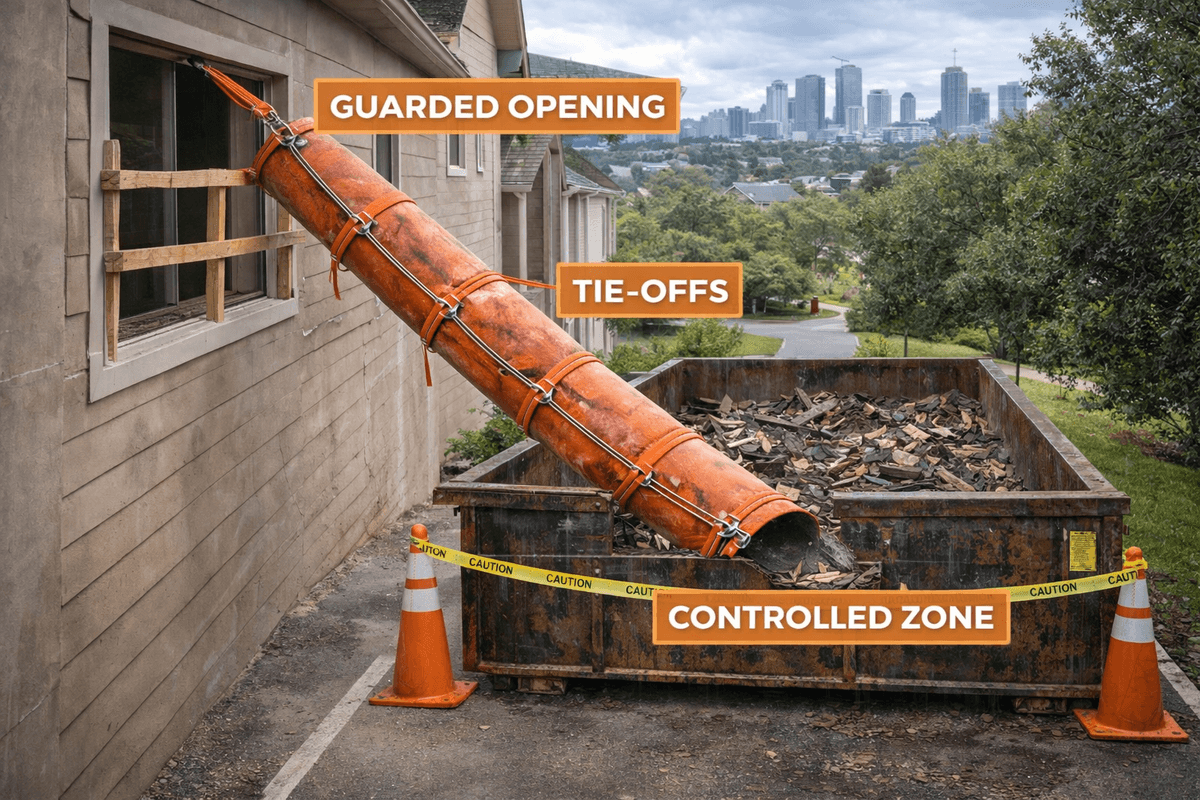
The True Cost of Debris Chute Rentals
Rental appears simple on the surface: weekly or monthly rate, delivery, pickup. But the full cost picture includes several components contractors often overlook.
Standard Rental Rate Components (2026)
- Weekly rental fee: $200–$400 per week for standard modular systems (25–50 ft sections)
- Delivery charge: $150–$300 per trip (one-time setup)
- Pickup charge: $150–$300 per trip (end-of-project removal)
- Damage waiver or insurance: 5–10% of rental cost (optional but recommended)
- Extended rental penalties: Daily overage fees ($30–$50/day) if the project runs longer than contracted
- Fuel surcharge: 2–5% depending on regional costs and distance from depot
For a typical 12-week commercial renovation, rental costs alone total roughly $2,400–$4,800 in base fees, plus $300–$600 in delivery/pickup. Add damage waiver ($120–$240) and a small fuel surcharge, and the true rental outlay sits at $2,900–$5,700 per project.
Rental Advantages for Specific Scenarios
- One-off projects: If you run fewer than three major projects annually, ownership logistics don’t justify the investment.
- Storage constraints: Renting eliminates the need for 40–60 linear feet of secure storage space between jobs.
- Maintenance risk: Rental companies handle repairs, section replacement, and compliance inspections.
- Flexibility with project scope: If debris volume spikes mid-project, you can upgrade to a larger system with a few days’ notice.
- Cash-flow preference: Monthly or weekly rental spreads costs across the project timeline; no large upfront capital outlay.
Rental is most cost-effective for contractors with irregular project schedules or limited equipment budgets.
Purchase Costs: Upfront and Hidden Expenses
Buying a debris chute system requires more than the sticker price. Consider the full ownership cost model.
Initial Purchase Price Range (2026)
- Lite-duty modular system (25 ft): $3,500–$5,500
- Standard modular system (50 ft): $6,500–$10,000
- Heavy-duty or high-capacity system (75+ ft): $12,000–$18,000
The trash chute cost comparison by section size article breaks down per-section pricing and guides you toward the right system for your typical projects.
Ownership Costs Beyond Purchase Price
- Storage facility (if not on-site): $150–$400/month ($1,800–$4,800 annually)
- Annual maintenance and inspection: $300–$800 for safety certifications and section checks
- Replacement sections (wear and tear): $400–$1,200/year for poly or canvas repairs
- Liability insurance add-on: $400–$800/year (equipment floater policy)
- Transportation and logistics: Fuel, truck rental if you don’t own delivery vehicles ($100–$300 per delivery)
- Depreciation: 15–20% year-one drop in resale value; 10% annually thereafter
In year one of ownership, total cost of ownership (TCO) typically runs $9,000–$15,000 when factoring in storage, insurance, maintenance, and depreciation.
ROI Calculator Framework for Contractors
Use this step-by-step framework to calculate your personal break-even point and ROI timeline.
Step 1: Establish Your Annual Project Volume
Count the number of projects that will use a debris chute in the next 12 months. Include roofing jobs, renovations, and demolition work—any project generating significant debris.
- Projects per year: ___
- Average project duration: ___ weeks
- Average debris volume per project: ___ cubic yards
Step 2: Calculate Total Annual Rental Cost
Multiply the number of projects by the average rental cost per project (using the 12-week estimate from above: $2,900–$5,700).
- Annual rental outlay = (Projects per year) × (Average cost per rental)
- Example: 6 projects/year × $4,300/rental = $25,800 annual rental spend
Step 3: Calculate Total Year-One Ownership Cost
Use the purchase price, storage, insurance, maintenance, and depreciation figures from the section above.
- Purchase price: $___ (choose your system size)
- Storage (annual): $___
- Insurance (annual): $___
- Maintenance and inspections (annual): $___
- Depreciation (15% of purchase price, year one): $___
- Year-one TCO = (all costs added together)
Step 4: Compare Year-One Costs and Identify Breakeven
If annual rental spend exceeds year-one TCO, purchase becomes financially viable. For example:
- Annual rental: $25,800
- Year-one TCO (purchase): $12,500
- Year-one savings: $13,300
In this scenario, you break even within the first year. By year two, annual ownership costs drop significantly (no major depreciation hit), making ownership highly favorable.
When Does Purchase Break Even?
The financial tipping point depends on three variables: annual project volume, average rental cost, and ownership TCO.
Break-Even Scenarios (2026)
- Low-volume contractor (2–3 projects/year): Break-even in 2–3 years. Rental is preferable unless you have secure storage and want to build fleet assets.
- Mid-volume contractor (4–6 projects/year): Break-even in 1–2 years. Purchase becomes attractive if you can manage storage and maintenance.
- High-volume contractor (8+ projects/year): Break-even in year one. Purchase generates immediate ROI and ongoing cost savings.
Using the modular trash chute cost calculator for Custom Scenarios
Our calculator lets you input your specific project volume, system size, local rental rates, and storage costs to model year-by-year ownership scenarios. This removes guesswork and gives you a data-driven decision tool.
Project Type Decision Tree
Not all projects are created equal. Your project profile influences whether rental or purchase makes sense.
Short-Duration Projects (1–4 weeks)
Recommendation: Rent. A short roofing project or a single-story renovation rarely justifies the delivery and logistics overhead of owned equipment. Rental keeps you agile and avoids idle time.
Medium-Duration Projects (5–12 weeks)
Recommendation: Rent, unless you have 3+ concurrent projects. Medium jobs are the sweet spot for rental efficiency. However, if you’re running overlapping projects and can move equipment between sites, ownership pays off.
Long-Duration or Phased Projects (12+ weeks)
Recommendation: Buy or negotiate extended-rental discounts. Extended projects put the cost-per-week of rental in your favor for ownership, especially if you can deploy the system to a second project during a maintenance break.
Mixed Project Mix (Roofing + Renovation + Demolition)
Recommendation: Buy, with a modular system. If you run diverse work types with varying debris volumes, a modular trash chute vs. traditional chute comparison shows that modular ownership gives you the flexibility to scale system size per project without additional rental hassles.
Tax Deductions and Financial Advantages of Ownership
Ownership opens tax planning opportunities that rental does not provide.
Section 179 Deduction
In 2026, commercial contractors can deduct up to $1,160,000 of qualified equipment purchases under Section 179. A debris chute system ($5,000–$18,000) typically qualifies, allowing you to deduct the full purchase price in the year of acquisition instead of depreciating it over multiple years.
Example: A $10,000 system purchase in January 2026 can generate a $10,000 tax deduction on your 2026 return, potentially saving 20–37% of that cost in federal tax liability (depending on your tax bracket).
Depreciation and MACRS (Modified Accelerated Cost Recovery System)
If you don’t elect Section 179, debris chutes depreciate over 5–7 years using the MACRS method. This spreads deductions across multiple years and can be advantageous if you prefer smaller annual deductions.
See the debris chute tax deductions guide for a detailed breakdown of deduction strategies and consulting with your accountant on the best approach for your business structure.
Rental as an Operating Expense
Rental payments are 100% deductible as a business operating expense, with no depreciation schedule required. However, because you’re deducting the entire rental cost upfront and receiving no asset residual, the long-term financial benefit is lower than ownership for high-volume contractors.
Depreciation, Resale Value, and Long-Term ROI
Your owned system doesn’t become worthless at the end of year one. Understanding resale value extends your ROI calculation.
Year-by-Year Depreciation (Standard Modular System, $8,500 Purchase)
- Year 1: $8,500 → $7,225 (15% depreciation) = $1,275 loss
- Year 2: $7,225 → $6,502 (10% depreciation) = $723 loss
- Year 3: $6,502 → $5,852 (10% depreciation) = $650 loss
- Year 4: $5,852 → $5,266 (10% depreciation) = $586 loss
- Year 5: $5,266 → $4,739 (10% depreciation) = $527 loss
After 5 years, a system purchased at $8,500 still holds approximately $4,700–$5,000 in resale value on the secondhand market. This residual value reduces your true cost of ownership and extends your ROI timeline positively.
Factors Affecting Resale Value
- System condition: Regular maintenance preserves value; visible damage or section wear reduces it by 5–15%.
- Market demand: High contractor activity in your region increases buyer interest and resale price.
- System age: Systems older than 7 years see steeper depreciation unless they are heavy-duty models with industrial demand.
- Section availability: Modular systems with standard sections (25 ft, 50 ft) are easier to resell than proprietary designs.
Fleet Efficiency Across Multiple Projects
For contractors running 2+ projects simultaneously, owned equipment deployment efficiency becomes a major financial lever.
The Multi-Project Advantage
Imagine you own two modular systems ($8,500 each, $17,000 total investment). You run three concurrent projects:
- Project A (weeks 1–8): Full 50 ft system
- Project B (weeks 3–10): Full 50 ft system (you own two units)
- Project C (weeks 9–12): One system becomes available from Project A; you move it to Project C
In this scenario, you deploy owned systems across three projects in 12 weeks, each running concurrent or back-to-back. Rental would have cost approximately 3 projects × $4,300 = $12,900. Ownership TCO for the year (including storage, insurance, maintenance) runs approximately $6,000–$8,000. Savings: $4,900–$6,900 per year.
This multi-project leverage is one of the strongest arguments for ownership among growing contracting firms.
Maintenance, Downtime Risk, and Rental Flexibility
Ownership carries maintenance responsibility and downtime risk; rental transfers that risk to the vendor.
Ownership Maintenance Burden
- Annual inspection: Every owned system should undergo a professional safety inspection ($300–$500).
- Section replacement: Poly or canvas sections wear out; expect to replace 1–2 sections per year at $400–$800 each.
- Fastener and bracket checks: Bolts, ties, and mounting hardware loosen with use; quarterly tightening prevents structural issues.
- Storage environment: UV exposure, temperature swings, and moisture degrade sections; covered storage adds cost but extends lifespan.
Total annual maintenance: $800–$1,500 for a well-maintained system.
Downtime Risk and Its Cost
If a section fails mid-project and you don’t have a backup, your crew sits idle. Replacement section delivery can take 3–7 days. For a contractor billing $5,000–$10,000/week, a week of downtime erases $5,000–$10,000 in profit.
Ownership works best when you have redundant systems or a quick repair supply chain in place.
Rental Flexibility Advantage
Rental companies maintain backup inventory and guarantee rapid replacement or repair. If your rented system fails, they swap it with a working unit within 24–48 hours. This downtime insurance is baked into the rental rate and is valuable for time-sensitive projects.
Financing Options and Cash Flow Timing
If purchase price is a barrier, financing solutions can bridge the gap.
Equipment Financing Loans (2026 Rates)
Commercial equipment financing for debris chutes runs 6–10% APR over 24–60 months. A $10,000 system financed at 8% over 36 months costs approximately $313/month (plus interest: total approximately $11,300 over 36 months).
- Monthly payment: $313
- Interest paid: ~$1,300 over 36 months
- Net effective cost: $11,300 vs. $9,000–$10,000 cash purchase
Financing makes sense if you can offset the interest with tax deductions (Section 179 still applies) or if seasonal cash flow makes monthly payments easier than a large upfront capital outlay.
Lease-to-Own Models
Some suppliers offer lease-to-own agreements: you rent for 24–36 months, and at the end, the system is yours. These typically cost 50–70% more than straight rental but less than purchase + financing combined. Useful for contractors testing equipment before committing to ownership.
Frequently Asked Questions
When does purchasing a debris chute break even compared to renting?
Break-even depends on annual project volume. High-volume contractors (8+ projects/year) break even in year one. Mid-volume (4–6 projects/year) break even in 1–2 years. Low-volume contractors (2–3 projects/year) may never break even on purchase alone, but ownership becomes attractive if you have secure storage and want to build a fleet asset. Use our modular trash chute cost calculator with your specific numbers to calculate your personal break-even point.
Can I deduct debris chute rental as a business expense?
Yes. Rental payments are 100% deductible as operational expenses in the year you pay them. You don’t need to depreciate rentals or file additional tax paperwork. Ownership, by contrast, requires depreciation schedules or Section 179 elections, which are more complex but often generate larger tax savings over multiple years.
What is the typical lifespan of an owned debris chute system?
With proper maintenance and storage, a modular debris chute system lasts 8–12 years. Individual sections (poly or canvas) may need replacement every 3–5 years depending on use intensity and UV exposure. The support frame and fasteners typically last the full 12-year lifespan if inspected annually. Our debris chute insurance requirements article covers compliance inspections that verify system longevity.
Should I buy a heavy-duty system or start with a lite-duty system?
Start with a system that matches your most common project type. If 80% of your work is roofing debris (lightweight), a lite-duty system ($3,500–$5,500) is sufficient. If you run mixed roofing, demolition, and renovation work with varying debris weights, invest in a standard or heavy-duty system ($6,500–$18,000) to avoid outgrowing your equipment. See our trash chute capacity calculator to right-size your system based on projected debris volume.
Is liability insurance required for owned debris chutes?
Yes. Most commercial general liability (CGL) policies do not automatically cover owned equipment. You need an equipment floater or add-on rider ($400–$800/year) to ensure the system is covered on-site. Rental companies include liability coverage in their rates, eliminating this hidden cost. Read our debris chute insurance requirements guide for state-specific coverage details.
Can I depreciate a debris chute system using Section 179 deduction?
Yes. In 2026, debris chutes qualify as commercial equipment and can be deducted under Section 179 (up to $1,160,000 per year). This allows you to deduct the full purchase price in the year of acquisition, generating immediate tax savings. Alternatively, you can use standard MACRS depreciation over 5–7 years if you prefer spreading deductions across multiple tax years. Consult your accountant on which strategy maximizes your tax benefits. See debris chute tax deductions for more details.
What are the most common mistakes contractors make when choosing rent vs. purchase?
The most common mistakes include underestimating annual project volume (leading to unnecessary rental spend), ignoring storage costs when budgeting ownership (inflating actual TCO), and failing to account for tax benefits of purchase (which can reduce net cost by 20–30%). Additionally, contractors often overlook the resale value of used systems, which extends ROI timelines favorably. Review our debris chute mistakes to avoid checklist for a complete list of rental and purchase pitfalls.
Local Regulatory and Permitting Considerations
Rental vs. purchase decisions can be influenced by local permit and compliance requirements, which vary by region. Whether you rent or own, most jurisdictions require:
- Safety inspection certificates (annual for owned systems)
- Proper tie-off and anchoring per local building codes
- Neighborhood noise and dust ordinance compliance
- Insurance certificate (coverage limits vary by municipality)
Rental companies typically handle compliance and inspections as part of their service, reducing your administrative burden. Ownership requires you to manage these responsibilities.
For state-specific permit and compliance guidance, reference your state’s building department or public works office:
- Massachusetts Construction Safety Regulations (Saugus, MA, where EasyChute is based, follows MA state codes)
- Connecticut, New Jersey, Pennsylvania, and other regional jurisdictions also publish debris management and contractor safety guidelines on their respective state construction or environmental protection websites.
Ready to Calculate Your ROI?
Now that you understand the rental vs. purchase decision framework, take the next step: use our modular trash chute cost calculator to model your specific scenario. Input your project volume, system size preference, local rental rates, and storage costs to see exactly when ownership pays off for your business.
If you have questions about system sizing, financing, tax strategies, or deployment logistics, contact our contractor support team at +1-855-902-4883 (EasyChute, Saugus, MA). We can also review your project schedule and recommend the right construction debris chute system or rental agreement for your needs in 2026.
Whether you choose to rent or purchase, the goal is the same: minimize debris management costs, keep your crew safe, and maintain project schedules. Use the tools and frameworks in this guide to make the decision that maximizes ROI for your business.