

Index: Trash Chute Solutions for Multi-Story Commercial Buildings
- Why Chutes Are Essential for Multi-Story Projects
- Planning Phases: Load, Height, and Footprint
- System Types and Material Options
- Safety Codes and Compliance
- Installation Process for Multi-Story Setups
- Capacity Considerations and Flow Rates
- Dumpster Logistics and Ground-Level Staging
- Weather, Wind, and Environmental Factors
- Maintenance, Cleaning, and Ongoing Safety
- Cost Estimation and Budget Planning
- Common Pitfalls and How to Avoid Them
- Frequently Asked Questions
- Ready to Set Up Your Multi-Story Chute?
Why Trash Chutes Are Essential for Multi-Story Commercial Buildings
Multi-story commercial projects—office renovations, facade work, interior demolition, tenant fit-outs—generate debris at multiple floor levels simultaneously. Without a controlled debris pathway, contractors face worker safety hazards, extended project timelines, and costly cleanup operations.
A properly configured trash chute system solves three critical problems: it isolates debris away from occupied floors and pedestrian areas, reduces manual material handling strain on workers, and centralizes waste disposal into a single ground-level collection point.
- Safety isolation: Debris is contained within the chute, not scattered across stairwells or exterior facades.
- Speed and workflow: Multiple floors dump simultaneously without waiting for ground-level pickup cycles.
- Cost efficiency: Fewer dumpster deliveries, faster cycle times, lower labor per ton of waste.
In urban and suburban commercial zones, where driveway space is often limited and street access tightly controlled, a trash chute becomes the most practical compliance-friendly option for managing high-volume debris.
Planning Phases: Load Estimation, Height, and Footprint
Before you rent or install a chute system, map the project’s debris profile and building geometry.
Step 1: Estimate Total Debris Volume and Duration
Calculate the total cubic yards of debris your project will generate, then divide by the project duration in days. This gives you an average daily debris load and helps size the chute diameter and dumpster capacity.
- Full building demolition or major renovation: 2–10+ cubic yards per day on multi-story sites.
- Partial gut renovation (tenant fit-out): 0.5–3 cubic yards per day.
- Facade or MEP work (lighter debris): 0.25–1 cubic yard per day.
Use our trash chute capacity calculator to cross-check your estimates against real-world chute specifications.
Step 2: Measure Building Height and Access Points
Document the vertical distance from the highest occupied floor to ground level. Account for roof overhangs, setbacks, and obstacles that might interfere with chute routing.
- Standard commercial buildings: 3–30+ stories; chutes are modular and stack seamlessly.
- Loading zone clearance: Ensure the discharge opening clears the dumpster by 12–18 inches and avoids parked vehicles or pedestrian zones.
- Weather exposure: North- and east-facing facades experience more wind; consider tie-off anchor points.
Step 3: Identify Potential Loading Floors
Not every floor may have safe, unobstructed loading. Map which floors will feed the chute and whether multiple chute sections will serve different zones.
System Types and Material Options for Multi-Story Commercial Use
Modern commercial trash chute systems come in two primary configurations, each with trade-offs for multi-story sites.
Lightweight Modular Poly Chutes
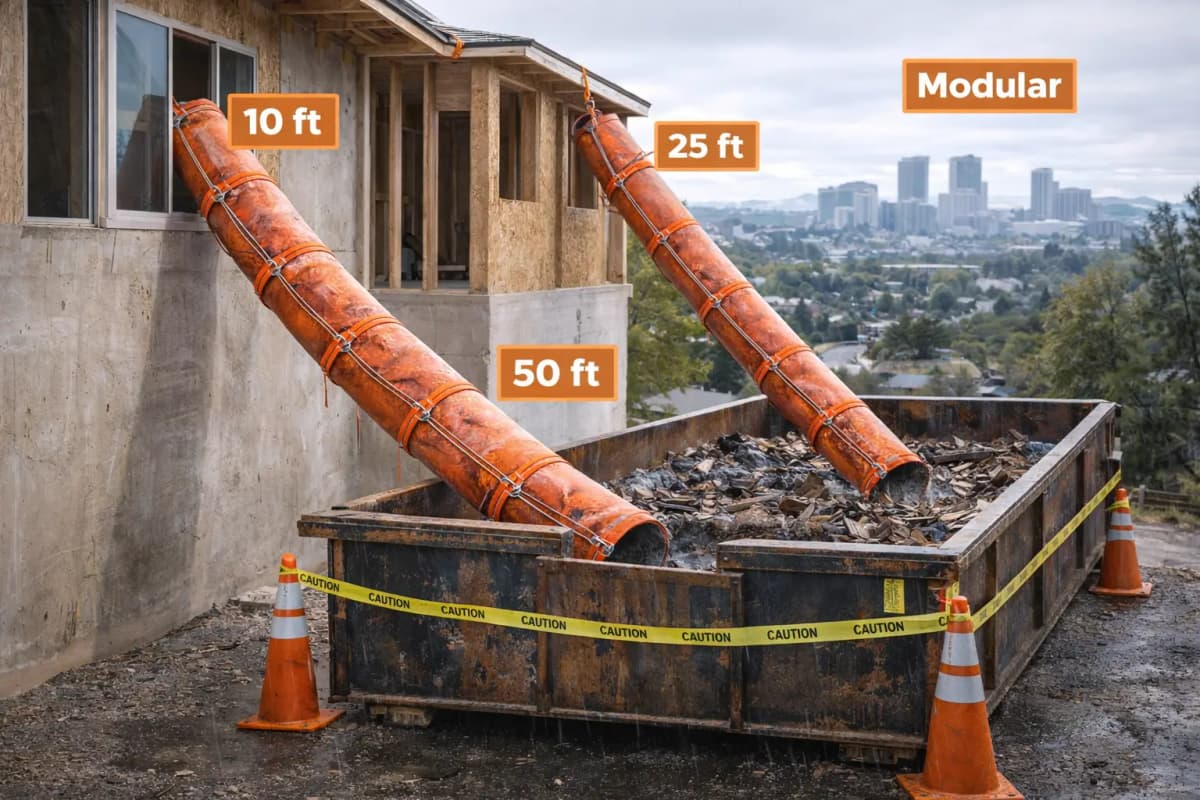
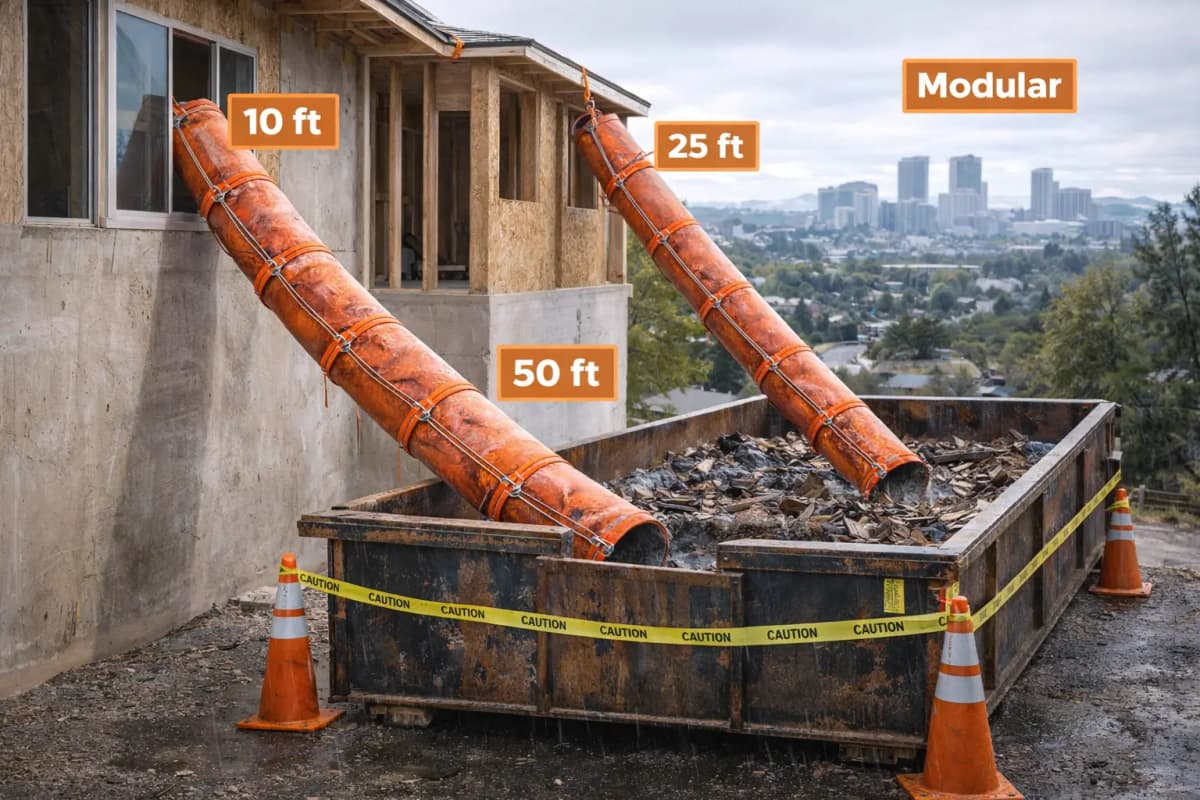
Orange polyethylene or polycarbonate sections are the most common system for commercial rental and repeated use. They are lightweight, easy to couple and uncouple, and can be transported in a standard pickup truck.
- Advantage: Portable, quick setup, compliant with fall protection and wind-load standards.
- Typical diameter: 18–36 inches; multi-story systems use 24–30 inches to maximize throughput.
- Weight per section: 15–40 pounds per 10-foot segment; manageable for small crews.
- Cost: Rental typically $150–400 per day depending on height and diameter.
Heavy-Duty Steel or Galvanized Chutes
Permanent or semi-permanent installations on commercial buildings undergoing major renovation or new construction often use steel or aluminum chutes bolted to the facade.
- Advantage: Superior durability, can withstand extreme weather and repeated use over months.
- Cost: Higher upfront capital but lower per-day rental if kept in place for 6+ weeks.
- Installation: Requires certified anchor points, engineering drawings, and professional installation.
Most commercial contractors opt for modular trash chute systems for flexibility and quick deployment across multiple projects.
Safety Codes and Compliance for Multi-Story Commercial Chutes
Every multi-story commercial chute installation must comply with local building codes, OSHA standards, and EPA guidelines. Non-compliance can halt work, result in citations, or create liability in the event of injury.
OSHA and Fall Protection
Chutes must be secured to the building facade at intervals (typically every 10–15 feet) to prevent lateral movement or collapse. Workers loading the chute must have fall protection if they are working from a height above 6 feet.
- Tie-offs and anchor points must meet OSHA Construction Industry standards for certified anchor strength (minimum 5,000 pounds per worker).
- Loading platforms or floors must have guardrails, handrails, or personal fall protection (harness) in place.
- Workers handling heavy materials must follow OSHA ergonomics guidelines for safe material handling to reduce strain injuries.
State and Local Building Codes
Chute placement, discharge location, and neighboring property access vary by jurisdiction. Consult your project’s state-by-state regulations before finalizing your setup.
- Some states mandate minimum distances between chute discharge and property lines.
- Noise ordinances may restrict chute hours of operation in residential or mixed-use zones.
- Environmental permits may be required if demolition involves hazardous materials (asbestos, lead paint).
Debris Management and EPA Compliance
EPA construction and demolition debris statistics show that over 600 million tons of C&D waste is generated annually in the U.S. Many jurisdictions now mandate sorting and diversion targets; verify whether your project must separate recyclables (wood, metal, concrete) from general waste.
Installation Process for Multi-Story Setups
Proper installation is the foundation of a safe, efficient chute operation. Follow this sequence for a typical multi-story commercial project.
Phase 1: Pre-Installation Survey and Anchoring
Before any sections arrive on site, confirm that anchor points on the facade can safely support the chute weight and lateral forces from falling debris and wind.
- Inspect concrete, steel, or masonry anchor points for cracks, deterioration, or prior damage.
- Verify that fasteners (bolts, anchors, clips) are appropriate for the substrate (concrete expansion bolts, masonry anchors, steel welding pads).
- Document anchor spacing: typically 10–15 feet vertically; adjust based on chute diameter and debris weight per section.
Phase 2: Section Stacking and Coupling
Assemble the chute from the ground up, coupling each section with pins, bolts, or friction-fit sleeves (depending on the manufacturer). Refer to our step-by-step installation guide for detailed coupling procedures.
- Ensure all couplings are hand-tight or torque-tight (as specified) to prevent separation.
- Check alignment at each coupling; sections should be plumb (vertical) to within 1 inch per 10 feet of height.
- As sections stack, secure the chute to the facade anchor points to prevent swaying or tilting.
Phase 3: Discharge Setup and Dumpster Placement
Position the dumpster directly beneath the chute discharge with a clearance of 12–18 inches to prevent overflow onto the ground or adjacent surfaces.
- Use chute bags or deflector attachments if the discharge angle needs adjustment.
- Place plywood or steel plates under dumpster wheels to prevent settling or tipping on soft ground.
- Ensure the discharge opening is never positioned directly over occupied areas, parked vehicles, or storage zones.
Capacity Considerations and Flow Rates
Multi-story chutes move a high volume of material in a short time. Undersizing the chute or dumpster creates bottlenecks; oversizing wastes rental cost.
Chute Diameter and Throughput
Chute diameter directly affects debris flow rate. A 24-inch diameter chute can handle roughly 8–15 cubic yards per day under continuous loading; a 30-inch chute can handle 15–25 cubic yards per day.
- 18-inch chutes: Small fit-out projects, light debris (drywall, trim, packaging materials).
- 24-inch chutes: Standard commercial renovation; handles mixed debris (drywall, wood, light concrete).
- 30-inch chutes: Heavy demolition or mixed-material projects; recommended for multi-story buildings with multiple loading floors.
Verify your system’s capacity using our capacity calculator to ensure flow rates match your daily debris generation.
Dumpster Sizing and Swap Frequency
A standard 20-yard dumpster holds approximately 8 cubic yards of settled debris (accounting for compaction). On a multi-story project generating 10 cubic yards per day, plan for one dumpster swap every day or every other day.
- Coordinate with your waste hauler to schedule swaps during non-work hours or at predictable intervals.
- If dumpster swaps are delayed, debris will back up into the chute and create safety hazards.
- Keep a backup dumpster on-site if your project cannot tolerate downtime.
Dumpster Logistics and Ground-Level Staging
Managing dumpster placement and debris flow on a congested commercial site requires planning and coordination.
Space and Access Constraints
Urban and suburban commercial zones often have limited driveway or loading zone access. Confirm that dumpster delivery trucks can reach the proposed discharge location and that there is sufficient space for the dumpster and chute infrastructure.
- Measure width and turning radius of waste hauler trucks (typically 35–40 feet long and 8–9 feet wide).
- Verify that loading zone permits allow dumpster placement during your project timeline.
- Plan for hose-out and spillage containment (tarps, berms) to prevent debris scatter into adjacent properties or storm drains.
Spillage and Secondary Containment
Multi-story chutes inevitably produce some overflow, especially during wet weather or if dense debris (concrete chunks, metal) impacts the dumpster edge. Use:
- Tarps or plywood mats around the dumpster perimeter to contain spillage.
- Plywood or steel splash guards on the chute discharge to reduce deflection and redirect material into the dumpster.
- Daily cleanup and raking of the staging area to maintain a clean, safe work zone.
Weather, Wind, and Environmental Factors
Multi-story chutes are exposed to wind, rain, and temperature extremes. Factor these into your site safety and operational plan.
Wind and Tie-Offs
High winds can cause chutes to sway, amplify debris impact loads, or even destabilize the system if anchor points are inadequate. Most jurisdictions require chute tie-offs every 15 feet of height in areas with sustained winds above 30 mph.
- Use diagonal cable ties or ratchet straps rated for the calculated wind force on the chute cross-section.
- Anchor tie-offs to certified structural points on the building (columns, beams, roof edges).
- During high-wind events (gusts above 40 mph), suspend chute operations and secure all loose sections.
Rain and Debris Fluidity
Wet debris is heavier and flows differently than dry material. Rain can increase throughput pressure on chutes, leading to jamming or overflow.
- Monitor chute and dumpster loading during rain; reduce drop rates if debris backs up.
- Keep drain holes in chute sections clear to prevent pooling and rust.
- Inspect the chute for ice formation in cold climates and remove accumulation daily.
Noise Ordinances and Neighbor Relations
Continuous chute noise (especially in residential or mixed-use zones) can trigger complaints and permit violations. Multi-story projects in urban areas often have restricted operating hours (e.g., 8 a.m. to 5 p.m., Monday–Friday).
- Confirm operating hour restrictions with the local building department and notify neighbors in advance.
- Use chute discharge baffles or quieter impact pads if permitted by your waste hauler.
Maintenance, Cleaning, and Ongoing Safety During the Project
A chute that runs for weeks must be inspected, cleaned, and maintained regularly to prevent operational failures and safety incidents.
Daily Inspection Routine
- Coupling integrity: Check that all pins, bolts, and friction-fit sleeves are secure; retighten as needed after heavy loading.
- Anchor fasteners: Verify that all facade anchors remain tight and show no corrosion or deterioration.
- Debris blockage: Clear any jams or partial blockages that might restrict flow or create unsafe pressure buildup.
- Chute sections: Look for cracks, warping, or loose seams; replace damaged sections immediately.
Weekly Cleaning and Inspection
Follow our chute cleanliness maintenance checklist for a comprehensive weekly protocol.
- Hose down the interior of chute sections to flush out dust, moisture, and compressed debris.
- Inspect couplings and fasteners for corrosion; apply light machine oil if needed.
- Check the discharge opening for buildup; clear any obstruction that could jam incoming debris.
- Document all findings in a site log; photograph any damage for insurance and warranty claims.
Weather and Seasonal Adjustments
Depending on project duration, you may experience seasonal weather shifts. Adjust the chute setup:
- Fall (leaves, moisture): Increase cleaning frequency; monitor for slippery interior surfaces.
- Winter (ice, snow): Remove ice accumulation daily; use de-icer on couplings and fasteners if permitted.
- Spring (heavy rain, wind): Reinforce tie-offs; monitor for overflow during peak rainfall.
- Summer (heat, UV): Poly chutes can soften slightly in extreme heat; avoid direct sun exposure if possible (e.g., with tarps on storage).
Cost Estimation and Budget Planning
Multi-story chute costs vary widely based on height, duration, system type, and local market rates. Here is a realistic breakdown for 2026 commercial projects.
Rental Costs
Most contractors rent rather than purchase chute systems for commercial projects. Costs typically include delivery, setup, daily rental, and removal.
- Delivery and setup: $200–500 (one-time, regardless of height).
- Daily rental (24-inch diameter): $150–250 per day for a standard 30–50-foot height; add $50–100 per day for every additional 50 feet.
- Weekly/monthly discounts: Renting for 2+ weeks often yields 15–25% per-day savings.
- Removal and haul-away: $200–400 (one-time, waived if sections are undamaged).
Review our rental pricing and budgeting guide for detailed cost scenarios and comparison tables.
Damage and Cleaning Fees
Rental companies typically charge for damage beyond normal wear. Budget for potential fees:
- Cracked sections: $150–400 per section.
- Loose or missing fasteners: $25–75 per fastener.
- Excessive dirt or debris buildup: $50–150 cleaning charge.
DIY vs. Rental: When to Purchase
If your company operates multiple multi-story projects per year, purchasing a modular chute system may offer better ROI than renting.
- Typical system cost: $2,500–6,000 for a complete 24–30-inch modular kit (10–15 sections).
- Break-even point: Approximately 15–20 rental days per year. If you rent more than 30 days annually, ownership is cheaper.
- Maintenance and storage: Budget $200–500 annually for cleaning, minor repairs, and secure storage.
Consult our cost breakdown and ROI guide to model your specific scenario.
Common Pitfalls and How to Avoid Them
Experienced contractors recognize recurring mistakes. Learning from them saves time, money, and safety incidents on your next multi-story project.
Pitfall 1: Underestimating Setup Time
Problem: Assuming a chute can be installed in 1–2 hours; in reality, 4–6 hours is typical for a 20–30-story setup with multiple anchor points.
Solution: Build chute setup into your project timeline as a separate mobilization day. Coordinate delivery, site preparation, and installation crew availability in advance.
Pitfall 2: Ignoring Anchor Point Integrity
Problem: Anchoring to damaged or deteriorated facade without inspection or reinforcement; leads to chute movement, coupling stress, and potential collapse.
Solution: Complete a structural survey of proposed anchor locations at least 1 week before delivery. Have a structural engineer or building inspector confirm that anchors can support the calculated load. Review common setup mistakes before installation.
Pitfall 3: Mismatched Dumpster Capacity and Debris Volume
Problem: Renting a single 20-yard dumpster for a multi-story project that generates 15+ cubic yards per day; dumpster fills within hours, debris backs up into the chute, and workers cannot dispose of material.
Solution: Use the capacity calculator to forecast daily debris volume, then schedule dumpster swaps at 80% fill capacity. On high-volume projects, keep a second dumpster on-site or arrange 1-2 swaps per day.
Pitfall 4: Inadequate Fall Protection and Worker Training
Problem: Workers loading the chute from upper floors without proper harnesses, guardrails, or awareness of safe loading procedures; increases injury risk and creates OSHA violations.
Solution: Conduct a site-specific safety briefing on the first day. Ensure all loading platforms have guardrails or certified fall protection anchors. Train workers on proper material placement (avoid jamming, avoid overloading a single drop, keep hands clear of the opening). Document training in your safety log.
Pitfall 5: Ignoring Weather-Related Operational Changes
Problem: Continuing full chute operations during high winds, ice formation, or heavy rain without monitoring debris flow or tie-off integrity; risks chute destabilization or overflow.
Solution: Establish daily pre-work weather briefings. Reduce drop rates during rain, suspend operations during gusts above 40 mph, and remove ice accumulation in winter. Adjust anchor tie-offs and inspect couplings after severe weather events.
Frequently Asked Questions
How long does it take to install a trash chute on a 15-story building?
Installation time depends on anchor point accessibility, crew size, and coupling type. Expect 4–8 hours for a complete 15-story setup with 2–3 installers. If anchors require drilling, welding, or reinforcement, add 2–4 additional hours. Plan a full mobilization day and coordinate with your construction schedule to avoid conflicts.
Can I use a residential chute on a commercial building?
No. Residential chutes are typically 18 inches in diameter and rated for lighter materials (drywall, roofing shingles, wood framing). Commercial multi-story projects generate denser, higher-volume debris that requires a minimum 24-inch diameter chute and heavy-duty fastening. Using undersized equipment creates jamming, overflow, and safety hazards. Always specify a commercial-grade system.
What happens if the dumpster is full and debris keeps coming down the chute?
Debris will back up into the lower sections of the chute, creating a blockage risk and potentially destabilizing the entire system if pressure becomes extreme. Immediately notify your waste hauler to swap the dumpster or stop loading from upper floors. Never allow debris to back up beyond the lowest 2–3 chute sections. Maintain a communication system (walkie-talkie or radio) between upper-floor loading crews and ground-level personnel monitoring the dumpster.
Are there weight limits for the chute discharge into a dumpster?
Yes. A standard 20-yard dumpster has a weight capacity of approximately 10 tons (20,000 pounds). Dense debris (concrete, brick, metal) compresses heavily; a filled dumpster may reach capacity well before the bin is visually full. Monitor weight and coordinate early swaps with your waste hauler. Our weight capacity guide provides detailed load-calculation worksheets.
What if the building facade cannot be drilled or bolted for anchor points?
Use temporary ground-based anchoring systems (weighted stabilizers, adjustable braces) or rope-and-cable ties anchored to roof edges, parapets, or interior structural elements. Consult your building owner or engineer for approval. Some commercial projects use non-penetrating fastening (magnetic clamps, adhesive pads) on steel facades. The goal is always to prevent lateral movement of the chute under loading and wind stress.
Can I use the same chute system for multiple buildings in a year?
Absolutely. Modular systems are designed for reuse across dozens of projects. After each project, complete a full inspection (couplings, sections for cracks or warping, fasteners for corrosion), perform a detailed cleaning, and store the system indoors or under cover. Well-maintained chute systems last 10–15 years and multiple companies. Our cleaning and maintenance best practices guide outlines the seasonal storage protocol.
What is the best practice for notifying neighbors about chute noise during a multi-story project?
Provide written notice (email, postcard, or posted sign) to adjacent properties at least 1 week before chute installation. Include the project duration, operating hours, and a contact name/phone for complaints. Confirm your chute operation hours align with local ordinances. If complaints arise, consider noise-mitigation measures (discharge baffles, operating-hour reductions) or negotiate a complaint resolution protocol with the property manager or HOA.
Ready to Set Up Your Multi-Story Commercial Chute?
A well-planned, properly installed trash chute system is the backbone of efficient debris management on multi-story commercial projects. From planning and safety compliance through installation, maintenance, and final removal, every phase requires attention to detail and coordination.
Start by assessing your project’s debris profile and building constraints. Use our capacity calculator to estimate chute diameter and dumpster swap frequency, review the step-by-step installation guide, and verify state and local regulations for your jurisdiction.
For first-time chute operators or complex multi-story scenarios, consult our first-time contractor guide and review common setup mistakes to sidestep costly errors.
Whether you are renting a temporary system for a renovation or considering a long-term purchase for your fleet, the key to success is planning, compliance, and consistent maintenance. Contact our team today to discuss your project scope and get a rental quote or system recommendation tailored to your commercial building profile.