
Debris chute setup Long Island split level homes are among the most common project type for remodeling contractors working across Nassau and Suffolk Counties. The split-level format — with its mid-height entry level, raised living areas, and partially below-grade lower level — creates unusual debris removal challenges. Standard window heights are inconsistent across floors, and basement-level tear-outs can be difficult to access from outside. A properly configured debris chute turns those challenges into a streamlined workflow.
This guide walks through how to configure a chute system for split level home debris chute operations on Long Island projects.
How Split-Level Architecture Changes Your Chute Setup
In a standard two-story colonial, the floor heights are predictable. In a split-level, you’re working with three or four different level heights, and the loading point needs to be re-evaluated for each phase of work:
- Upper level (raised living areas): typically 6–8 feet above grade — a short 10–15 foot chute run is usually sufficient
- Entry level: essentially at grade — debris from this floor may need to be carted rather than chuted unless there’s an accessible window
- Lower level (partial below-grade): egress windows are typically 3–5 feet above the exterior grade but below the driveway — requires measuring carefully to the dumpster rim
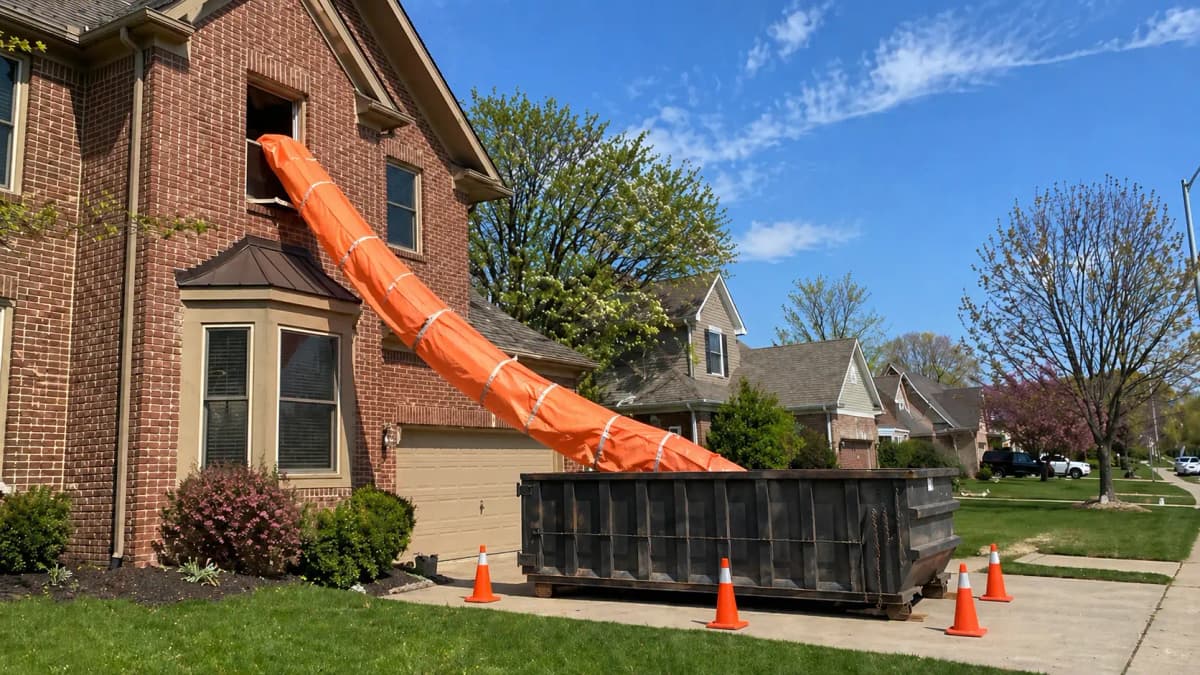
Measuring for a Split-Level Chute
For a debris chute setup Long Island on split-level homes, take three separate measurements before ordering chute lengths:
- Upper level window to dumpster rim — this is your longest run
- Entry-level window to dumpster rim — often shortest or unavailable if windows are at grade
- Lower level egress window to dumpster rim — this one can be tricky; egress windows may be at or below driveway grade, changing the angle
Add 6–12 inches to each measurement for rim buffer. See our trash chute length guide for detailed measurement instructions. For split-level lower level setups, also review our sloped site dumpster alignment guide — the angle variables are similar.
Dumpster Placement for Long Island Split-Level Jobs
On a typical Nassau or Suffolk County split-level property, the dumpster goes in the driveway — which is usually single-width with minimal side clearance. Position it as close to the working face of the house as possible without blocking egress windows or creating sight-line hazards for traffic.
For anchor point guidance once the chute is positioned, see our renovation debris chute safety checklist and the OSHA 1926.852 construction chute standard (opens in new tab).
Order EasyChute for Your Long Island Project
EasyChute’s modular system gives you the flexibility to configure the right run for any floor of a Long Island split-level. Visit our shop or the debris chute product page to get started.